Venus On The Half Shell
October, 2009
The Playboy gourmand has a date with Destiny in the Big Easy: hundreds of Oysters await
-----1 THE PLAYBOY GOURMAND
HAS A DATE WITH DESTINY THE BIG EASY: HUNDREDS OYSTERS AWAIT
I N O F
Pacific Northwest oysters have their place, as do the delicate oysters of Maine. Japanese oysters—kumamotos—are among the best. And French oysters—belons, for example—are delectable. Every oyster is a unique reflection of the seabed in which it grows. To me, there's nothing better than Louisiana oysters. What they lack in delicacy they make up in vigor. They're usually big and salty and sweet. But it doesn't matter much how they vary from other oysters, because they all taste like the sea. And New Orleans is the place to go if you want to eat oysters.
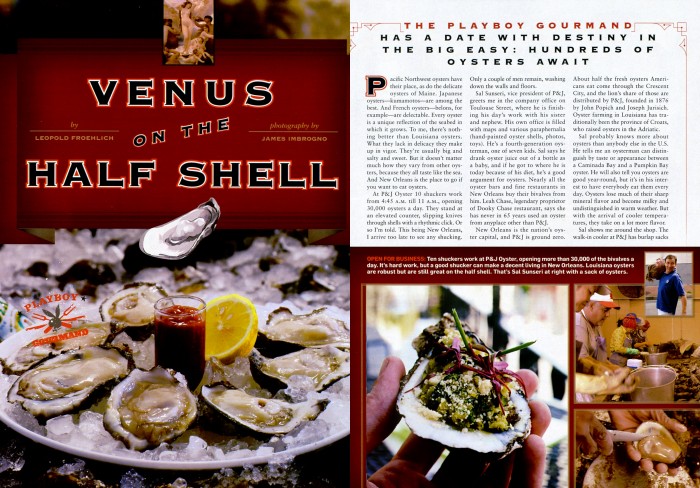
At P&J Oyster 10 shuckers work from 4:45 a.m. till 11 a.m., opening 30,000 oysters a day. They stand at an elevated counter, slipping knives through shells with a rhythmic click. Or so I'm told. This being New Orleans, 1 arrive too late to see any shucking.
Only a couple of men remain, washing down the walls and floors.
Sal Sunseri, vice president of P&J, greets me in the company office on Toulouse Street, where he is finishing his day's work with his sister and nephew. His own office is filled with maps and various paraphernalia (hand-painted oyster shells, photos, toys). He's a fourth-generation oys-terman, one of seven kids. Sal says he drank oyster juice out of a bottle as a baby, and if he got to where he is today because of his diet, he's a good argument for oysters. Nearly all the oyster bars and fine restaurants in New Orleans buy their bivalves from him. Leah Chase, legendary proprietor of Dooky Chase restaurant, says she has never in 65 years used an oyster from anyplace other than P&J.
New Orleans is the nation's oyster capital, and P&J is ground zero.
cans eat come through the Crescent City, and the lion's share of those are distributed by P&J, founded in 1876 by John Popich and Joseph Jurisich. Oyster farming in Louisiana has traditionally been the province of Croats, who raised oysters in the Adriatic.
Sal probably knows more about oysters than anybody else in the U.S. He tells me an oysterman can distinguish by taste or appearance between a Caminada Bay and a Pumpkin Bay oyster. He will also tell you oysters are good year-round, but it's in his interest to have everybody eat them every day. Oysters lose much of their sharp mineral flavor and become milky and undistinguished in warm weather. But with the arrival of cooler temperatures, they take on a lot more flavor.
Sal shows me around the shop. The walk-in cooler at P&J has burlap sacks
of oysters piled on pallets. It smells invigoratingly of the sea and of minerals. I'm ready for a dozen right there.
H.L. Mencken disapproved of frying oysters, claiming it destroyed the flavor. But Casamento's is a temple of oysterdom, and co-owner C.J. Gerdes makes the finest fried oysters in the world. Since the restaurant's founding, in 1919, its white clapboard front, classic neon sign and brisk white-tile interior have been an uptown landmark on Magazine Street. New Orleans has other oyster joints, of course. Bozo's in Metairie is worth a visit, and Drago's is famous for its garlicky char-grilled oysters. But nobody tops Casamento's. C.J. is a broad-shouldered 52-year-old who has worked in the family business since he was a teenager. He's the grandson of founder Joe Casamento, and he and his wife, Linda, run the place. When I go to visit C.J. on his birthday, he's wearing a sleeveless Under Armour shirt and a close-trimmed beard. His restaurant is closed for the __^_^ summer, and C.J. is on vaca-
tion. We sit at a table and talk.
C.J. has fried millions of oysters in his day, all in cast-iron pots on an old six-top stove. He works with two shuckers, then dredges the oysters in corn flour. His secret is frying them in lard at a high temperature (450 degrees). He tells me he can judge the oil's heat by the way a pinch of corn flour spreads or how the oysters sound when they go into the pot. Such knowledge derives from experience. "I've had people tell me they tried to fry oysters at home," says C.J., "but most home stoves don't get hot enough. Even if you get the oil hot, it becomes too cool when the oysters go in." Not much has changed at the restaurant since the 1920s, and that's
one reason Casamento's is so extraordinary. It's a small place, and sometimes you have to wait to eat at one of the 12 tables. But it's always worth it.
There are two camps in New Orleans: those who prefer to eat oysters at Acme and those who prefer theirs across Iber-ville Street at Felix's. I am in the latter camp, primarily because Felix's has a better feel and a majestic marble oyster bar. Lee Harvey Oswald is said to have worked as a numbers runner out of there. Nothing is better than to stand at the rail at Felix's and have the shucker open a dozen—remember to tip him well—to accompany a cold Abita Amber.
And there's the matter of aphrodisiacs. Casanova, it is said, ate 50 oysters for breakfast whenever he had a chance. Maybe it's symbolic, maybe it's real. Some people will tell you oysters arc high in zinc, and zinc is one of nature's most fertile nutrients. Who knows? But one thing is certain: Few things are more promising than a woman who has an appetite for oysters on the half shell.
"NO CIVILIZED MAN, SAVE PERHAPS IN MERE B RAVADO, WOULD VOLUNTARILY EAT A FRIED OYSTER." —H.L. MENCKEN

