David Walton
December, 2014
THE TOUGHEST LAWYER IN AMERICA IS ON YOUR SIDE
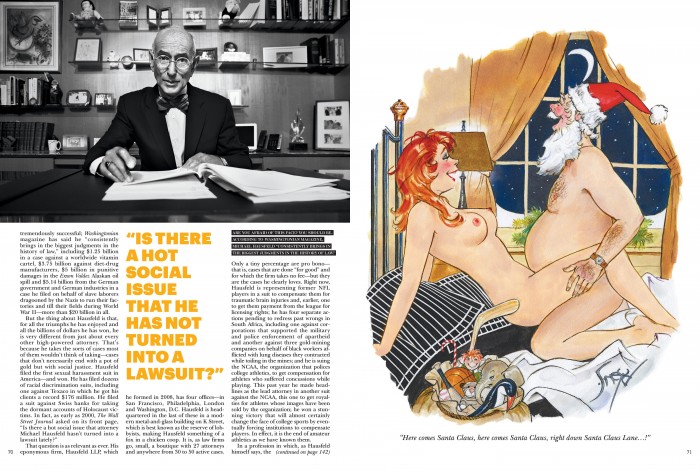
n a cavernous conference room in the Treasury Building, Michael Hausfeld, arguably the most powerful lawyer in America, is sitting at a long wooden table facing half a dozen government officials, their eyes riveted on him. Hausfeld is there to discuss a potentially massive case involving bank fraud that came to him, as many of his cases do, through an e-mail from whistle-blowers he is now representing. Hausfeld is small and his speech is measured, but there is no question he exudes authority. When he says of the transgressing bank, "You've got an evil institution," he says it evenly but chillingly, like the aging gangster Hyman Roth in The Godfather: Part II. Watching him, you realize you wouldn't want to be that bank. And you realize Hausfeld will soon be gaining another enemy. At the age of 68, Hausfeld is the preeminent plaintiffs' antitrust attorney in the country—the man who sues giant corporations on behalf of wronged consumers and smaller companies harmed by monopolistic business practices—and he has acquired a lot of enemies as a result, enough of them that his wife, Marilyn, quips, "I used to say that if our house got bombed, there were so many people who were after him, they wouldn't know who to blame." Of course, there are the giant corporations he sues and those who make a living defending them. They have called Hausfeld a "glorified ambulance chaser" and a "corporate shakedown artist." And he may have even more enemies from the plaintiffs' bar, some of whom have accused him of getting involved in too many of their cases and forcing them to split their fees. He even had an enemy in a former partner who sued him for wrongful termination and began his pleading, "This is a case about a bully," meaning, of course, Hausfeld. (An arbitrator denied the merits of the case and ordered the man to apologize publicly.) Perhaps worst of all, he made enemies of a majority of the partners at the old firm he'd founded and at which he'd worked for 37 years before they left a note on his chair one November day in 2008 telling him he was fired. The enmity hasn't slowed him. Hausfeld has been MICHAEL HAUSFELD IS NO CORPORATE STOOGE. HE REPRESENTS THE LITTLE GUYS VS. GOLIATHS LIKE THE NCAA, GERMANY, EXXON AND THE NFL. AND HE KEEPS WINNING tremendously successful; Washingtonian magazine has said he "consistently brings in the biggest judgments in the history of law," including $1.25 billion in a case against a worldwide vitamin cartel, $3.75 billion against diet-drug manufacturers, $5 billion in punitive damages in the Exxon Valdez Alaskan oil spill and $5.14 billion from the German government and German industries in a case he filed on behalf of slave laborers dragooned by the Nazis to run their factories and till their fields during World War II—more than $20 billion in all. But the thing about Hausfeld is that, for all the triumphs he has enjoyed and all the billions of dollars he has won, he is very different from just about every other high-powered attorney. That's because he takes the sorts of cases most of them wouldn't think of taking—cases that don't necessarily end with a pot of gold but with social justice. Hausfeld filed the first sexual harassment suit in America—and won. He has filed dozens of racial discrimination suits, including one against Texaco in which he got his clients a record $176 million. He filed a suit against Swiss banks for taking the dormant accounts of Holocaust victims. In fact, as early as 2000, The Wall Street Journal asked on its front page, "Is there a hot social issue that attorney Michael Hausfeld hasn't turned into a lawsuit lately?" That question is as relevant as ever. His eponymous firm, Hausfeld LLP, which he formed in 2008, has tour oriices—in San Francisco, Philadelphia, London and Washington, D.C. Hausfeld is headquartered in the last of these in a modern metal-and-glass building on K Street, which is best known as the reserve of lobbyists, making Hausfeld something of a fox in a chicken coop. It is, as law firms go, small, a boutique with 27 attorneys and anywhere from 30 to 50 active cases. Only a tiny percentage are pro bono— that is, cases that are done "for good" and for which the firm takes no fee—but they are the cases he clearly loves. Right now, Hausfeld is representing former NFL players in a suit to compensate them for traumatic brain injuries and, earlier, one to get them payment from the league for licensing rights; he has four separate actions pending to redress past wrongs in South Africa, including one against corporations that supported the military and police enforcement of apartheid and another against three gold-mining companies on behalf of black workers afflicted with lung diseases they contracted while toiling in the mines; and he is suing the NCAA, the organization that polices college athletics, to get compensation for athletes who suffered concussions while playing. This past year he made headlines as the lead attorney in another suit against the NCAA, this one to get royalties for athletes whose images have been sold by the organization; he won a stunning victory that will almost certainly change the face of college sports by eventually forcing institutions to compensate players. In effect, it is the end of amateur athletics as we have known them. In a profession in which, as Hausfeld himself says, the (continued on page 142) accormnc to M.-i.smwmv/.-ix magazine. MICHAEL II Al SI'KI.l) ¦CONSISTKNTI.V HRINCK IN THE BIMiEST JUDGMENTS IN THE HISTORY OK LAW." THE TOUGHEST LAWYER IN AMERICA Continued from page 70 main objective is to make money, and in a world in which status is largely measured by material success, the most powerful lawyer in America is not a corporate shark; he is a "Goody Two-shoes"—a term he both raises and blanches at—who is determined to bring the mighty to justice. In that vein, he recalls a meeting at Washington's Hay-Adams Hotel, overlooking the White House, with legendary Nazi hunter Simon Wiesenthal just as Hausfeld was embarking on his campaign against the Swiss banks. Wiesenthal told him, "Michael, always remember: Don't let the momzers [Yiddish for "bastards"] rest." He hasn't. The question is why: Why has Michael Hausfeld dedicated his life to bedeviling the momzers when so few other attorneys have? It didn't start out that way. It started out in Brooklyn, where Hausfeld was born in 1946 to a lower-middle-class Orthodox Jewish family. His father had escaped Poland in his 20s, shortly after the Nazi invasion, and arrived in New York on the last boat out of Europe before the U-2 blockade. Two brothers had preceded him, and another came with him. But a fifth brother, Michael David, stayed behind with the rest of the family. Michael David, Hausfeld's namesake, was rounded up and shot in the woods by the Nazis. The other Polish Hausfelds disappeared into the Holocaust. Hausfeld says his father never spoke of his time in Poland or of the Holocaust. He worked as a furrier in Manhattan's garment district, where Michael assisted him on weekends from the time he was eight years old. It wasn't Michael's only responsibility. His maternal grandfather suffered a stroke, and Michael, as the oldest of three children, was charged with living with and caring for him—at first in a separate apartment and later, when his parents moved to larger quarters, in his own room. This lasted from the time Michael was eight until he was 16, when his grandfather died. And even that was not the last of his duties. One brother was eight and a half years younger, and Michael became his babysitter, even dragging him along on dates when Michael was a teenager because there was no place to leave him. Hausfeld describes his youthful self as a "nerd extraordinaire" who carried a briefcase to school and wore a pocket protector in his shirt. He didn't grow up dreaming of justice. His parents wanted him to be a doctor, and he had a flair for science. But when Hausfeld was in middle school, he and a partner made an analog computer for the New York State Science Fair; as it turned out, the computer failed to function just as the judges came by. So Hausfeld vamped, telling the judges how the computer would work. He was so impressive that one of the judges told him, "Forget science. You should go into law." It turned out to be fateful. He had superb verbal skills and a quick intelligence. He organized the debate team in his high school, where he dreamed of Princeton, though his parents could only afford Brooklyn College, which was free. In the summer after his high school graduation, a friend and he planned a motorcycle trip across the country. His father wanted to know why. "So I can find myself," he said. His father clamped his hands on Michael's shoulders and told him, "I found you. You're right here." And that was the end of the trip. He didn't find himself in college either. He was something of a grind—a straight-A student studying political science and Russian history. It was the 1960s, a time of campus radicalism, but the future legal flamethrower was hardly a radical. He spent his Friday and Saturday nights in the library reading, typically novels. By the time he graduated, he had settled on law, but he always tended to overthink things, just as he does now, so he did poorly on the LSAT, the standardized law school entrance exam, and was rejected by every one of the 10 law schools to which he'd applied, save one: George Washington University, where he was warned he would have to work hard to keep up. In fact, he was a natural. At GW Law, Hausfeld was still the kid who wore a suit to class every day, but he was also the kid who kept peppering the professors with questions—"stupid questions," one of his classmates said, until the fellow discovered that Hausfeld was one of the top students in the class. But what intrigued Hausfeld even then was not just the nuts and bolts of law; it was the distance between law and principle. He says that when fellow students would compare answers and crow after an exam, he would think, "That's not what I wrote.... So I saw things differently." What he saw was that the written law often had to be stretched to fit the higher principles of justice. He just had to figure out how. Although Hausfeld is known as a legal crusader, it's not always easy to square the mission with descriptions of the man. Stuart Eizenstat, President Jimmy Carter's chief domestic policy advisor and the special envoy recruited by the State Department to help resolve the Swiss bank and slave labor reparations cases, once wrote, "Hausfeld could be sweetness and light at one moment and anger and darkness the next." Others have described him as being known as difficult. One judge called him a "bulldog" in the courtroom after Hausfeld had joked with a witness and then, having disarmed him, suddenly pummeled him with penetrating questions. There were also tales of Hausfeld in his younger days screaming at associates. But that is not the Hausfeld you see now. For one thing, he has undergone a physical transformation. The young Hausfeld was short and cherubic, and there was a period in his early career when he grew out his hair, sprouted a beard and wore aviator glasses and loud, baggy suits. The older Hausfeld hasn't aged, despite the loss of that hair, so much as he has been purified. He is thin to the point of being gaunt. His skin is like parchment, his eyes a very pale blue, his features delicately handsome. And there is his demeanor, which is regal. If he was once a yeller, he isn't anymore. His manner is preternaturally calm and deliberate. The word that comes to mind is impeccable. His words are impeccably chosen, his gestures are impeccably economical, his nails are impeccably manicured, his glasses are impeccably silver-framed. He dresses impeccably in dark suits and starched white shirts (he is color blind) so crisp the creases are like blades, and his impeccably matched ties bear an impeccably perfect dimple. You can understand why opponents find him formidable, because there is something intimidating, even terrifying, in this quiet, self-possessed, imperturbable, impeccable man who is somewhere between a rabbi and a consigliere. You can sense, as Anthony Maton, the head of Hausfeld's London office, says, a "core of steel." He lives impeccably too. He gets up at six every morning and carpools to his office, an airy warren of white cubicles that is every bit as quiet and dignified as its proprietor. His own office, with floor-to-ceiling windows overlooking K Street, is tastefully decorated with family photos of his wife and three grown children on shelves behind his large walnut desk and a framed quote from Holocaust survivor and Nobel laureate Elie Wiesel: "Indifference to evil is worse than evil." On the wall facing him is a large photograph of the Lincoln Memorial, which he got from a photographer in Alaska during the Exxon Valdez case. The photo is a reminder of his firm's enterprise. Hausfeld admits, "If you want a firm just to make money, this is not necessarily it." No doubt he is a millionaire many times over, but you would never know it. "He's not one of these trial lawyers with a $5,000 suit, slicked-back hair and lots of jewelry," says one partner. He has been married for 46 years to his college sweetheart— an actress who is as vivacious and voluble as Hausfeld is reserved and laconic. He lives in the same modest house they bought in 1975 in Fairfax, Virginia, and he hasn't added a foot to it since. For more than 30 years he has gone to and from work in that carpool. Even his impeccable suits are off-the-rack and come in a cardboard box sent by a friend, a Detroit haberdasher he met years ago during one of his and Marilyn's yearly stays at the Pritikin Longevity Center in Florida when the man complained about the fit of Hausfeld's clothes. He travels extensively—eight to 10 trips to Europe alone each year—but only for work. He drinks abstemiously—so little that when the officials of the countries he represented in the slave labor reparations case celebrated the settlement by toasting their capitals with glass after glass of vodka, they did so hoping, they later admitted, to get Hausfeld drunk. His closest friends are people he has known for years. His only indulgence is a country home in West Virginia. That is because it was never about money for Hausfeld, or even glory. It was always about something else. When Hausfeld left law school, he joined a large firm, Arent, Fox, Kintner, Plotkin and Kahn, that specialized in defending accused antitrust violators. At Arent Fox he learned a few things. He learned that very little in the law was black-and-white, that there was a lot of gray, which meant there was potentially a lot of flexibility— flexibility to get courts to interpret the law in more expansive ways. He learned he had lost his "fervor for any kind of defense law" because he was always writing memos on how companies could avoid antitrust scrutiny, and he realized how much easier it was to maintain the status quo than to challenge it, as he wanted to do. And he learned that a staid defense firm such as Arent Fox wasn't going to put up with him for very long when he began to express some of the things he wanted to do. In fact, it put up with him for six months before giving him notice. But what a six months they were. In the midst of the civil rights movement and at the height of the Vietnam war, young Hausfeld—the long-haired, bearded, aviator-bespectacled Hausfeld—counseled draft dodgers, women's groups and African Americans who had been discriminated against, including bringing a case against the D.C. chief of police for denying promotions to black officers. He even brought a complaint to the Federal Trade Commission on behalf of several feminist organizations protesting that Women's Wear Daily had colluded with the fashion industry to stop making miniskirts and begin making midi dresses instead, thus forcing women to wear what the industry dictated. It may have seemed like a loony argument, but the FTC agreed with him. "Retailers had to eat a large inventory of dresses they could no longer sell," Hausfeld says. And then it ended. Facing unemployment, he grudgingly accepted a job with a Michigan law firm. But just before he was to leave Washington, he got a call from an attorney he'd interviewed with six months earlier—an attorney who had not been in touch with him all that time. His name was Jerry Cohen, and Cohen asked if Hausfeld was still interested. A former marine, six-foot-five and broad-shouldered with great, bushy black hair and an extroverted manner that matched his appearance, Cohen was a force of nature. He had been the chief of staff for Michigan senator Philip Hart's subcommittee on antitrust and monopoly before becoming one of the icons of plaintiffs' antitrust law—suing companies rather than defending them—which was the law Hausfeld wanted to practice. When he accepted Cohen's offer, after Cohen had already called the Michigan firm to tell them he needed Hausfeld more than they did, Hausfeld began the most important relationship of his professional life. Twenty years Hausfeld's senior, Cohen became his partner, his friend and his father Figure. He also became Hausfeld's facilitator. All the wild cases that Arent Fox had discouraged, Cohen encouraged. More important, Cohen, who shared Hausfeld's sense of injustice, was willing to use his successful antitrust practice to finance Hausfeld's social justice crusades. That was the whole idea. They were quite a contrasting pair to see—the hulking, animated Cohen and the tiny, reserved Hausfeld—though they were kindred spirits, peas in a pod. The duo knew they were condescended to by the so-called white-shoe law firms whose attorneys came from Harvard and Yale, while Hausfeld came from Brooklyn College and GW, and Cohen came from the blue-collar city of Hamtramck, adjacent to Detroit, and Wayne State University Law School. "There was always the sense that we didn't have the pedigree," Hausfeld says. He remembers standing around with Cohen and some of those upscale attorneys one September day when the white shoes were talking about where they were putting up their boats for the winter, then turning to Cohen and Hausfeld and asking where they were putting up their boats. Hausfeld mused for a moment and said, "I'm taking it out of the bathtub this year." The condescension only increased when Hausfeld began to take on cases he hoped would change the law. He represented a group of black workers at the Library of Congress who were fired after staging a sit-in in the reading room because they were denied promotions even though many of them held master's degrees in library science. It was his first class-action suit—that is, a case in which he represented not just one plaintiff but a whole class of plaintiffs. He won, though it cost him his beard and long hair when the judge called him into chambers and said, "You sound very reasonable, but you look like Jesus Christ." Hausfeld took the hint. After he won the D.C. police case, he was approached by a former Department of Justice employee named Diane Williams, a young single mother who was looking for an attorney. One of Williams's supervisors had been making sexual advances toward her, and when she rejected them, he fired her. At the time there was no legal concept of sexual harassment, and Hausfeld was ridiculed by others in the bar for bringing the case. Still, Hausfeld felt it was an obvious violation of Title VII of the Civil Rights Act, which prohibited employment discrimination. Against the odds, he won. And in winning, he stretched the law. By this time Hausfeld was beginning to gain a reputation for taking difficult cases involving social justice. Cohen told him that if he looked up what Hausfeld was doing in the phone book, it would be listed under W for "weird." These were cases other attorneys didn't want—strange cases, unwinnable cases, cases that required a new slant on old laws. Hausfeld took them. He was, as Cohen said, the "lawyer of last resort." And most of the cases were from people who would have been overlooked by the legal system if it weren't for Hausfeld—the poor, the disenfranchised, women and minorities. Cohen would occasionally answer the phone, then hand it to Hausfeld. When Hausfeld asked who it was, Cohen would say, " I don't know, but they don't speak English, so it has to be for you." Hausfeld was ecstatic. But eventually he felt trapped even in Cohen's firm, which his friend owned with another senior partner. In 1978, Hausfeld says, he cajoled Cohen and yet another partner, Herbert Milstein, into leaving and forming a new firm with him: Cohen, Milstein, Hausfeld. It was a huge gamble. Cohen's senior partner kept most of the clients. Still, Cohen, Milstein, Hausfeld continued to practice plaintiffs' antitrust law, and Hausfeld was, if anything, even more energetic on issues of social justice: a case against the Smithsonian to recover Cheyenne artifacts; a case that argued bullets were hazardous to one's health and should be banned by the Consumer Product Safety Commission (the bar howled in laughter, but when a judge ordered hearings, Congress immediately passed a law exempting bullets from the commission's purview); and a case on behalf of Orthodox Jewish twins, one a valedictorian, to change their high school graduation ceremony in Fairfax County, Virginia from a Saturday so they could attend. He lost, then worshipped at services with them on their graduation day. Two weeks later, the county decided to move future graduations to a weekday. "In losing, we won," he now says. He admits it wasn't easy. Nearly every penny the firm had went to subsidize the social justice cases. "There were years Marilyn and I and Jerry were living hand-to-mouth," he recalls. "There literally wasn't any money." And it wasn't just money that made things difficult. There were the cases that broke his heart. After getting a call from a group who had been so-called comfort women—Asians who were enslaved as prostitutes by the Japanese during World War II and returned to their own countries after the war as pariahs—Hausfeld took up the cause. This time he even lobbied the American government to intervene diplomatically, but to no avail. You can hear the disappointment in his voice. He calls the Japanese government the most intransigent defendant he has ever faced. But over time Cohen, Milstein, Hausfeld began to have its triumphs, and a few shook the legal world. Several of Hausfeld's neighbors came to his house in suburban Virginia and asked him to investigate whether a nearby Texaco tank farm could be polluting their water and making their children sick. One Sunday morning he took a stroll to the farm, where a few engineers volunteered that there was a much bigger problem than the public knew. Hausfeld took the case and won a settlement, which was unprecedented at the time. But the settlement was only the beginning. A woman named Bari-Ellen Roberts had heard of Hausfeld's victory and phoned him in 1992 to discuss a complaint. Roberts worked for Texaco as a senior financial analyst. Her superiors praised her work, but they did not promote her because, one of them confessed, they thought she was too "uppity." Roberts arrived at the inescapable conclusion that she and other workers with whom she discussed the issue were being denied promotions because they were black. Hausfeld investigated her charges for nearly a year—he always does—then filed a suit on Roberts's behalf. Texaco fought them "tooth and nail," Hausfeld says. He realized something was grievously wrong when one of the company's outside counsels told him, "What do you want us to do—just throw money at a bunch of monkeys?" If that was the outside counsel's attitude, Hausfeld thought, imagine what the attitude of Texaco's executives was. It didn't take long for him to find out. Hausfeld says he got a call from an attorney representing a disgruntled Texaco employee, and the lawyer offered him tapes of Texaco executives making racially insensitive remarks. (A Hausfeld associate later said Hausfeld was obsessive about getting those tapes, screaming at him at one point, "If you don't get me those fucking tapes, this case is going to go on for another 10 years!") As it turned out, New York Times reporter Kurt Eichenwald had also been alerted about the tapes and begged Hausfeld to share them. Hausfeld said he did so reluctantly, though critics have accused Hausfeld of doctoring or misinterpreting them, then tricking the Times into publishing the transcripts. He claims both he and the Times subjected them to expert analysis and came to the same conclusion: The Texaco executives were closet racists. In any case, once excerpts of the transcripts were printed, the suit exploded. Texaco couldn't settle quickly enough. The plaintiffs received $176 million. Moreover, at Hausfeld's insistence, Texaco agreed to hire an outside ombudsman to oversee the company's hiring practices. That set another precedent. It was over the Christmas holiday in 1995, while Hausfeld was on vacation in Alaska with his family, that he got word Jerry Cohen had dropped dead of a heart attack in Sun Valley, Idaho, and a huge hole opened in Hausfeld's life. He filled it with a case. Years earlier, he and a close attorney friend, Martin Mendelsohn, had brought suit on behalf of Jewish immigrants against a vicious former Croatian interior minister named Andrija Artukovic, the so-called Butcher of the Balkans, who had been a Nazi puppet during the war. Since members of the Croatian fascist terrorist group Ustase were still alive, this was, says Hausfeld, the only time he feared his life might be in danger. Now Mendelsohn approached him with another daring gambit to help victims of the war: filing a class-action suit against Swiss banks on behalf of Holocaust survivors and their heirs for dormant accounts the banks had appropriated. "Nobody gave us a chance of recovering," Hausfeld says. But he locked himself in his conference room with stacks of books, including transcripts of the Nuremberg war crime trials, and with all the documentation his researcher had gathered, and spent weeks, eight to 10 hours a day, reading through all of it before filing his complaint, which added complicity with the Nazis for good measure. The banks vowed to fight, and the president of Switzerland publicly fulminated. When one attorney asked Hausfeld how much he was looking for in a settlement and Hausfeld said, "At least a billion dollars," the man sputtered, "With a b?" Hausfeld got his clients their billion. He took no fee for the case, and he is furious with the attorneys who did. "Once we started the Swiss case," he says, "it opened the floodgates." And that led to the slave labor reparations case. Even Mendelsohn, his eventual co-counsel, told him he was crazy to sue the German government and prominent German companies on behalf of millions of people the Nazis had conscripted for their factories and fields. But Hausfeld had a plan, a wild plan, and he took it to the Polish ambassador to the United States. "Let's see if I get this straight," the ambassador asked. "You want the five Eastern European countries that were occupied by Germany, which now dominates the postwar economies of those countries, to band together to pursue reparations?" He paused. "I like it!" Hausfeld not only got a $5.14 billion settlement, but he enlisted a prominent German historian to force the government to acknowledge its complicity not just for the Holocaust but for enslaving millions more, Jew and non-Jew. Hausfeld called the settlement the apex of his career. Then came the nadir. After Jerry Cohen's death, nothing was ever the same at Cohen, Milstein, Hausfeld. "I was alone," is how Hausfeld describes it. He remained the firm's chief breadwinner with his antitrust cases, but most of the remaining partners didn't share his zeal for social justice or his interest in rewriting the law. The animosity simmered until Hausfeld began to push for a London branch of the firm to pursue his cause of bringing class-action suits to the European Union, where the courts had not recognized them—a pursuit based in part on his fear that an increasingly conservative judiciary would gut plaintiffs' antitrust suits in the U.S. The partners reluctantly agreed, spending millions on the new office, but the European courts were not immediately receptive to Hausfeld's cause. And that's when the simmer among the partners turned to a boil. They derided him. He derided them. "I lost it every once in a while," Hausfeld concedes. "I was angry at the animosity. I was angry at the adversity. I was angry at the cowardice." As the warfare dragged on, Hausfeld approached his partners about negotiating an amicable separation. Instead, Hausfeld's adversaries essentially pulled a fast one, which showed how much they had come to resent him. Meeting clandestinely, they unilaterally reduced Hausfeld's share of compensation from 28.95 percent to 14 percent and that of another partner and Hausfeld ally by enough to push their combined shares below the 33.3 per- cent threshold that would have allowed Hausfeld and his supporters to block his termination. And having rejiggered the shares, the partners fired him the next day, November 6, 2008, by placing a note on his chair, after 37 years, and ordering him to leave the building immediately or be arrested for trespassing. Hausfeld thinks the partners must have thought he would retire quietly, but that only shows how little they understood him. Social justice isn't ajob for Hausfeld. It is a life fed by deep wellsprings, which brings us to the whys of Hausfeld's commitment. One of those wellsprings no doubt is his family's destruction by the Nazis. Another, he says, came from maturing in the 1960s, when he saw a "lot of inequities," and his realization that his father's motto, "Love everybody and everybody will love you," simply wasn't true. Perhaps more important were the personal realizations. He remembers a psychology experiment in college when he and four other students were called to the front of the class and asked their opinion of a new campus curfew. After the first four students expressed support, Hausfeld suppressed his own opposition and agreed with them, only to learn that those students had been ringers designed to show that people confronted by large groups will not stand by their convictions. From that point on, Hausfeld resolved, he would always follow his conscience. He would be the exemplar of rectitude in a legal world where rectitude didn't matter much. He would be different. And among those wellsprings are wounds that surface in a comment one of his clients, a Navajo, made when he engaged Hausfeld to bring suit against Hispanic Americans who had discriminated against him: "Michael, everywhere there's a totem pole, and everywhere there is someone on the bottom." Hausfeld hated when, during settlement discussions with Shell Oil for the inhabitants of a trailer park that had been contaminated by chemicals, Shell's counsel asked sneeringly, "How much do you want us to pay trailer park people?" just as he hated it when Texaco's executives had called Hausfeld's black clients "porch monkeys," or when the lawyers at the top of the totem pole would laugh at him for his strange legal theories. It hurt. But it also helped him identify with the others at the bottom of that totem pole. He had been there himself. In some ways, he admits, he still is— still the lawyer without the Ivy League pedigree. "No matter how many times I've been vindicated," he says, "I'm still not used to people laughing at me." So instead of retiring on that awful November afternoon, Hausfeld walked immediately to a friendly law firm, Venable LLP, and began strategizing to start a new firm. Within days, more than a dozen of his former associates from Cohen, Milstein, Hausfeld were crammed into a Venable conference room, passing around the only computer with Adobe, sharing cell phones, tracking cases on large white sheets of paper and conducting business amid what one partner called "controlled chaos." Hausfeld conveyed his usual calm, but underneath he was terrified. To get a line of credit to set up an office and pay his attorneys, he had to stake everything he owned as collateral. In a way, he was right back at the beginning: broke. Most of the associates and partners say the unruly start of Hausfeld LLP was a bonding experience. Meanwhile, courts awarded Hausfeld virtually all the cases for which he was counsel at the old firm, and he quickly started getting new ones, including the NCAA case, in which he successfully argued that the organization was a cartel that denied current and former student athletes the rights to their own images—rights, thanks to Hausfeld, the court has now granted. Even his decade-long crusade to bring those plaintiff class-action suits to Europe is finally panning out, and he fully expects the principle to be established there soon, which would be a crowning achievement. "People are definitely watching us to see what we're going to do next," says one partner. All of this seems to have reenergized Hausfeld. His wife jokes that when she reminded him that no one on his deathbed ever said he wished he had spent more time at the office, he countered, "I'll be the only one." The firm is expanding—the London branch alone has doubled in the past 18 months—and he is forever searching for new wrongs to right, though he says ruefully that no one has ever approached him to see how Hausfeld LLP might serve as a model for other firms. So he must trudge on—that lonely man of rectitude. Asked when he might retire, he points to a framed cartoon on a side table in his office with the caption "God put me on this earth to accomplish a certain number of things. Right now, I am so far behind that I will never die." That is close to a framed quote from Deuteronomy 16:20 one sees upon entering the adjacent conference room: JUSTICE, ONLY JUSTICE, SHALT THOU PURSUE.

