Rise & Shine
December, 2014
CLARENCE THOMAS'S THEOCRACY
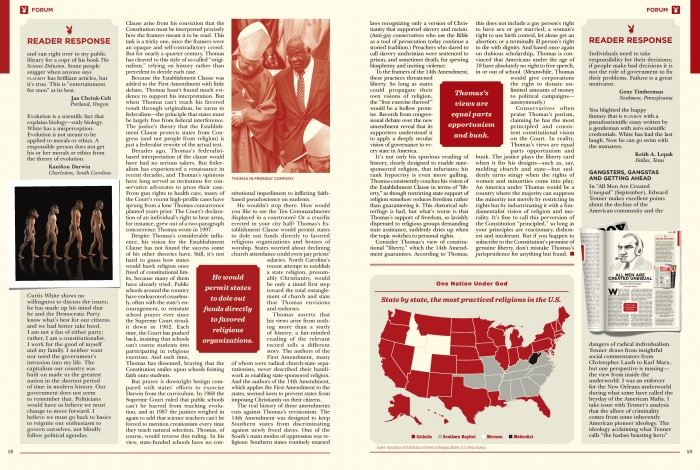
Is the Supreme Court justice laying the legal groundwork to establish official religions in the United States? In last term's blockbuster First Amendment case, five Supreme Court justices ruled that town councils can open legislative sessions with a prayer without violating the Constitution. That decision in and of itself distorts the Establishment Clause of the First Amendment—that all-important phrase in the Bill of Rights that says "Congress shall make no law re- specting an establishment of religion." People may refer to the U.S. as a Christian nation, but because of this clause, that cannot be codified into federal law without first changing the Constitution. However, in a little-noted concurrence, Justice Clarence Thomas hoped to take it even fur- ther, writing separately to explain that the clause was actually designed to let states establish their own religions. Thomas's opinion didn't surprise those femiliar with his views. No Supreme Court justice in recent memory has been as dedicated to dismantling the wall of separa- don between church and state. From his earliest years on the Court, Thomas has painted—with nearly obsessive fervor— a picture of the Constitution that treads dangerously close to theocracy. There is, to his mind, virtually no limit on the amount of religion state governments can force into Americans' lives. As radical as these ideas sound, they've edged closer to the Court s mainstream with each passing term. Justice Antonin Scalia has championed Thomas's dream of granting states a near-boundless ability to encourage and impose religion. Even Justice Anthony Kennedy, who supported some separation of church and state early in his career, has grown increasingly pro-religion in the shadow of Thomas's jurisprudence. The notion that every state has a constitutional right to endorse religion was once considered a joke. Today, fewer justices are laughing. Thomas's beliefs about the Establishment Clause arise from his conviction that the Constitution must be interpreted precisely how the framers meant it to be read. This task is a tricky one, since the framers were an opaque and self-contradictory crowd. But for nearly a quarter century, Thomas has cleaved to this style of so-called "origi-nalism," relying on history rather than precedent to decide each case. Because the Establishment Clause was added to the First Amendment with little debate, Thomas hasn't found much evidence to support his interpretation. But when Thomas can't reach his favored result through originalism, he turns to federalism—the principle that states must be largely free from federal interference. The justice's theory that the Establishment Clause protects states from Congress (and not people from religion) is just a federalist rewrite of the actual text. Decades ago, Thomas's federalist-based interpretation of the clause would have had no serious takers. But federalism has experienced a renaissance in recent decades, and Thomas's opinions have long served as invitations for conservative advocates to press their case. From gun rights to health care, many of the Court's recent high-profile cases have sprung from a lone Thomas concurrence planted years prior. The Court's declaration of an individual's right to bear arms, for instance, grew out of a two-paragraph concurrence Thomas wrote in 1997. Despite Thomas's considerable influence, his vision for the Establishment Clause has not found the success some of his other theories have. Still, it's not hard to guess how states would hawk religion once freed of constitutional limits, because many of them have already tried. Public schools around the country have endeavored ceaselessly, often with the state's encouragement, to reinstate school prayer ever since the Supreme Court struck it down in 1962. Each time, the Court has pushed back, insisting that schools can't coerce students into participating in religious exercises. And each time, Thomas has dissented, braying that the Constitution smiles upon schools foisting faith onto students. But prayer is downright benign compared with states' efforts to exorcise Darwin from the curriculum. In 1968 the Supreme Court ruled that public schools can't be barred from teaching evolution, and in 1987 the justices weighed in again to add that science teachers can't be forced to mention creationism every time they teach natural selection. Thomas, of course, would reverse this ruling. In his view, state-funded schools have no con- stitutional impediment to inflicting faith-based pseudoscience on students. He wouldn't stop there. How would you like to see the Ten Commandments displayed in a courtroom? Or a crucifix erected in your city hall? Thomas's Establishment Clause would permit states to dole out funds directly to favored religious organizations and houses of worship. States worried about declining church attendance could even pay priests' salaries. North Carolina s recent attempt to establish a state religion, presumably Christianity, would be only a timid first step toward the total entanglement of church and state that Thomas envisions and endorses. Thomas asserts that his views arise from nothing more than a study of history; a fair-minded reading of the relevant record tells a different story. The authors of the First Amendment, many of whom were radical church-state sepa-rationists, never described their handiwork as enabling state-sponsored religion. And the authors of the 14th Amendment, which applies the First Amendment to the states, seemed keen to prevent states from imposing Christianity on their citizens. The real history of these amendments cuts against Thomas's revisionism. The 14th Amendment was designed to keep Southern states from discriminating against newly freed slaves. One of the South's main modes of oppression was religious: Southern states routinely enacted laws recognizing only a version of Christianity that supported slavery and racism. (Anti-gay conservatives who use the Bible as a tool of persecution today continue a storied tradition.) Preachers who dared to call slavery unchristian were sentenced to prison, and sometimes death, for spewing blasphemy and inciting violence. To the framers of the 14th Amendment, these practices threatened liberty. So long as states could propagate their own visions of religion, the "free exercise thereof" would be a hollow promise. Records from congressional debate over the new amendment reveal that its supporters understood it to apply a deeply secular vision of governance to every state in America. It's not only his spurious reading of history, clearly designed to enable state-sponsored religion, that infuriates; his rank hypocrisy is even more galling. Thomas consistently couches his vision of the Establishment Clause in terms of "liberty," as though restricting state support of religion somehow reduces freedom rather than guaranteeing it. This rhetorical subterfuge is bad, but what's worse is that Thomas's support of freedom, so lavishly dispensed to religious groups demanding state assistance, suddenly dries up when the topic switches to personal rights. Consider Thomas's view of constitutional "liberty," which the 14th Amendment guarantees. According to Thomas, this does not include a gay person's right to have sex or get married; a woman's right to use birth control, let alone get an abortion; or a terminally ill person's right to die with dignity. And based once again on dubious scholarship, Thomas is convinced that Americans under the age of 18 have absolutely no right to free speech, in or out of school. (Meanwhile, Thomas would give corporations the right to donate unlimited amounts of money to political campaigns— anonymously.) Conservatives often praise Thomas's purism, claiming he has the most principled and consistent constitutional vision on the Court. In reality, Thomas's views are equal parts opportunism and bunk. The justice plays the liberty card when it fits his designs—such as, say, melding church and state—but suddenly turns stingy when the rights of women and minorities come into play. An America under Thomas would be a country where the majority can suppress the minority not merely by restricting its rights but by indoctrinating it with a fundamentalist vision of religion and morality. It's fine to call this perversion of the Constitution "principled," so long as your principles are reactionary, dishonest and intolerant. But if you happen to subscribe to the Constitution's promise of genuine liberty, don't mistake Thomas's jurisprudence for anything but fraud. ¦ One Nation Under God State by state, the most practiced religions in the U.S.

