Playboy Classic: Ayn Rand
July / August, 2012
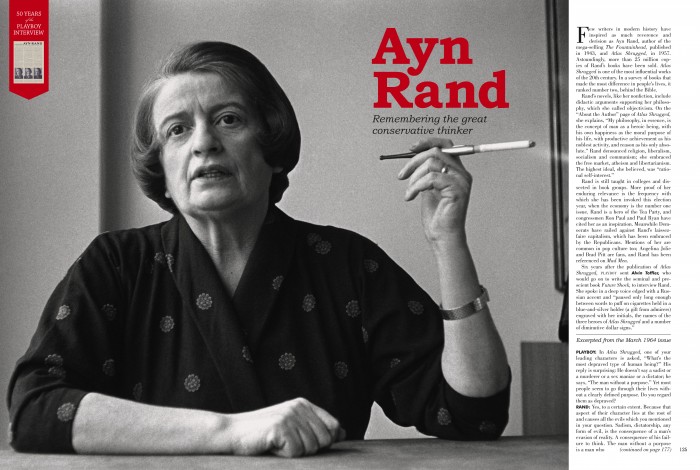
Ayn Rand
Remembering the great conservative thinker
50 YEARS
| PLAYBOY INTERVIEW
F
ew writers in modern history have inspired as much reverence and derision as Ayn Rand, author of the mega-selling The Founlainhead, published in 1943, and Atlas Shrugged, in 1957. Astoundingly. more than 25 million copies of Rand's hooks have been sold. Atlas Shrugged is one of the most influential works of the 20th century. In a survey of hooks that made the most difference in people's lives, it ranked number two. behind the Bible.
Rand's novels, like her nonliction. include didactic arguments supporting her philosophy, which she called objectivism. On the "About the Author' page of Atlas Shrugged, she explains, "My philosophy, in essence, is the concept of man as a heroic being, with his own happiness as the moral purpose of his life, with productive achievement as his noblest activity, and reason as his only absolute." Rand denounced religion, liberalism, socialism and communism; she embraced the free market, atheism and libertarianism. The highest ideal, she believed, was "rational self-interest."
Rand is still taught in colleges and dissected in book groups. More proof of her enduring relevance is the frequency with which she has been invoked this election year, when the economy is the number one issue. Rand is a hero of the Tea Party, and congressmen Ron Paul and Paul Ryan have cited her as an inspiration. Meanwhile Democrats have railed against Rand's laissez-faire capitalism, which has been embraced by the Republicans. Mentions of her are common in pop culture too; Angelina Jolie and Brad Pitt are fans, and Rand has been referenced on Mad Men.
Six years after the publication of Atlas Shrugged, PLAYBOY sent Ah/In Toffler, who would go on to write the seminal and prescient book Future Shock, to interview Rand. She spoke in a deep voice edged with a Russian accent and "paused only long enough between words to puff on cigarettes held in a blue-and-silver holder (a gift from admirers) engraved with her initials, the names of the three heroes of Atlas Shrugged and a number of diminutive dollar signs."
Excerpted from the March 1964 issue
PLAYBOY: In Atlas Shrugged, one of your leading characters is asked. "What's the most depraved type of human being?" His reply is surprising: He doesn't say a sadist or a murderer or a sex maniac or a dictator; he says, "The man without a purpose." Yet most people seem to go through their lives without a clearly defined purpose. Do you regard them as depraved?
RAND: Yes. to a certain extent. Because that
aspect of their character lies at the root of
and causes all the evils which you mentioned
in your question. Sadism, dictatorship, any
form of evil, is the consequence of a man's
evasion of reality. A consequence of his fail
ure to think. The man without a purpose
is a man who (continued on page 177)
AYN RAND
(continued from page 125)
drifts at the mercy of random feelings or unidentified urges and is capable of any evil, because he is totally out of control of his own life. In order to be in control of your life, you have to have a purpose—a productive purpose.
PLAYBOY: If a person organizes his life around a single, neatly defined purpose, isn't he in danger of becoming extremely narrow in his horizons? RAND: Quite the contrary. A central purpose serves to integrate all the other concerns of a man's life. It establishes the hierarchy, the relative importance, of his values, it saves him from pointless inner conflicts, it permits him to enjoy life on a wide scale and to carry that enjoyment into any area open to his mind; whereas a man without a purpose is lost in chaos. He does not know what his values are. He does not know how to judge. He cannot tell what is or is not important to him, and therefore he drifts helplessly at the mercy of any chance stimulus or any whim of the moment. He can enjoy nothing. He spends his life searching for some value which he will never find. PLAYBOY: Couldn't the attempt to rule whim out of life, to act in a totally rational fashion, be viewed as conducive to a juice-less, joyless kind of existence? RAND: I truly must say that I don't know what you are talking about. Reason is man's tool of knowledge, the faculty that enables him to perceive the facts of reality. To act rationally means to act in accordance with the facts of reality. Emotions are not tools of cognition. What you feel tells you nothing about the facts; it merely tells you something about your estimate of the facts. Emotions are the result of your value judgments; they are caused by your basic premises, which you may hold consciously or subconsciously, which may be right or wrong. A whim is an emotion whose cause you neither know nor care to discover. Now what does it mean, to act on whim? It means that a man acts like a zombie, without any knowledge of what he deals with, what he wants to accomplish or what motivates him. It means that a man acts in a state of temporary insanity. Is this what you call juicy or colorful? I think the only juice that can come out of such a situation is blood. To act against the facts of reality can result only in destruction. PLAYBOY: Should one ignore emotions altogether?
RAND: Of course not. One should merely keep them in their place. An emotion is an automatic response, an automatic effect of man's value premises. An effect, not a cause. There is no necessary clash, no dichotomy between man's reason and his emotions— provided he observes their proper relationship. A rational man knows—or makes it a point to discover—the source of his emotions, the basic premises from which they come; if his premises are wrong, he corrects them. He never acts on emotions for which he cannot account, the meaning of which he does not understand.
PLAYBOY: According to your philosophy, work and achievement are the highest goals of life. Do you regard as immoral those who find greater fulfillment in the warmth of friendship and family ties? RAND: If they place such things as friendship and family ties above their own productive work, yes, then they are immoral. Friendship, family life and human relationships are not primary in a man's life. A man who places others first, above his own creative work, is an emotional parasite; whereas, if he places his work first, there is no conflict between his work and his enjoyment of human relationships. PLAYBOY: Do you believe that women as well as men should organize their lives around work—and if so, what kind of work? RAND: Of course. I believe that women are human beings. What is proper for a man is proper for a woman. I would not attempt to prescribe what kind of work a man should do, and I would not attempt it in regard to women. Women can choose their work according to their own purpose and premises in the same manner as men do. PLAYBOY: In your opinion, is a woman immoral who chooses to devote herself to home and family instead of a career? RAND: Not immoral—I would say she is impractical, because a home cannot be a full-time occupation, except when her children are young.
PLAYBOY: Where, would you say, should romantic love fit into the life of a rational person whose single driving passion is work? RAND: It is his greatest reward. The only man capable of experiencing a profound romantic love is the man driven by passion for his work—because love is an expression of self-esteem, of the deepest values in a man's or a woman's character. One falls in love with the person who shares these values. If a man has no clearly defined values and no moral character, he is not able to appreciate another person. In this respect, I would like to quote from The Fountainhead, in which the hero utters a line that has often been quoted by readers: "To say 'I love you' one must know first how to say the 'I.'" PLAYBOY: You have denounced the puritan notion that physical love is ugly or evil; yet you have written, "Indiscriminate desire and unselective indulgence are possible only to those who regard sex and themselves as evil." Would you say that discriminate and selective indulgence in sex is moral? RAND: I would say that a selective and discriminate sex life is not an indulgence. The term indulgence implies that it is an action taken lightly and casually. I say that sex is one of the most important aspects of man's life and, therefore, must never be approached lightly or casually. Sex must not be anything other than a response to values. And that is why I consider promiscuity immoral. Not because sex is evil but because sex is too good and too important. PLAYBOY: Does this mean, in your view, that sex should involve only married partners? RAND: Not necessarily. What sex should involve is a very serious relationship. I consider marriage a very important institution, but it is important when and if two people have found the person with whom
they wish to spend the rest of their lives—a question of which no man or woman can be automatically certain. When one is certain that one's choice is final, then marriage is, of course, a desirable state. But this does not mean that any relationship based on less than total certainty is improper. I think the question of an affair or a marriage depends on the knowledge and the position of the two persons involved and should be left up to them. Either is moral, provided only that both parties take the relationship seriously and that it is based on values. PLAYBOY: As one who champions the cause of enlightened self-interest, how do you feel about dedicating one's life to hedonistic self-gratification?
RAND: I am profoundly opposed to the philosophy of hedonism. Hedonism is the doctrine which holds that the good is whatever gives you pleasure and, therefore, pleasure is the standard of morality. Objectivism holds that the good must be defined by a rational standard of value, that pleasure is not a first cause but only a consequence, that only the pleasure which proceeds from a rational value judgment can be regarded as moral, that pleasure, as such, is not a guide to action nor a standard of morality. My philosophy is the opposite of hedonism. I hold that one cannot achieve happiness by random, arbitrary or subjective means. One can achieve happiness only on the basis of rational values. PLAYBOY: You attack the idea that sex is "impervious to reason." But isn't sex a non-rational biological instinct? RAND: No. To begin with, man does not possess any instincts. Physically, sex is merely a capacity. But how a man will exercise this capacity and whom he will find attractive depends on his standard of value. It depends on his premises, which he may hold consciously or subconsciously and which determine his choices. It is in this manner that his philosophy directs his sex life. PLAYBOY: Isn't the individual equipped with powerful, nonrational biological drives? RAND: He is not. A man is equipped with a certain kind of physical mechanism and certain needs but without any knowledge of how to fulfill them. For instance, man needs food. He experiences hunger. But unless he learns first to identify this hunger, then to know that he needs food and how to obtain it, he will starve. The need, the hunger, will not tell him how to satisfy it. Man is born with certain physical and psychological needs, but he can neither discover them nor satisfy them without the use of his mind. Man has to discover what is right or wrong for him as a rational being. His so-called urges will not tell him what to do.
PLAYBOY: In Atlas Shrugged you write, "There are two sides to every issue. One side is right and the other is wrong, but the middle is always evil." Isn't this a rather black-and-white set of values? RAND: I most emphatically advocate a black-and-white view of the world. What is meant by the expression black and white'? It means good and evil. Before you can identify anything as gray, as middle of the road, you have to know what is black
and what is white, because gray is merely a mixture of the two. And when you have established that one alternative is good and the other is evil, there is no justification for the choice of a mixture. There is no justification ever for choosing any part of what you know to be evil. PLAYBOY: Then you believe in absolutes? RAND: I do.
PLAYBOY: Can't objectivism, then, be called a dogma?
RAND: No. A dogma is a set of beliefs accepted on faith; that is, without rational justification or against rational evidence. A dogma is a matter of blind faith. Objectivism is the exact opposite. Objectivism tells you that you must not accept any idea or conviction unless you can demonstrate its truth by means of reason. PLAYBOY: You have said you are opposed to faith. Do you believe in God? RAND: Certainly not.
PLAYBOY: You've been quoted as saying, "The cross is the symbol of torture, of the sacrifice of the ideal to the nonideal. I prefer the dollar sign." Do you truly feel that 2,000 years of Christianity can be summed up with the word torture} RAND: To begin with, I never said that. It's not my style. I don't say I prefer the dollar sign—that is cheap nonsense. What is correct is that I do regard the cross as the symbol of the sacrifice of the ideal to the nonideal. Christ, in terms of the Christian philosophy, is the human ideal. He personifies that which men should strive to emulate. Yet, according to the Christian mythology, he died on the cross not for his own sins but for the sins of the nonideal people. In other words, a man of perfect virtue was sacrificed for men who are vicious and who are expected or supposed to accept that sacrifice. If I were a Christian, nothing could make me more indignant than that: the notion of sacrificing the ideal to the nonideal, or virtue to vice. And it is in the name of that symbol that men are asked to sacrifice themselves for their inferiors. That is precisely how the symbolism is used. That is torture. PLAYBOY: Has no religion, in your estimation, ever offered anything of constructive value to human life?
RAND: Qua religion, no—in the sense of blind belief, belief unsupported by, or contrary to, the facts of reality and the conclusions of reason. Faith, as such, is extremely detrimental to human life: It is the negation of reason. But you must remember that religion is an early form of philosophy, that the first attempts to explain the universe, to give a coherent frame of reference to man's life and a code of moral values, were made by religion, before men graduated or developed enough to have philosophy. And, as philosophies, some religions have very valuable moral points. PLAYBOY: In your early novel Anthem, your protagonist declares, "It is my will which chooses, and the choice of my will is the only edict I respect." Isn't this anarchism? Is one's own desire or will the only law one must respect?
RAND: Not one's own will. This is, more or less, a poetic expression made clear by
the total context of the story in Anthem. One's own rational judgment. You see, I use the term free will in a totally different sense from the one usually attached to it. Free will consists of man's ability to think or not to think. The act of thinking is man's primary act of choice. A rational man will never be guided by desires or whims, only by values based on his rational judgment. That is the only authority he can recognize. This does not mean anarchy, because, if a man wants to live in a free, civilized society, he would, in reason, have to choose to observe the laws, when those laws are objective, rational and valid. I have written an article on this subject for The Objectivist Newsletter—on the need and proper function of a government. PLAYBOY: What, in your view, is the proper function of a government? RAND: Basically, there is really only one proper function: the protection of individual rights. Since rights can be violated only by physical force, and by certain derivatives of physical force, the proper function of government is to protect men from those who initiate the use of physical force: from those who are criminals. Force, in a free society, may be used only in retalia-
tion and only against those who initiate its use. This is the proper task of government: to serve as a policeman who protects men from the use of force. PLAYBOY: If force may be used only in retaliation against force, does the government have the right to use force to collect taxes, for example, or to draft soldiers? RAND: In principle, I believe that taxation should be voluntary, like everything else. But how one would implement this is a very complex question. I can only suggest certain methods, but I would not attempt to insist on them as a definitive answer. A government lottery, for instance, used in many countries in Europe, is one good method of voluntary taxation. There are others. Taxes should be voluntary contributions for the proper governmental services which people do need and therefore would be and should be willing to pay for—as they pay for insurance. But, of course, this is a problem for a distant future, for the time when men will establish a fully free social system. It would be the last, not the first, reform to advocate. As to the draft, it is improper and unconstitutional. It is a violation of fundamental rights, of a man's right to his own life. No man has the right to send another man to fight and die for
his, the sender's, cause. A country has no
right to force men into involuntary servi
tude. Armies should be strictly voluntary,
and as military authorities will tell you, vol
unteer armies are the best armies.
PLAYBOY: What about other public needs?
Do you consider the post office, for exam
ple, a legitimate function of government?
RAND: My position is fully consistent. Not
only the post office but streets, roads and
above all schools, should all be privately
owned and privately run. I advocate the
separation of state and economics. The
government should be concerned only
with those issues which involve the use of
force. This means: the police, the armed
services and the law courts to settle dis
putes among men. Nothing else. Every
thing else should be privately run and
would be much better run.
PLAYBOY: Would you create any new gov
ernment departments or agencies?
RAND: No, and I truly cannot discuss things
that way. I am not a government planner
nor do I spend my time inventing Utopias.
I'm talking about principles whose practi
cal applications are clear. If I have said that
I am opposed to the initiation of force,
what else has to be discussed?
PLAYBOY: What about force in foreign
policy? You have said that any free nation
had the right to invade Nazi Germany dur
ing World War II
RAND: Certainly.
PLAYBOY: And that any free nation today has the moral right—though not the duty—to invade Soviet Russia, Cuba or any other "slave pen." Correct? RAND: Correct. A dictatorship—a country that violates the rights of its own citizens— is an outlaw and can claim no rights. PLAYBOY: Would you actively advocate that the United States invade Cuba or the Soviet Union?
RAND: Not at present. I don't think it's necessary. I would advocate that which the Soviet Union fears above all else: economic boycott. I would advocate a blockade of Cuba and an economic boycott of Soviet Russia, and you would see both those regimes collapse without the loss of a single American life.
PLAYBOY: Would you favor U.S. withdrawal from the United Nations? RAND: Yes. I do not sanction the grotesque pretense of an organization allegedly devoted to world peace and human rights, which includes Soviet Russia, the worst aggressor and bloodiest butcher in history, as one of its members. The notion of protecting rights, with Soviet Russia among the protectors, is an insult to the concept of rights and to the intelligence of any man who is asked to endorse or sanction such an organization. I do not believe that an individual should cooperate with criminals, and, for all the same reasons, I do not believe that free countries should cooperate with dictatorships.
PLAYBOY: Would you advocate severing diplomatic relations with Russia? RAND: Yes.
PLAYBOY: You are a declared anticommu-nist, antisocialist and antiliberal. Yet you reject the notion that you are a conservative.
In fact, you have reserved some of your angriest criticism for conservatives. Where do you stand politically?
RAND: Correction. I never describe my position in terms of negatives. I am an advocate of laissez-faire capitalism, of individual rights—there are no others—of individual freedom. It is on this ground that I oppose any doctrine which proposes the sacrifice of the individual to the collective, such as communism, socialism, the welfare state, fascism, Nazism and modern liberalism. I oppose the conservatives on the same ground. The conservatives are advocates of a mixed economy and of a welfare state. Their difference from the liberals is only one of degree, not of principle. PLAYBOY: Are there any political groups in the United States today of which you approve?
RAND: Political groups, as such—no. Is there any political group today which is fully consistent? Such groups today are guided by or advocate blatant contradictions. PLAYBOY: Do you have any personal political aspirations yourself? Have you ever considered running for office? RAND: Certainly not. And I trust that you don't hate me enough to wish such a thing on me.
PLAYBOY: Throughout your work you argue that the way in which the contemporary world is organized, even in the capitalist countries, submerges the individual and stifles initiative. In Atlas Shrugged, [the protagonist] John Gait leads a strike of the men of the mind—which results in the collapse of the collectivist society around them. Do you think the time has come for the artists, intellectuals and creative businessmen of today to withdraw their talents from society in this way? RAND: No, not yet. But before I explain, I must correct one part of your question. What we have today is not a capitalist society but a mixed economy—that is, a mixture of freedom and controls, which, by the presently dominant trend, is moving toward dictatorship. The action in Atlas Shrugged takes place at a time when society has reached the stage of dictatorship. When and if this happens, that will be the time to go on strike, but not until then. PLAYBOY: What do you mean by dictatorship? How would you define it? RAND: A dictatorship is a country that does not recognize individual rights, whose government holds total, unlimited power over men.
PLAYBOY: What is the dividing line, by your definition, between a mixed economy and a dictatorship?
RAND: A dictatorship has four characteristics: one-party rule, executions without trial for political offenses, expropriation or nationalization of private property, and censorship. Above all, this last. So long as men can speak and write freely, so long as there is no censorship, they still have a chance to reform their society or to put it on a better road. When censorship is imposed, that is the sign that men should go on strike intellectually, by which I mean, should not cooperate with the social system in any way whatever.
PLAYBOY: Do you believe that objectivism as a philosophy will eventually sweep the world? RAND: Nobody can answer a question of that kind. Men have free will. There is no guarantee that they will choose to be rational, at any one time or in any one generation. Nor is it necessary for a philosophy to "sweep the world." If you ask the question in a somewhat different form, if you say, do I think that objectivism will be the philosophy of the future, I would say yes, but with this qualification: If men turn to reason, if they are not destroyed by dictatorship and precipitated into another Dark Ages, if men remain free long enough to have time to think, then objectivism is the philosophy they will accept. PLAYBOY: Why?
RAND: In any historical period when men were free, it has always been the most rational philosophy that won. It is from this perspective that I would say, yes, objectivism will win. But there is no guarantee, no predetermined necessity about it. PLAYBOY: You are sharply critical of the world as you see it today, and your books offer radical proposals for changing not merely the shape of society but the very way
in which most men work, think and love. Are you optimistic about man's future? RAND: Yes, I am optimistic. Collectivism, as an intellectual power and a moral ideal, is dead. But freedom and individualism, and their political expression, capitalism, have not yet been discovered. It is significant that the dying collectivist philosophy of today has produced nothing but a cult of depravity, impotence and despair. Look at modern art and literature with their image of man as a helpless, mindless creature doomed to failure, frustration and destruction. This may be the collectivists' psychological confession, but it is not an image of man. If it were, we would never have risen from the cave. But we did. Look around you and look at history. You will see the achievements of man's mind. You will see man's unlimited potentiality for greatness and the faculty that makes it possible. You will see that man is not a helpless monster by nature, but he becomes one when he discards that faculty: his mind. And if you ask me, what is greatness?—I will answer, it is the capacity to live by three fundamental values: reason, purpose, self-esteem.
Not only the post office
but streets, roads and
above all schools, should be
privately owned and run.
I advocate the separation of
state and economics.

