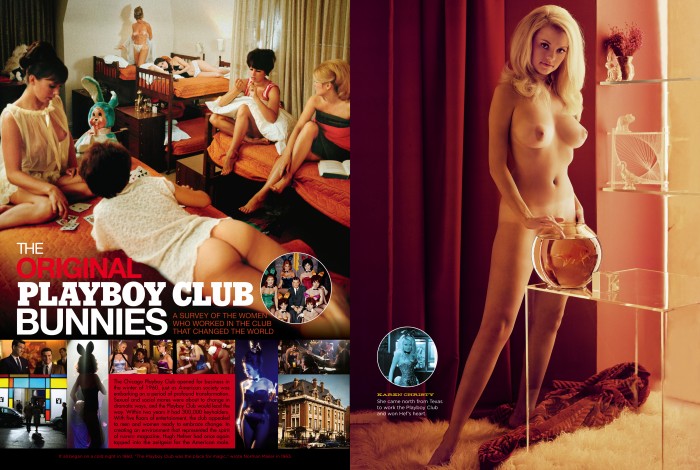
The Original Playboy Club Bunnies
October, 2011
Bunny Number One
Bena.nti
a real
Playboy
Bunny.
But sne
->la.ys one
on T"V
Laura Benanti is one tough Bunny Mother. The Tony Award-winning actress has long been a Broadway darling, but this fall she shines on the new prime-time drama The Playboy Club as Carol-Lynne—the shrewd and enterprising original Playboy Bunny at the Chicago club in 1961, who fights for a managerial position when she is pushed aside for younger newcomers such as Bunny Maureen (Amber Heard). "There's a major love triangle between me, Maureen and Nick [Eddie Cibrian]," Laura divulges. "My character says a lot of sassy, snappy things, because let's face it, she's a bit of an undercover bitch." To prepare for her role as "unwitting feminist" Carol-Lynne, Laura did her research. "I was intrigued to discover how much the girls loved working at the club and what a progressive person Hef was," she says. Another pleasant surprise? Her Bunny costume. "I was nervous about putting it on, but it's sexy and adorable and somehow makes every woman look beautiful. It's kind of awesome."
I
A SURVEY OF THE WOMEN WHO WORKED IN THE CLU THAT CHANGED THE WORI
The Chicago Playboy Club opened for business in the winter of 1 960, just as American society was embarking on a period of profound transformation. Sexual and social mores were about to change in dramatic ways, and the Playboy Club would lead the way. Within two years it had 300,000 keyholders. With five floors of entertainment, the club appealed to men and women ready to embrace change. In creating an environment that represented the spirit of playboy magazine, Hugh Hefner had once again tapped into the Zeitgeist for the American male.
It all began on a cold night in 1960. "The Playboy Club was the place for magic," wrote Norman Mailer in 1963.
ICA-ptEKT CHRISTY
She came north from Texas to work the Playboy Club *~* I won Hef s heart.
The club's most conspicuous feature was the Bunnies—those incredible women who worked as waitresses and hostesses but who served more as avatars of sexuality. "The main thrust of our creativity," wrote Hefner, "was to bring the pages of playboy to life."
Miss November 1969 modeled b Bunny costume in 1971.
"Not many people are aware of it," wrote Art Buchwald in 1962, "but Chicago has become the sex-symbol capital of the United
States." Bunnies were encouraged to be sexual figures but were forbidden to see patrons after hours—or even give out their
phone numbers. "If any of our girls dates a customer," Hefner told the Minneapolis Sunday Tribune, "she gets fired."
COXT3STIE} MA.SOIT
Miss June 1963 served beverages in the Playmate Bar.
Miss November 1962 also ran her own boutique.
BR..AXTDY JOHNSTON
Ms. Johnston was known in Chicago as "the finest Brandy this sidapf France."
iss Marc
along with her twin sister, Janis—kept heads spinning in the club.
The Bunny was a prefeminist feminist, a sexy, liberated and independent woman. "It seemed every great-looking woman in town wanted to be a Bunny," wrote John Dante, who worked as a club bartender. "They were the reason why the club was packed."
The fourth floor of the Chicago Playboy Mansion was converted into a Bunny dormitory, much to the delight of discerning neighbors.
JOYCE NIZEARI
Miss December 1958 served food in the Chicago club.
Kai was called "a model embodi-¦flient of Chicago Bunnyhood."
CA.R.OH.
Miss December 1970 also worked as a Chi-town Bunny.
See more club Bunnies at playboy.com/bunnies.

