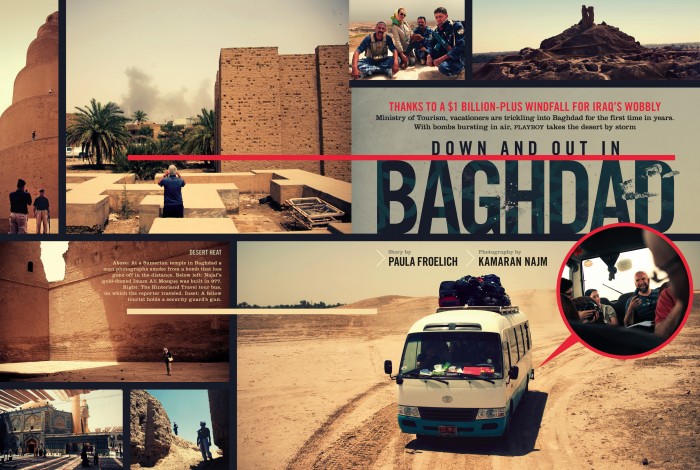
Down And Out In Baghdad
September, 2011
THANKS TO A $1 BILLION-PLUS WINDFALL FOR IRAQ'S WOBBLY
Ministry of Tourism, vacationers are trickling: into Baghdad for the first time in years. With bombs bursting in air, playboy takes the desert by storm
DESERT HEAT
UN IYIAY 13, ZU I I, as four rockets exploded outside Baghdad, one near the U.S. Army base, a group of 17 mostly middle-aged tourists lingered in various states of disarray in Baghdad International Airport's passport control area for four hours as their visas were processed. Tempers started to fray.
"GEOFFREY! GEOFFREY! How much longer?" Margaret, a retired British PR director, asked the tour leader, Geoff Hann, an easily disconcerted man in his 70s who resembled a yard gnome, complete with long curling eyebrows and potbelly.
Geoff—the man behind the British tourist company Hinterland Travel, specializing in trips to Iraq—had a comb-over that acted as a barometer for his nerves. It started in the morning neatly plastered on the right side
and by sunset ended up flopped over completely, hanging precariously from his left ear.
"We could be touring Baghdad. Instead we're just sitting here," said Peter, a Welsh librarian who had a habit of pointing out the obvious. "It's just mildly ridiculous."
"Just hold your horses! Patience! Patience!" Geoff sputtered, his hair starting to frazzle. He looked over at me accusingly. "Some people booked last minute."
Justine, a New Zealand-born lawyer, nattered away. "As they say in New York, 'Whatevah!'"
Geoff had another distraction: Tina, a dyed-blonde Robin Byrd doppelganger with pendulous breasts and teeth straight out of the British book of smiles. The two were already acquainted.
"Jeffreh," Tina cooed in a Yorkshire accent, "do something," inspiring her knight in short shirtsleeves to spring into action. He picked up his phone and screamed at someone at the Ministry of Tourism, "I'm very angry! I will leave! I will! Do you hear me?"
Tina, excited by GeofFs display of strength, removed her
As the writer ventured through Iraq with tourism company Hinterland Travel, bombs and shootings felled dozens around her. Here's a day-by-day itinerary with excerpts from official UN Security Reports
DING REL1G1C
cardigan to reveal her huge rack crammed into a tight yellow tank top—just as a religious tour group from Iran entered. An African American contractor sitting next to me said, "You're here as a tourist? With these guys? That shit is crazy." He pointed to a sign that read entry visa: S82 and said, "It was $2 in January. Damn, I fucking hate this country." He started laughing. "Anyway, have fun. Don't get killed," he said and walked off, visa in hand.
Shortly after the Iraq civil war ended, in 2008, while the stink of improvised explosive devices still smoldered and the Iraqi economy wheezed, NGO wonks, USAID, special interest groups
and the Iraqi government concocted a brilliant idea: Spur private-sector growth and employment by making the country a tourist destination. After all, driving through Iraq is like taking a tour of the Old Testament. It's home to Nebuchadnezzar's Babylon, the Ziggurat of Ur, Nimrud's famed acropolis and the 5,000-year-old Assyrian capital of Ashur. It's where the Code of Hammurabi was written. Its geography marks the heart of the Fertile Crescent, the most ancient of all human civilizations.
The group of optimistic visionaries came up with a PR slogan for the country: "Explore Civilization of Life." And as nothing beckons tourists like a Ferris wheel, it was announced with fanfare to the international press that the city would build a wheel, dubbed the Baghdad Eye, that would be taller
MAY 15 > Arrived at the Uruk Hotel in the Karradah section of Baghdad. Walked around the Karradah market with security guards. Visited Kadhimain Shrine, built in 1515. Dinner at a kebab shop. UN SECURITY REPORT: Small-arms fire kills one in northwestern Baghdad. Gunmen broke into a civilian house in al-Dhura village west of Baghdad—three killed, four injured.
MAY 16 > Whole day in Baghdad. Went to Saray Souk, the main market, and 13th century Mustansiriya University. Visited the Iraqi National Museum, then rode the Ferris wheel in Zawra Park. UN SECURITY REPORT: Small-arms fire and two improvised explosive devices kill four Iraqi policemen in Baghdad. One other I ED in Baghdad injures four, including three foreign nationals.
MAY 17 > Drove to Samarra. Saw the spires and a palace built by Saddam Hussein. Drove through Kirkuk to the Avesta Hotel in Erbil. UN SECURITY REPORT: Armed opposition groups attack U.S. forces in Kirkuk and Samarra. IED injures two southwest of Kirkuk.
MAY 18 > Drove from Erbil into the desert. Visited Nimrud's palace (ninth century B.C.), and the Mar Mattai monastery near Mosul, where Christian refugees were living in a shantytown. Back to Kirkuk for the night. UN SECURITY REPORT: An IED east of Mosul injures an Iraqi policeman. Five other IEDs detonate in Baghdad; no injuries reported.
.MAY 19 > Drove through Kirkuk (saw the tomb of LNoah from the bus), then through the desert to Tikrit, then Ashur. Then back to Baghdad, hitting 159 police checkpoints. UN SECURITY REPORT: Five IEDs explode in Baghdad and Kirkuk—27 killed, 87 injured. A Kurdish national is kidnapped in Kirkuk. Another kidnap victim is found dead in the same city.
MAY 20 > Drove from Baghdad south to the town of Salman Pak, site of a military complex where Saddam Hussein based his chemical-weapons program. Back to Baghdad, where we toured a sheik's home. Dinner on the Tigris River on Abu Nawas Street. UN SECURITY REPORT: Two small-arms-fire attacks in Baghdad—two killed, two injured. Three IEDs explode in Baghdad; no serious injuries.
MAY 21 > Baghdad to Babylon and Borsippa, then to the tomb of Ezekiel. Ended up in Karbala—visited Imam Husayn's shrine, one of the world's oldest mosques, which dates back to the seventh century. UN SECURITY REPORT: Two IEDs explode in Baghdad, injuring two Iraqi Security Forces.
MAY 22 > Drove from Karbala to Najaf to visit Imam Ali's shrine, a major holy site for Shiites. Quick stop in Kufa, then back to Baghdad's Uruk Hotel. UN SECURITY REPORT: At least 12 IEDs in Baghdad kill 12 and linjure nearly 60, all Iraqi civilians and police officers.
than the London Eye. It would have a view of the entire city. There would even be an amusement park and a zoo built around the Eye, named Sinbad Land. All would be happily housed in West Baghdad's Zawra Park, conveniently situated next door to the Green Zone.
The Ministry of Tourism dropped $500 million on the project. Despite some concerns over whether it was prudent to build a Ferris wheel within sniper-shot range of the American embassy, ground was broken.
And thus Baghdad came under siege from a new and uniquely sinister lot: tourists.
There are certain rules to abide by when traveling in the Middle East, where a woman's worth is counted in cattle and she is considered either a virgin, married or a slut. Chief among these rules: Cover your arms, cover your legs and cover your hair. In fact, just to be safe, cover everything. A glimpse of thigh is a money shot over there. Cleavage is practically pay-per-view.
Other, non-gender-specific rules when traveling in a "troubled" area include:
Don't make a scene. Don't draw attention to yourself. Remember to be respectful of religion. Don't wander off alone, due to high kidnapping rates. Do not pilfer from archeological sites. And never use your hotel prayer mat, found in most rooms, as a rag to mop up a leaking toilet. All these rules were about to be broken
as our group headed heart-of-darkness-like into the desert and its cruel sun.
As we waited for our visas in the airport, Geoff—now leading his third group of the year into Baghdad—grew more addled. The interpreter from the Ministry of Tourism who usually accompanied him was "called away unexpectedly" and replaced
with Mohammed, an anxious, sweaty man with a Saddam mustache and pom-padoured jet-black hair. Mohammed wore a uniform of pleated chinos and golf shirt and carried a briefcase at all times, like a 1965 insurance salesman. He claimed to have been an interpreter for the Americans at some point. God help them if he was; the few times he was brought in to decipher what locals were saying, his interpretation varied from sort of correct to not even close. (Example: A man with scars all over his body talked to me for five minutes. Mohammed's interpretation: "He says welcome!" Actual interpretation: "Look at my scars. I got these in an attack while I was working for the Americans. Can you help me get to America to get medical help? I'm in constant pain.")
This was Mohammed's first tourist rodeo. He was in for a rough ride.
An hour later our group of sightseers boarded our chariot: a decrepit blue-and-white bus with multicolored carpeting covering the seats and air-conditioning that felt like an old man blowing softly over a bowl of (continued on page 100)
BAGHDAD
(continued from page 50) ice. The dashboard was covered in Bubble Wrap and red-and-black-striped faux fur. In front of the driver, Ahmad, was a huge crack in the windshield, as if someone had thrown a rock at his head. Geoff, still rattled, announced to the bus, "Everyone, please. Now, I must stress that you cannot take pictures of police or police checkpoints. You will be arrested and your cameras confiscated."
Here's the thing about police checkpoints: There are many in Iraq. We went through 159 one day. Everyone with a gun is in charge, unless, of course, no one is. One foreign passport must be presented (preferably not an American one), calls must be made, and eventually you will be allowed to pass. Average wait time at a checkpoint if you are stopped: 20 minutes to two hours, depending on the mood or the amount of female skin exposed that day.
At the first checkpoint we hit, Tobias, a 31-year-old German computer engineer who claimed to travel to "dangerous places and get pictures of myself jumping off famous things," moaned, "I need pictures of zee checkpoint for color! It is local flavor!" His camera clicked away.
•
The first impression of Baghdad: Tensions are very high. The city retains some of its former glory despite the signs of sectarian violence. Barbed wire surrounds blue-domed mosques, and concrete bomb walls encompass almost any building that still has intact windows. Kebab shops, clothing stores and furniture outlets selling that special brand of Iraqi elegance line the streets in between tanks and troops. The whole city could use a Valium and a tab of ecstasy.
When we arrived at the Iraqi National Museum we were refused entry. According to Geoff, "The Ministry of Culture says the museum is such a mess they don't want to let us in. But I was there a month ago and it was a mess then, too!" We went around to the front to take a few shots of the Assyrian sculptures in the entryway, encircled by bomb walls and sandbags.
Within moments we were surrounded by six policemen armed to the teeth, pointing their guns and screaming at us to stop taking pictures.
One of our assigned security guards said, "All is okay. No problem."
Geoff pleaded, "Please stop"—click— "taking pictures." Click, click. "Now!" Click. " I mmediately...."
Justine: "Ooh! That man's pointing a gun at us!" Click. "He looks really mad!" Click, click.
Geoff: "I mean it." Click. "Put the camera away!" Click, click, click.
Official papers were produced, but the police weren't satisfied. All six started making calls. Ten minutes later Geoff announced, "Okay. Everyone back on the bus. Now! We have to leave. Quickly!"
Mohammed, standing uselessly, had sweat through his shirt and was clutching his briefcase like a security blanket.
Later, at Mustansiriya University, near
Saray Souk, the historic downtown market, a group of angry policemen started shouting and pointing at us. Someone had taken a picture of the Central Bank—another no-no.
"Whose camera do we smash?" one policeman yelled.
"I will stomp on them all!" another cried.
Several minutes later we were hustled outside and back onto the bus.
By the third day Mohammed had finally figured out I was a reporter and asked, "You will write nice propaganda for Iraq? You will do advertisement, yes? We don't have time, but Iraq has nice wax museum."
"Wax museum?" I said, confused. "Like Madame Tussauds?
"Huh?"
"Famous people in wax?"
"No, cities and historic scenes made out of wax!" Mohammed grinned.
"But what happens when the power goes off? Doesn't it melt?"
"They use air-cooling system!" Mohammed said proudly.
"But what about when the power is down? It's down all the time here."
"Yes! Air cooling!"
"Forget it."
One reason I wanted to visit Iraq, besides my being a history buff: I knew the January 2012 deadline for U.S. troops to pull out was looming—when the country will, most likely, fall into chaos again. The Sadrists—a religious political movement based mainly among the Shia population—have threatened to go all sorts of crazy if the American troops don't leave by the promised deadline. According to a pal involved with Operation New Dawn, "If we leave, the Iraqis are screwed. If we don't, we are screwed."
In June the Maliki government announced it would "invite" the U.S. to stay longer. No one got a comment from Muqtada al-Sadr, the Sadrist leader. But while I was in Iraq, the violence escalated. Maliki, upon "winning" the election earlier in the year (despite widespread claims of vote rigging), gave himself a 100-day deadline to clean up corruption in the government. Meanwhile, $6.6 billion earmarked for reconstruction had gone "missing." Our trip fell at the tail end of Maliki's 100-day empty promise—further angering insurgents, who were starting to blow shit up.
As our group traipsed over the dusty remains of an ancient Sumerian temple, a large explosion went off just over a mile away. Black smoke filled a section of blue sky; one woman in our group looked at the ominous cloud and optimistically said, "It's probably just someone burning garbage. You know, they do that over here."
It wasn't garbage.
On the way to the relatively safe environs of Erbil, via Samarra—the town where a mosque was bombed in 2006, sparking a two-year-long civil war, and where Al Qaeda in Iraq likes to hang out—we passed through Kirkuk and picked up heavily armed police escorts. They guided us into a gas station hidden behind thick cement
walls. As Ahmad filled up the tank a few men approached the bus, staring at Justine's bare arms dangling out the window. They started shouting and pointing. More men drew near.
"Oh, they want to take my pic-chah\" Justine cooed, posing. One of our guards with a machine gun and a face mask started beating the men back.
"Well," someone huffed, "that's not very nice, is it?"
"He seems awfully nervous," someone else said. "And so sweaty—maybe he should take off that face mask."
Our guard slammed our windows shut and yelled at another policeman, who rushed onto the bus, yelling at Mohammed, who turned to Geoff, who finally realized Justine was wearing a tank top and said, "Put on a shirt! Now!"
"Oh, ha-ha-ha!" she said, laughing and pulling a shawl over her arms. "I'm quite the Jezebel!"
Two days later we passed through Kirkuk again, picking up another security detail. This time, instead of just getting gas and leaving town, the bus ambled down some small side roads as Geoff pointed out the tomb of Noah (he of the Ark) and other bullet-marked significant sites.
As we made our way through the desert to the archeological site of Ashur, news came that a series of bombs had gone off at the Kirkuk police station, blocks from where we'd been earlier that morning, killing 27 and wounding more than 80.
Despite the threat of violence, a clearer picture of Iraq started to come into focus. While I was roaming the ruins at Ashur, the ancient Assyrian capital on the banks of the Tigris River, I began to feel very small. Although the ruins are a UNESCO-designated site, they are barely touched by archeological hands, and as I walked over ancient bones trapped in the earth, past cuneiform-stamped pottery, 5,000-year-old marble railway tracks and bits of ornately carved buildings peeking out of the ground, I started to feel like a character in the Old Testament.
This city and its ziggurat were once the center of the human universe—where the roots of our own civilization were formed. Now it lies untouched under dirt and sand. The little that has been dug up has been carted away, but most of it is undiscovered and for the most part forgotten. My adopted hometown of New York City and its Empire State Building faded into a distant memory covered by this all-powerful force of wind, sea and sand.
Out of the corner of my eye I saw Tobias jumping on the ziggurat while a policeman crushed ajar fragment with his boot.
After we left Ashur we enjoyed a two-night respite in the safety of the wheat-green mountains of Erbil in Kurdistan. I escaped the roach motel the Ministry of Tourism had put us in—where the sheets had cigarette burns and the carpet looked as if it would have walked away on its own had it not been tacked down—and went for drinks at the five-star Rotana Hotel, five minutes
away. An Air Force colonel looked at me with bug-eyes and said, "Wow. That's crazy. Kirkuk? Tikrit? Mosul? Wow. Um...."
Unlike in the rest of Iraq, there were no bombed-out windows in Erbil, which sported blocks of new construction, women with no head scarves and cleared areas for housing developments. Optimists had even deposited an American-style two-car-garage home in the middle of the city, promising a future development full of such comfy houses. Kurdistan is currently the only region in Iraq that allows single-visa touring. As an American, you can look around alone. However, if hiking in the hills on the Iraq-Iran border, be wary of Iranian police who beckon saying they just want to chat—10 feet over there, which just happens to be on the Iranian side of the border. That's the local Erbil account of what happened to the two U.S. hikers now held prisoner in Iran.
On a day trip from Erbil to a picturesque monastery perched on a mountain outside Mosul, we passed a shotgun-blasted sign surrounded by sandbags and bomb walls that read united towards prosperity. People on the bus started to grumble.
"Can we stop? I'd like a photograph."
"If we go much farther we won't get the right shot."
Geoff talked to Mohammed, who talked to our armed-guard escorts via walkie-talkie. We started to slow down.
"Oh, wail—can we go about a kilometer farther? That would be better."
"You've seen one monastery you've seen them all."
"They built monasteries high up so they could be closer to God."
Mohammed put his head in his hands and started rocking back and forth.
At the monastery lived several Christian families who had fled persecution in Mosul and Baghdad. One of the families lit up upon realizing I was American. They took me out on a rocky hilltop to see a cave where monks used to sleep a thousand years ago and where the view extended for miles.
"Beautiful, yes?" the daughter asked. "We love you!"
Nowhere in Iraq can you get a better sense of Saddam-era design than in his hometown of Tikrit or his palace at Babylon. Lining the roads in between date palms and goatherd shacks are mansions combining four or five architectural styles (Mediterranean! Chinese pagoda! Concrete phantasmal), all dipped in the baroque splendor of marble and gilt. Most of it has been stripped by looters, but in Saddam's Babylonian residence you can still get the gist of his vision—even with graffiti lining the walls: doun [sic] usa! and IRAQ NOT liv [sic] usa! Meanwhile, from the 100-degree heat and the insufficient air-conditioning system, the bus was starting to smell like a gym locker, and food was scarce. On the seven-hour drive back to Baghdad, Tobias lost it and started fuming, "Where is my lunch? Where is my dinner?"
In Karbala, one of the holiest cities in the Shia religion (along with Najaf), Tina refused to wear a burka. At the barricaded entrance to the old city, as we were surrounded by 25 policemen demanding that the women burka up, Tina screeched, "How dare you! This is even more Shia than Iran. Get away from me, fascists! They always pick on me. I'm sick of it." She stormed off into the inner city, with several policemen and Geoff trailing helplessly in her wake.
"She's nuts," someone said.
Crowds of angry men started following us.
"Maybe she doesn't realize there were several kidnappings and assassinations here recendy," someone else said.
Tina eventually capitulated, but she shook with rage as she entered the shrine of Imam Husayn—the second-most-holy site for Shias. Moments later Justine, whose burka had started to slip, announced, "I was being followed by a nuttah, so I just walked right up to him and said, 'Hey, you, nuttah! Get away from me!'"
"Way to keep a low profile," someone muttered.
"I'm out of here," my Kurdish photographer said.
Unfortunately Geoff had forgotten to tell us we weren't allowed in the inner sanctum of the shrine. So, further incensing the inhabitants, several women wandered in. Some took pictures, and just as a revolt was brewing, several men from the mosque whisked us into a room and locked the door behind them.
Another tour member took this opportunity to snap a picture of Tina in her shroud, prompting her to lift her veil and shriek, "How dare you take my picture without asking! Delete that immediately! Now!"
"I can't. Ha-ha-ha—it's not digital."
The men from the mosque shrank back and started whispering. Three more men entered the room and again locked the door. We were surrounded.
"Geoff, I think we should go," I said.
"Yes, perhaps that's a good idea," he said nervously.
But how? We were trapped. It was at this moment that I became acquainted with the emotion of pure terror. These men were going to take us to jail. I was going to have my face on the front page of The New York Times under the headline DUMB ass TOURS IRAQ with
EXPOSED ANKLES!
Geoff sprang into action. He talked his way through, and we quickly departed—safe but disturbed. Who would've known this gnome with his curling eyebrows would end up the hero of our story? We left the mosque and were escorted back to our hotel. I needed whiskey, and quickly.
An ashen-faced Stephen, a West Hollywood librarian who has traveled the world over, whispered, "I survived Somalia, but I'm going to be killed in Iraq."
After my nine-day tour ended, back home in New York I received a postscript. Anya (not her real name), a member of our group still on the tour, caused a kerfuffle. She reportedly used a hotel prayer mat in Basra as a rag to sop up a leaky toilet, which led to a lot of shouting by the outraged hotel staff and an immediate departure from the city. Then some eagle-eyed guards at an archeological site near Ur claimed to witness a tourist with Hinterland Travel pilfering a small 4,500-year-old statue. The guards reported the alleged theft to their headquarters, which called the Ministry of Tourism, which called a panicky Mohammed, who in turn questioned Geoff, who denied everything. Guards—who'd been informed of the alleged theft—insisted on searching every piece of luggage inside and outside the bus and patting down the men in the 110-degree heat.
As the report goes, a frantic Geoff started to remove his clothes. As he ripped open his shirt he screamed, "We have nothing to hide!" Tina then got into the act and demanded the guards search the women, too—thrusting her chesticles into their faces, crying, "Go on, then. Do it! Search me, why don't you?" No statue was ever found. Shortly thereafter, an "Iraqi film crew" started following the bus, documenting its every move.
On the way to the airport Justine continued taking pictures of checkpoints and policemen, prompting Geoff to say, "Put your rucking"— click—"camera away." Click. "Now!" Click, click.
'Okay. Everyone back on the bus. Now!
WE HAVE TO LEAVE. QUICKLY!"

