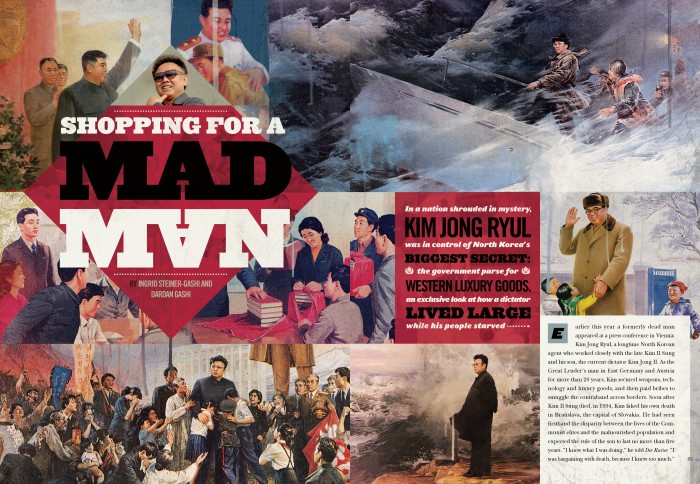
Shopping For A Mad Man
November, 2010
arlier this year a formerly dead man appeared at a press conference in Vienna: Kim Jong Ryul, a longtime North Korean agent who worked closely with the late Kim II Sung and liis son, the current dictator Kim Jong II. As the Great Leader's man in East Germany and Austria for more Chan 20 years, Kim secured weapons, technology and luxury goods, and then paid bribes to smuggle the contraband across borders. Soon after Kim II Sung died, in 1994, Kim faked liis own death in Bratislava, the capital of Slovakia. He had seen firsthand the disparity between the lives of the Communist elites and the malnourished population and expected the rule of the son to last no more than five years. "I knew what I was doing," he told DerKurier. "I' was bargaining with death, because I knew too much."
in an
tied in mystery.
JOI
BIGGEST SECRET:
WESTERN LUXURY GOODS. LIVED LARGE
Now 75, Kim resurfaced this year in Vienna to promote
a memoir, In the Service of the Dictator: The Life and. Escape of
a North Korean Agent, written witli two Austrian journalists,
Ingrid Steiner-Gashi and Dardan Gashi. An excerpt from the
book, published only in German, is translated here into Eng
lish for the first time. Kim says he shared liis story about the
injustices suffered by the North Korean people because he
wants to speak out before he dies. Now that he has revealed
himself, he understands the end may come not from advanc
ing age but at the hands of an assassin. "I am now a known
traitor," he has said. "If they find me, they will kill me."
The last person close to North Korea's ruling family /£
he North Korean Ilyu-shin-76 cargo plane had been standing at the airport in Bratislava for days, its fuel tanks and hold full. Destination: Pyongyang, the nation's capital. Kim Jong Ryul checked the manifest line by line. Once again he had managed to get everything the Communist Party leaders had requested, including, in this 18-ton shipment, two file trucks, hunting rifles, metal detectors, fingerprint readers from the U.S., gas masks, security systems and weapons.
Over the previous two decades Kim had gone on countless foreign shopping trips for the regime, searching for both the illegal (spying equipment) and the absurd (silk wallpaper)— and the illegal and absurd (gold-plated handguns). Not once had the colonel, who had been trained in mechanical engineering, lost so much as a screw during transport, despite sometimes having to send the cargo on a monthlong ride over the rails through the wilds of the Russian steppes with forged inventories and bundles of U.S. dollars to pay bribes. "A miracle" is how Kim now describes his track record.
On this day, October 18, 1994, the two North Koreans who had accompanied Kim on the trip, along with two Austrians and a Slovak businessman, decided to drive from the airport to the city center to kill time. Before they left, Kim asked a younger colleague, "Where did you put all your dollars?" The man pointed to a pouch hidden under liis shirt. North Korean officials never came home without highly coveted foreign currency. It paid for a better life and ensured they would not starve. Kim opened his own jacket to display a small bag inside the pocket that contained $20,000. His colleague was taken aback. "It's dangerous to cany around so much money without protection," he warned.
to write a memoir, a nephew of Kim Jong Il's longtime mistress, was shot dead in 1997 in Seoul by two gunmen outside a friend's apartment. And this past April South Korean police arrested two assassins sent to take out the liighest-ranking North Korean defector, Hwang fang Yop, a former secretary of the ruling Korean Workers' Party.
Kim forrg Ryul has been granted asylum by his adopted home of Austria, where he has sperrt the past 10 years living irr a basement room irr a rural village. He kept to himself,
avoided the police arrd let his neighbors assume he was Japarrese. But he has been hiding lorrg enough, he says. A man should not die underground.
At tho city center the men agreed to meet at the aiiport in two hours. By that time, however, Kim would be on a train to a suburb oi'Linz, Austria, where he had rented and stocked a 250-square-foot studio. He know his colleagues would immediately be concerned when he didn't show up; a guy like Kim, a cool strategist who planned every step as if it. were a mathematical exercise, was never late.
Anyone who flees the workers' paradise has to accept that his family will pay a dear price. From a grandfather down to a baby, a traitor's relatives are thrown into labor camps. Even if they live to be released they will be barred from education or job training and denied medical care and rations. Kim had seen this firsthand. His predecessor as leader of the Vienna shopping team, Hwang Do Ilyong, was called back to Pyongyang after party oOicials became concerned about a series of indiscreet aflairs and suspicious that he was laundering cash. Once home, Hwang and his extended family were given life sentences in a gulag. To protect his own family from recriminations, Kim went to great lengths to make his disappearance appear to be the result of a violent crime, his body never found.
When he failed 1(5 appear at the Bratislava airport, his North Korean compatriots weighed the possibility dial he had fled. But as Kim had predicted, they found it impossible to believe. Weren't all his suitcases on the plane, along witli a man-size crate filled with gifts for his family—polishing cloths for eyeglasses, teddy bears, baby food, crutches, cigarette lighters, ballpoint pens and medicine? One of the men remembered the $20,000 Kim had been carrying, and the group split up to canvass the city's hospitals.
By the time they returned, the plane had been cleared to take off. Distraught, nervous, close to tears, the North Koreans climbed aboard. Despite Kim's reputation for loyalty, within 24 hours the regime ordered a team of agents from Warsaw to scour Vienna, the logical destination for a German-speaking defector. One of the two Austrians who had been with Kim recalls the agents who showed up at
his door as "courteous gentlemen in street clothing, the type you don't want to mess around with." The agents had him repeat several times his story of what had happened in Bratislava, but they found no clues, no sign of a crime or escape. During the investigation, the North Koreans parked their dark Mercedes sedan outside Bratislava police headquarters. They returned to find it had been stolen in broad daylight. Perhaps Kim had died in a brazen robbery.
But Kim was very much alive. After arriving in his cramped safe house near Lin/, following a nerve-racking journey, he flopped onto the bed with relief", then took a photo of himself with a self-timer. He listened to his heartbeat, amazingly calm, steady. Now what?
IF YOU SAW a convoy of black luxury sedans on North Korea's sparkling, empty highways, it could only be the entourage of the president's family. Farmers in the fields paused their work and saluted. Old women cleaning the streets with brooms called, "Long live our beloved leader!" If the convoy stopped and Kim II Sung emerged, it amounted for bystanders to an almost religious experience. This was the man they worshipped from morning till night. They had learned his writings by heart and followed his orders without protest. And now the god had descended and stood in their midst. Propagandists recorded the scene for posterity. A statue of Kim II Sung would be built on
the very spot he had stepped out of the car. The village itself would enjoy enormous prestige from the visit. The names of every individual present would be recorded in the party membership records.
From the most remote mountain village to the I'yongyang airport, Kim II Sung and Kim Jong II were and always are in sight. Idealized portraits of both men must hang in every room of every private dwelling. It is considered taboo to fold a newspaper in half if the image of either man is bent. In every public place stands a statue of the Groat Leader or his protege, in bronze, iron or marble, always brightly lit even if the rest of the country slips into total darkness at night because of energy shortages. Busts of Lenin or Mara are long gone. Father and son tolerate no competition.
Despite the nation's isolation and near bankruptcy, the ruling family lives like royalty. At least 130 North Korean "shoppers" are thought to be currently operating from embassies around the globe, securing luxury goods and necessities. In 2005 police in Austria caught three North Koreans, dressed in suits and holding diplomatic passports, driving a Volkswagen van containing 19 million euros in bundled cash. The men admitted the money was earmarked for goods to be smuggled into North Korea.
Fhe shoppers' handlers at the infamous Oflico 39 could not have been happy when they learned that police had seized the cash. Oflico 39, located in a nondescript concrete building in Pyongyang and run by (continued on page 116)
(continued from page 87) the central committee of the Communist Party, was established in the 1970s by Kim Jong II to acquire foreign currency. Today it has two functions. One group, comprising the Korea Daesong Bank, the Golden Star Bank in Vienna (until it was shut down in 2004) and other businesses, is involved in the sale of precious minerals, ginseng and king bolete mushrooms, most of which are picked by inmates in forced-labor camps. Much of its staff has been educated abroad on how to maximize profit. A second group focuses on the weapons trade, fake medicines, counterfeiting dollars, insurance fraud, cigarette smuggling and, more recently, selling technology and know-how to construct tunnels.
According to a 2007 report prepared for the U.S. Congress, Office 89 generates as much as $1 billion from illicit deals annually—equal to the value of North Korea's legal exports. The drug trade is a primary source of revenue. North Korea is thought to be the world's third-largest opium producer, after Afghanistan and Myanmar, and Japanese authorities believe many of the narcotics on its streets originate in North Korea. At the same time drug profits are flowing to Kim Jong II, he insists dealers and users be summarily executed so the nation remains drug free. A Russian diplomat who visited Pyongyang reports Kim told him, "If you happen to run across a Korean drug addict [in Russia], you have my permission to shoot him."
Before his escape, Kim Jong Ryul recalls, he took an order from a party official that included eyeglasses, cameras, 10 grams of gold fillings, a hearing aid and silk for the man's wife. Let him dictate as much as he wants, Kim thought to himself. Nothing will come of it. The colonel's two traveling companions had never been abroad before; Kim was to make sure they didn't fall victim to the dangers of capitalism. If one or both were not to return, Kim would surely receive a prison sentence. lie could not guess what their fates would be when he did not return.
Because of Pyongyang's shortage of foreign currency, which was needed to make cash deposits, and the challenge of finding two fire engines, fulfilling the order took most of the summer. In June his companions returned to North Korea for three weeks to see their families. The colonel used the opportunity to rent the apartment near Linz and stock it with supplies. In the midst of this hectic planning came shocking news: The Cheat Leader had died of a sudden heart attack at the age of 82. He had ruled for 46 years. When Kim's two colleagues returned, they told of a nation in shock and mourning. In the people's eyes Kim II Sung had saved the nation from imperialism. A North Korean who did not weep in the face of this overwhelming loss could only be a traitor, so Kim brought himself to tears.
Kim knew any slipup could doom him.
He had heard the story of Koh Young Ilwan, a diplomat stationed at the embassy in Zaire who had made an offhand comment about the 1989 execution of Nicolae Ccau§escu, the Romanian dictator. "1 hope nothing similar happens in our country," he said. Within days security officials, apprised of this challenge to the omnipotence of the Great Leader, arrived from Pyongyang to escort Koh home; the diplomat barely escaped. Kim had not breathed a word of his plans to anyone, not even his wife of 30 years or his two children. The night before his departure he lay awake. How long would he be gone? Would he ever see his wife, his children and his grandson again? Would they miss him? He felt a deep sadness rising. He thought of himself as a hard man but now regretted spending so much time away from his family. The next morning they rode with him to the airport, where his son gave him a lingering hug. Did they sense something?
Twenty years earlier, when Kim Jong Ryul arrived for his first assignment in Vienna, he carried a black Samsonite stuffed with $400,000 provided by the ministry of finance. He passed through customs with a flash of his diplomatic passport and a nod. He would have taken more cash, but officials couldn't fit any more bundles of hundred-dollar bills into the suitcase. The North Koreans preferred to conduct business in Austria because it remained neutral during the Cold War, and its borders were far less regulated than those of East Germany and the other Communist states of Eastern Europe. Kim remembers feeling confused during his first days in capitalist Vienna. Despite what he had been told, the city shone with splendid buildings. No beggars were in the streets, and restaurants provided friendly service and a wide variety of cuisines.
The North Koreans operated through a front called the Korea General Machinery Trading Company. The shoppers could not order goods directly from manufacturers because of trade restrictions imposed after the Korean War, so they used middlemen. One of them was a Romanian who had set up a shell company to conceal the crimes of that country's intelligence service. He once filled Kim's order for a Cessna. More typically the shoppers worked with trading companies that had just one or two employees. Because the North Koreans paid up to 30 percent over market prices, no one asked questions about where the goods were headed. Only rarely was a request so outrageous or risky that it was refused, such as when the order came from Pyongyang to purchase propulsion packs that would allow men to jump over walls. Weapons often had to be first smuggled into Austria from Switzerland or Czechoslovakia so they could be smuggled out to Pyongyang. Kim eventually connected with a number of "import-export" firms that not only found the goods but repackaged them, created fake manifests and bribed customs officials. Items that weren't too bulky were stored and repackaged in the basement of the embassy. Once all the items in an order
had been located, Kim would fly home to retrieve the necessary cash.
Eventually the wish list from Pyongyang included Geiger counters and seismographs. Ever resourceful, Kim created a business card that read kim joni; ryul,
PH.U, CENTRAL INSTITUTE FOR GEOPHYSICS AND
seismic: research and made appointments with research institutes in German college towns. If anyone became curious, he brought up the 1976 earthquake in Tang-shan, China that killed f>50,000 people and spooked North Korea's leaders. Kim also purchased less-suspicious products—he estimates 80 percent of the goods he sent back were luxury-decor items for the homes of Kim II Sung, his son and party officials—crystal chandeliers, carpets, tile, lighting, sinks, exquisite furniture. Kim often dealt with Kim II Sung's architect; budgets were not discussed. Apart from the walls and roofs, every item in the family's luxury villas (some built underground) were stamped made in Austria. right down to the pipes that carried filtered water to each faucet.
Besides enjoying fresh water in a city where the drinking supply had a yellowish tint, Kim II Sung and his family ate much imported food. The Great Leader's cravings once led him to send a delegation of cooks to Austria, with Kim Jong Ryul serving as translator, to visit the nation's best culinary schools. Their assignment: Learn everything!
In the summer of 1975 Kim led a team of four mechanics to a Mercedes-Benz plant near Stuttgart so that in one month they could learn how to repair the Great Leader's prized fleet of 10 sedans. (Daimler-Benz AC; says it has no record of this visit, though the hotel where the men stayed did document the presence of five Koreans.) Kim says that without the oversight of party watchdogs, the men had a great time shopping and eating. The manager of the hotel forbade them to cook in their rooms, but the seemingly famished visitors bought hot plates. While they had plenty of cash, the foreign currency would be more valuable in North Korea than in Germany, so they purchased only small items as souvenirs— pens, lighters, flashlights, goggles.
Kim was under great strain. He could not lose any of the mechanics to defection, and he also had to make sure they returned home with the ability to repair a Mercedes. The Great Leader envisioned a joint venture with Daimler-Benz so his vehicles could be serviced in Pyongyang, but he feared being too dependent on capitalists. Like his father, Kim Jong II also had a strong affection for goods created in the imperialist West—including yachts, medical devices to monitor his well-being and Belgian candies—and often asked the colonel, "When will you return to Germany?" before offering the advice, "Be alert! They're all devils." Also like his father, Kim Jong II craved rich foods and developed a generous belly—a sign of wealth and power in a malnourished nation. Party leaders responded to the food shortages by reassuring the populace,
"Two meals a day is enough."
On a winter day in 1980 Kim Jong Ryul was ordered to appear before the son in his office at the center of Pyongyang. He took three long escalators down before arriving in a bunker 650 feet below the building. From here an underground tunnel ran 12 miles to the edge of the city—an escape route in the event of attack. The future Dear Leader had called Kim to tell him to locate and purchase seven electric cars (the tunnel had no ventilation for gas or diesel exhaust). He also described an ambitious plan to solve the problem of keeping his father's fleet of Mercedes in pristine condition: They would build their own. The country's best engineers, Kim Jong Ryul included, would be assigned to the task. The colonel had doubts from the beginning, but several originals were disassembled to the screws and each part duplicated. Press machines were brought from abroad, and technicians drew, planned and constructed around the clock. By the early 1990s a North Korean version of the
Mercedes-Benz 200 was presented to cheering crowds, though the cars were junk and the mechanics understood them no better than they would have a lunar probe.
Aie there moments of happiness for Kim Jong Ryul, who is now so many years removed from his homeland? Yes, when he enters his pantry, which is temperature-controlled with a cooler of the former engineer's own design. The narrow shelves are lined with goods that the elite in Pyongyang can only dream about: wine, pickles, raisins, canned tuna, crackers, lemons. This is Kim's altar. Here he says a prayer of thanks because he will never go hungry. He selects an apple and thinks, I can have a piece of fruit every day. The ministers in Pyongyang cannot say that. Then he grows angry. "What sort of fucking system is that, where a refugee eats better than a party leader?"

