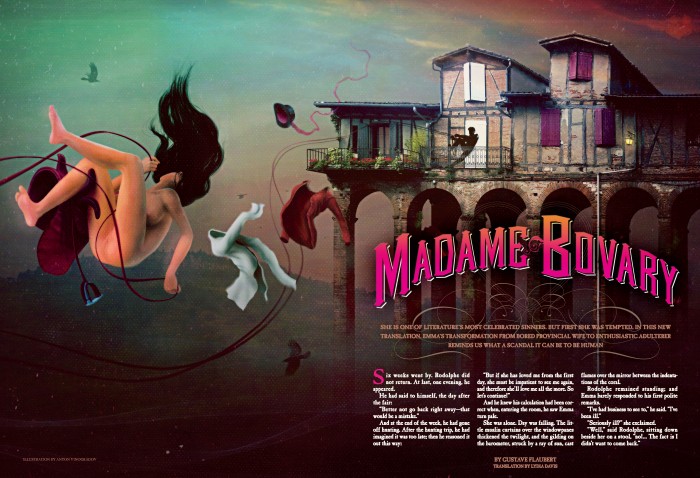
Madame Bovary
September, 2010
CELEBRA
SHE IS ONEVOF LITERATURE'S M
TRANSLATION. EMMAS TRANSFORMATION FROM BORED PROVINCIAL WIFE/]
^ REMINDS US WHAT A SCANDAL IT CAN BE TO BE HU
WAS TEMPTED. IN THIS NEW D ENTHUSIASTIC ADULTERER
return. At last, one evening, he appeared.
He had said to himself, the day after the fair:
"Better not go hack right iwiy—that would be a mistake."
And at die end of die week, he had gone off hunting. After die hunting trip, he had imagined it was too late: then he reasoned it out this way:
"But if she has loved me from the first day, she must be impatient to see me agin, and therefore she'll love me all the more. So let's contiBBcl"
Aid he knew his calculation had been correct when, catering die room, he saw Emma tarn pale.
She was alone. Day was falling. The little muslin curtains over the windowpancs thickened die twilight, and the gilding on the barometer, struck by a ray of son. cast
fkmc* over the minor between die indentations of die coral
Rodolphe remained standiig; aid Emma barely responded to his first polite remarks.
Tve bad bvauess to see to." be said. Tve been ill"
^Seriovsly ill?" sbe exrlaimcd.
"Well." said Rodolpbc. sitting down beside her on a stool. "boI~ The fact is I didn't want to come back."
"Why?"
"Can't you guess?"
He looked at her again but with such intensity that she bowed her head, blushing. He went on:
"Emma....
"Monsieur! she said, moving away slightly.
"Ah! You sec, he replied in a melancholy voice, "I was right not to want to come back: because that name, the name that fills my soul and that slipped out of me—you forbid me to use it! Madame BovaryL. Oh, everyone calls you that!... It's not your name, anyway: it belongs to someone else!"
He said it again:
"Someone else!"
And he hid his face in his hands.
"Yes. I think about you constantly!... The memory of you makes me despair! Oh, forgive me!... I'll leave you alone.... Good-bye!... I'll go away...so far away that you 11 never hear of me again!... And yet... today...I dont know what power it was that impelled me to sec you! For one cant fight against providence, one cant resist the smiles of an angel! One can't help being carried away by what is beautiful, charming, endearing!"
It was the first time Emma had heard such things said to her; and her pride, like someone relaxing in a steam bath, stretched out languidly in the warmth of the words.
"But though I didn't come to you," he went on, "though I couldn't sec you, ah!—at least I could sec what surrounded you. At night, every night, I would get up, I would come here, I would gaze at your house, at the roof shining in the moonlight, at the trees in the garden swaying by your window, and at a little lamp, a gleam of light, shining through the panes of glass in the darkness. Ah! You scarcely knew that out there, so close and yet so far away, was a poor wretch....
She turned to him with a sob.
"Oh! You re so good! she said.
"No. I love you, that s all! You cant doubt it! Say it to me: one word! Just one word!"
And imperceptibly, Rodolphc let himself slip from the stool to the floor: but they could hear the sound of wooden shoes in the kitchen, and he noticed that the parlor door was not closed.
"It would be very kind of you." he went on. straightening up, "to indulge a whim of mine!"
The whim was to walk through her house: he wanted to sec it: and since Madame Bovary had no objection, they were both rising when Charles came in.
"Hello, Doctor, Rodolphc said to him.
The public health officer, flattered at being addressed by this unexpected title, launched into a stream of obsequious remarks, and the other took advantage of this to collect himself a little.
"Madame was telling me," he said then, "about her health...."
Charles interrupted him: He was terribly worried, in fact; his wife's fits of brcathlcssncss had started up again. Then Rodolphc asked if exercise in the form of horseback riding would not be good for her.
"Certainly! Excellent, perfect!... What a fine idea! You ought to act upon it.
And when she objected that she did not have a horse. Monsieur Rodolphc offered her one of his: she refused his offer: he did not insist: then, to give a reason for his visit, he said that his carter, the man who had been bled, was still having dizzy spells.
"I'll come by," said Bovary.
"No, no, I'll send him to you: we'll come here—it'll be more convenient for you.
"Well, all right! Thank you."
And as soon as they were alone:
Why won t you accept Monsieur Boulangcr s suggestions? He's being so gracious.
She looked cross, contemplated a dozen excuses, and finally declared that it might seem strange.
"Well, I really don't care!" said Charles, turning on his heel. "Health comes first! You're quite wrong!"
"Well, how do you expect me to go riding if I don't have a riding habit?"
"You must order one!" he answered.
The riding habit decided her.
When the outfit was ready, Charles wrote to Monsieur Boulanger that his wife was at his disposition and that they were grateful for his kindness.
The following day, at noon, Rodolphc arrived in front of Charles's door with two saddle horses. One was wearing pink pom-poms at its cars and a lady s buckskin saddle.
Rodolphc had put on tall boots of soft leather, telling himself that she had probably never seen anything like them: and indeed Emma was charmed by the way he looked when he appeared on the landing in his full velvet coat and his white tricot riding breeches. She was ready; she was waiting for him.
Justin slipped out of the pharmacy to sec her, and the pharmacist, too, left his work. He gave Monsieur Boulangcr some advice:
An accident can happen so quickly! Watch out! Your horses may be high-spirited!
She heard a noise over her head: It was Fclicitc drumming on the windowpancs to amuse little Bcrthc. The child sent her a kiss; her mother answered by motioning with the butt of her riding crop.
"Have a good ride!" shouted Monsieur Homais. "But be careful! Be careful!"
And he waved his newspaper as he watched them go off.
As soon as he felt the earth. Emma's horse broke into a gallop. Rodolphc galloped next to her. At times they would exchange a few words. With her face tilted down a little, her hand raised and her right arm outstretched, she abandoned herself to the cadence of the motion that rocked her in the saddle.
At the base of the hill, Rodolphc loosened his reins; they took off together in a single leap: then, at the top, the horses stopped suddenly, and her long blue veil fell back around her.
It was the beginning of October. There (continued on page 106)
MADAME BOVARY
(continued from page 58) was a haze over the countryside. Mist lay along the horizon, between the outlines of the hills; and elsewhere it tore apart, rose, vanished. Sometimes, through a gap in the haze, one could see the roof's of Yonville under a ray of sunlight in the distance, with its gardens by the water's edge, its courtyards, walls and church steeple. Emma would half close her eyes so as to distinguish her own house, and never had this poor village where she lived seemed so small to her. From the height on which they were standing, the whole valley appeared to be one vast, pale lake, evaporating into the air. Clumps of trees jutted up at intervals like black rocks; and the tall lines of poplars, rising above the fog, were like its shores, stirred by the wind.
Beside them, among the pine trees, a dusky light eddied above the grass in the warm atmosphere. The reddish earth, the color of snuff, deadened the sound of their steps; and the horses, as they walked, pushed the fallen pinecones before them with the tips of their iron shoes.
Rodolphe and Emma went on along the edge of the wood. She would turn away from time to time to avoid his eyes, and then she would see only the trunks of the pines in rows, the continuous succession of which dizzied her a little. The horses were blowing. The leather of the saddles creaked.
Just as they entered the forest, the sun appeared.
"God is protecting us!" said Rodolphe.
"Do you think so?" she said.
"Let's go on!" he said.
lie clicked his tongue. The two animals began to trot.
Tall ferns by the side of the path kept catching in Emma's stirrup. Rodolphe, as he rode, would lean flown each time and pull them out. At other moments, to move a branch out of the way, he would come close to her, and Emma would feel his knee brush against her leg. The sky was blue now. The leaves were not moving. There were large clearings full of heather all in bloom; and the expanses of violet alternated with the tangle of trees, which were gray, fawn or gold depending on their different leaves. Often one would hear a faint beating of wings slipping past under the bushes, or the hoarse, gentle caw of crows flying up into the oaks.
They dismounted. Rodolphe tied up the horses. She walked ahead over the moss, between the ruts.
But her long skirt was getting in her way, even though she carried the end of it, and Rodolphe, walking behind her, kept gazing at her delicate white st
She stopped.
"I'm tired," she said.
"Gome now, a little farther!" he said. "Take heart—try!"
Then, a hundred steps farther on, she
stopped again; and through her veil, which fell obliquely from her man's hat down over her hips, her face could be seen in a bluish transparency, as though she were swimming under azure waves.
"Where are we going?"
He did not answer. She was breathing unevenly. Rodolphe was glancing around him and biting his mustache.
They came to a larger open space, where some saplings had been cleared. They sat down on a felled tree trunk, and Rodolphe began talking to her about his love.
lie did not frighten her, at first, with compliments. lie was calm, serious, melancholy.
Emma listened to him with her head bowed, stirring the wood chips on the ground with the toe of her boot.
But when he said:
"Our destinies are bound together now, aren't they?"
"No!" she answered. "You know that perfectly well. It can't be."
She stood up to leave. He seized her by the wrist. She stopped. Then, after looking at him for a few minutes with tearful, loving eyes, she said quickly:
"Oh, come, let's not talk about it anymore.... Where are the horses? Let's go back."
He made a gesture of anger and weariness. She repeated:
"Where are the horses? Where are the horses?"
Then, smiling a strange smile, his eyes unmoving, his teeth clenched, he moved toward her with open arms. She backed away trembling. She stammered:
"Oh, you're frightening me! You're upsetting me! Let's go."
"If we must," he said, changing his expression.
And he immediately became respectful again, tender, timid. She gave him her aim. They turned back. lie said:
"Now, what was the matter? What happened? I don't understand! You must be misjudging me. Within my soul you're like a madonna on a pedestal, in an exalted place, secure, immaculate. But I need you ill am to live! I need your eyes, your voice, your thoughts. Be my friend, my sister, my angel!"
And he reached out his arm and put it around her waist. She tried gently to free herself. lie held her that way as they walked.
But they could hear the two horses, who were browsing on leaves.
"Oh, just a little longer!" said Rodolphe. "Let's not go yet. Stay here!"
He drew her farther on, around a little pond where duckweed made a patch of green on the water. Faded water lilies lay motionless among the rushes. At the sound of their steps in the grass, frogs leaped away to conceal themselves.
"I'm wrong, I'm wrong," she said. "I'm insane to listen to you."
"Why?... Kinina! Emma!"
"Oh, Rodolphe!...," the young woman said slowly, leaning on his shoulder.
The material of her riding habit caught on his velvet coat. She tipped back her head, her white throat swelled with a sigh; and weakened, bathed in tears, hiding her face, with a long tremor she gave herself up to him.
The evening shadows were coming down; the horizontal sun, passing between the branches, dazzled her eyes. Here and there, all around her, patches of light shimmered in the leaves or on the ground, as if hummingbirds in flight had scattered their feathers there. Silence was everywhere; something mild seemed to be coming forth from the trees; she could feel her heart, which was beginning to beat again, and her blood flowing through her flesh like a river of milk. Then, from far away beyond the woods, on the other hills, she heard a vague, prolonged cry, a voice that lingered, and she listened to it in silence as it lost itself like a kind of music in the last vibrations of her tingling nerves. Rodolphe, a cigar between his teeth, was mending with his penknife one of the bridles, which had broken.
They returned to Yonville by the same path. They saw the prints of their horses in the mud, side by side, and the same bushes, the same stones in the grass. Nothing around them had changed; and yet, for her, something had happened that was more momentous than if mountains had moved. Rodolphe would lean over, from time to time, and take up her hand to kiss it.
She was charming, on horseback! Upright, with her slender waist, her knee bent against her horse's mane, and a little rosy from the fresh air in the ruddy light of the evening.
As she entered Yonville, she pranced on the paving stones. People were watching her from the windows.
Her husband, at dinner, thought she looked well; but she seemed not to hear him when he asked about her outing; and she sat still with her elbow at the edge of her plate, between the two burning candles.
"Emma!" he said.
"What?"
"Well, I spent this afternoon with Monsieur Alexandre; he has an old filly that's still quite fine, only a little broken in the knees; she could be had, I'm sure, for about a hundred ecus...."
He added:
"In fact, thinking you would be pleased, I secured her...I bought her.... Did I do right? Now tell me."
She nodded her head in agreement; then, a quarter of an hour later:
"Are you going out this evening?" she asked.
"Yes. Why?"
"Oh, nothing! Nothing, dear."
And as soon as she was rid of Charles, she went upstairs and shut herself in her room.
At first, it was like a kind of dizziness; she saw the trees, the paths, the ditches, Rodolphe, and she could still feel his arms
holding her while the leaves quivered and the rushes whistled.
But catching sight of herself in the mirror, she was surprised by her face. Her eyes had never been so large, so dark or so deep. Something subtle had spread through her body and was transfiguring her.
She said to herself again and again: "I have a lover! A lover!" reveling in the thought as though she had come into a second puberty. At last she would possess those joys of love, that fever of happiness of which she had despaired. She was entering something marvelous in which all was passion, ecstasy, delirium; a blue-tinged immensity surrounded her, heights of feeling sparkled under her thoughts, and ordinary life appeared only in the distance, far below, in shadow, in the spaces between (host; peaks.
Then she recalled the heroines of the books she had read, and this lyrical throng of adulterous women began to sing in her memory with sisterly voices that enchanted her. She herself was in some way becoming an actual part of those imaginings and was fulfilling the long daydream of her youth, by seeing herself as this type of amorous woman
she had so much envied. Besides, Knima was experiencing the satisfaction of revenge. Hadn't she suffered enough? But now she was triumphing, and love, so long contained, was springing forth whole, with joyful effervescence. She savored it without remorse, without uneasiness, without distress.
The next day passed in a new sweetness. They exchanged vows. She confided her sorrows. Rodolphe kept interrupting her with his kisses; and she, gazing at him with her eyes half closed, would ask him to call her by her name again and tell her again that he loved her. They were in the forest, as on the day before, in a hut used by sabot makers. Its walls were of straw, and its roof came down so low that one had to stoop. They sat close together, on a bed of dry leaves.
From that day on, they wrote to each other regularly every evening. Emma would take her letter to the bottom of the garden, by the stream, to a crack in the terrace wall. Rodolphe would come look for it there and in its place put another, which she would always complain was too short.
One morning, when Charles had gone out before dawn, she was seized by the urge to
see Rodolphe that very instant. She could get to La Iluchette quickly, stay there one hour and be back in Yonville while everyone was still asleep. The thought made her breathe hard with longing, and she soon found herself in the middle of the meadow, walking with quick steps, not looking behind her.
Day was breaking. From far away, Emma recognized her lover's house, with its two swallow-tailed weather vanes standing out black against the pale twilight.
Beyond the farmyard was a main building that had to be the chateau. She entered it as if the walls, at her approach, had parted of their own accord. A broad straight staircase rose to a hallway. Emma turned the latch of a door, and at once, at the far end of the bedroom, she saw a man asleep. It was Rodolphe. She cried out.
"It's you! You're here!" he said again and again. "How did you manage to get here?... Oh, your dress is wet!"
"I love you!" she answered, putting her arms around his neck.
This first bold venture having been a success, now each time Charles went out early, Emma would dress quickly and steal down the short flight of steps that led to the edge of the water.
But when the plank bridge for the cows had been raised, she would have to follow the walls that lined the stream; the bank was slippery; to keep from falling, she would cling to the clumps of faded wallflowers. Then she would strike out across the plowed fields, sinking down, stumbling and catching her thin little boots. Her scarf, tied over her head, would flutter in the wind in the pastures; she was afraid of the cattle, she would start running; she would arrive out of breath, her cheeks pink, her whole body exhaling a cool fragrance of sap, leaves and fresh air. Rodolphe, at that hour, was still asleep. She was like a spring morning coming into his bedroom.
The yellow curtains, over the windows, gently let in a heavy flaxen light. Emma would grope her way forward, blinking, while the dewdrops suspended in her bands of hair made a sort of halo of topazes all around her face. Rodolphe, laughing, would draw her to him and hold her against his heart.
Afterward, she would examine the room, she would open the drawers of the furniture, she would comb her hair with his comb and look at herself in the shaving mirror. Often, she would even place between her teeth the stem of a large pipe that lay on the night table among the lemons and sugar lumps, next to a carafe of water.
It took them a good quarter of an hour to say good-bye. Then Emma would weep; she wished she never had to leave Rodolphe. Something stronger than she was kept impelling her to go to him, until one day, seeing her come unexpectedly, he frowned as though annoyed.
"What's wrong?" she said. "Are you in pain? Speak to me!"
At last he declared gravely that her visits were becoming reckless and that she was compromising herself.
WITH HER FACE TILTED DOWN A LITTLE. SHE ABANDONED HERSELF TO THE CADENCE OF THE MOTION THAT ROCKED
HER IN THE SADDLE.

