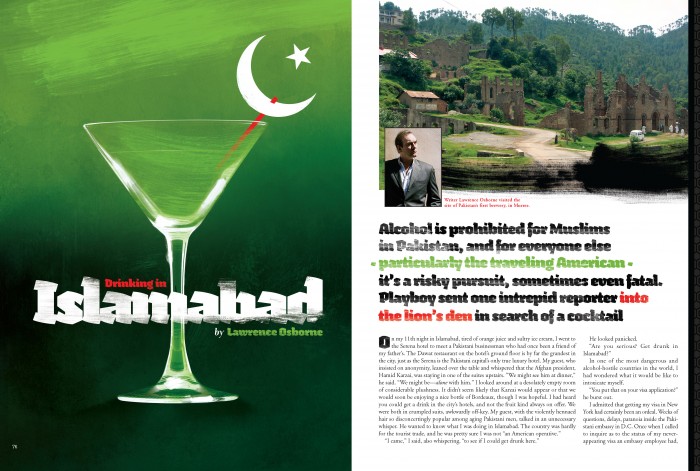
Drinking In Islamabad
July, 2010
Alcohol is prohibited for Muslims
y tte traveling American
* and for everyone
it's a risky pursuit* sonietimcs mwn fatal^ Playboy scut one intrepid reporter into the lion's dot in search of a cocktail
O
n my 1 lth night in Islamabad, tired of orange juice and sultry ice cream, I went to the Serena hotel to meet a Pakistani businessman who had once been a friend of my father's. The Dawat restaurant on the hotel's ground floor is by far the grandest in the city, just as the Serena is the Pakistani capital's only true luxury hotel. My guest, who insisted on anonymity, leaned over the table and whispered that the Afghan president, Hamid Karzai, was staying in one of the suites upstairs. "We might see him at dinner," he said. "We might be—alone with him." I looked around at a desolately empty room of considerable plushness. It didn't seem likely that Karzai would appear or that we would soon be enjoying a nice bottle of Bordeaux, though I was hopeful. I had heard you could get a drink in the city's hotels, and not the fruit kind always on offer. We were both in crumpled suits, awkwardly off-key. My guest, with the violently hennaed hair so disconcertingly popular among aging Pakistani men, talked in an unnecessary whisper. He wanted to know what I was doing in Islamabad. The country was hardly for the tourist trade, and he was pretty sure I was not "an American operative." "I came," I said, also whispering, "to see if I could get drunk here."
He looked panicked.
"Are you serious? Get drunk in Islamabad?"
In one of the most dangerous and alcohol-hostile countries in the world, I had wondered what it would be like to intoxicate myself.
"You put that on your visa application?" he burst out.
I admitted that getting my visa in New York had certainly been an ordeal. Weeks of questions, delays, paranoia inside the Pakistani embassy in D.C. Once when I called to inquire as to the status of my never-appearing visa an embassy employee had,
after a polite altercation and a few expressions of frustration, screamed at me, "We don't have your passport! Go away now!"
My guest laughed.
"Yes, I see. They thought you were a visiting alcoholic."
"I am a visiting alcoholic," I said.
From a palatial marble lobby came the sound of a lonely pianist struggling with die simple tunes of "Love Story," which echoed over and over through the Serenas glass-bright arcades and salons, which were lit with chandeliers but never seemed to fill. Seedy-looking Americans sat in corners glued to their cell phones, also frantically whispering, also in crumpled suits, and a man in a red turban stood by the outer doors, ready for trouble. They say the CIA is in fact fond of the place. Surprisingly, it hasn't been bombed yet, but terrorists are patient people.
With the rise of Islamic militancy, bars are increasingly obvious targets across the Muslim world, and for years, with a grim fascination I have been following the mass murder of humble tipplers in suicide attacks from Bali to Islamabad itself. When the Marriott hotel in Pakistan's capital was destroyed by a suicide truck bomber on September 20, 2008, more than 50 people were killed and more than 260 seriously injured. No one doubted that the Marriott's famous bar and its long-standing association with alcohol were among the reasons it was hit so viciously.
I remember once having lunch with the
Lebanese Druze warlord Walid Jumblatt at his castle in the Shuf mountains outside Beirut. Jumblatt makes wine and is a great wine lover, and during our conversation he pointed through the window in the direction of Hezbollah's nearest stronghold.
"They are surrounding us in order to cut off the water to our vineyards. It's the alcohol that they hate. They're going to make us dry. That's the radical fantasy."
It's a hatred that is gaining intensity. The Al Qaeda-linked Jemaah Islamiyah terrorist group in Indonesia bombed the JW Marriott in Jakarta twice, first in 2003 and then on July 17, 2009, and like the Marriott in Islamabad, the JW in Jakarta was famous for its flashy socialite bar. Eight dead. In 2002 the same group detonated two bombs inside Paddy's Pub and the Sari Club in Kuta, Bali, killing 202 people. In 2005 it repeated the stunt at a food court in Kuta and at some warungs (small outdoor restaurants often serving beer) at a Westerner-frequented beach town called Jimbaran. Twenty-six people were killed, many by shrapnel and ball bearings packed into the explosives. The perpetrators, later executed, called it justice.
There is therefore an undeniable thrill about getting liquored up in this part of the world. There is the very real possibilit)' that as you sit discreetly sipping your Bulgarian merlot from a plastic bag you will be instantly decapitated by a nail bomb. You may even be shot in the head for the simple crime of ingesting a substance— alcohol—given its name by the Arabs. Your chances of dying in this way are not astronomically high. Nor are they astronomically low.
The girls in saris brought us our hnnndi curries with exquisitely tense expressions, and I asked Mr. A if I could suggest— it was just an idea; I'd heard it could be arranged—a glass of wine.
His eyes opened wide.
"Glass of wine, nah?"
I also whispered.
"They can do it sometimes, no?"
"They can?"
He beckoned a waitress and spoke with her in Urdu.
"Wine?" she said to me in English.
"Just a glass."
The businessman began to squirm a little. The waitress leaned in to whisper, "We cannot. Not even in a plastic bag. How about a fresh strawberry juice?"
"Watermelon too, nah," the businessman suggested hopefully. "They call it natural Viagra."
"All right," I sighed. "I'll take a fresh
strawberry (continued on page 92)
Islamabad
(continued from page 78) juice. On the rocks."
The waitress whispered even lower.
"Sir, there is a bar downstairs. You can go after dinner."
"Bar?" the businessman hissed.
"Yes, sir. There is a bar. In the basement."
When she had gone, my friend frowned.
"It may be true. But it may not be true. I cannot come with you either way. They will never allow a Muslim in. I would be arrested."
I asked him what the punishment would be if he were caught sipping a Guinness with me in the Serena bar.
"It depends, nan," he said glumly. "It could be prison."
Islamabad is the capital of a nation of 175 million people and itself a city of about a million. And yet, my companion assured me, the number of places where you could get a drink could be numbered on the fingers of one hand. By my reckoning there were three open bars in the entire city and only about 60 outlets for alcohol in the entire country. Aside from the secret basement bar of the Serena, there was a bar called Rumors in the Marriott hotel, which was bombed by Islamic militants in September 2008. And there was reputedly a bar in the Best Western, though he had never been there. Outside the city there was a luxury hotel in the hill station of Murree called the Pearl Continental, where—again, according to rumor—there was a bar that enjoyed views of the snowcapped mountains of Kashmir. He had heard of a friend of his enjoying a gin and tonic there, once upon a time. There was also a bar, he added, in Islamabad's alter-ego twin city, Rawalpindi, in a hotel gloriously named the Klashman. But the minister of tourism had vindictively closed it down.
The noose was tightening around the city's bar culture. There were bars of sorts inside some of the foreign embassies, but they were accessible only to the diplomatic corps. There was a UN Club, with access similarly restricted, and there was an Italian restaurant called Luna Caprese, popular with Westerners, where, as dark gossip had it, the stall'would bring you a glass of wine from a bottle liidden inside a plastic bag. They wouldn't show you the label, but they would pour you a glass and you would pay for it separately so it didn't show up on the restaurant's books.
"Is it popular?" I asked.
He looked infinitely sad.
"It was—until it was bombed."
After dinner my friend made a rather desperate gesture with his hand and walked off, wishing me a "pleasant drink." I doubled back through the echoing arcades to a grand staircase near the Dawat which plunged down into an altogether different part of the hotel. There was not a soul there. I went down, slipping on the polished marble, and as I came into the immense underground galleiy a rather magnificent figure suddenly appealed, a
bellboy of sorts done up in a beautiful white uniform with gloves and a turban.
"Where," I whispered, "is the bar?"
"Bar, sir? Bar is here."
And he executed a flourish indicating a pair of doors around the corner. I thanked him, and he bowed, moving with glacial elegance up the staircase. I looked around to make sure I was alone, a pervert approaching his darkest desire, and moved quickly up to the unmarked doors. I pushed the doors and they merely rattled: The handles were tied together with a padlk them, but they didn't yield. It was not even nine p.m., and I realized it was going to be a long night of strawberry juices.
A few nights later I went to the Marriott because I had a hankering for a gin and tonic and it appeared to be the only bar in town that was dependably open at nine p.m. The hotel has now been completely rebuilt and is surrounded by soldiers and roadblocks—those sad concrete barriers you see all over Islamabad, covered with stickers for Vac motor oil and a thing called lasty. Inside, the Marriott lobby, garnished with fish tanks, Punjabi art and box-shaped fountains, was nervously half alive, its opulent coffee shop filled with Saudis planted stiffly in front of slabs of nonalcoholic cake. I went through to the Jason steakhouse. No one was there. I ordered a steak and then asked—with my usual delicacy—if I could get a bottle of wine.
"I'll ask," the waiter said.
He came back with a black plastic bag with the top of a wine bottle sticking out of it. It was the red.
"And the white?"
"Not recommended, sir."
I asked what this one was. He leaned down to whisper in my ear.
"Greek shira/., sir."
The Marriott chain is a symbol of American imperialism across the Muslim world, but as I have suggested, Rumors had made this one so offensive to militants. This was the bar I repaired to after my steak and my glass of rancid Greek shira/ (the waiter wouldn't show me the label). A bellboy led me there, down an immense lonely corridor and a flight of stairs, turning left at a desolate landing with a lone chandelier and down yet another flight of steps. At the bottom, like an S&M club buried under the sidewalk, was the neon sign for Rumors. The entrance doors were shielded by security cameras designed to pick up errant Pakistanis. "This is bar," the boy whispered firmly. This time the door opened.
I went in, expecting a riotous speakeasy filled with drunken CIA men and off-duty marines, perhaps abetted—I was hoping— by a smattering of loose Pakistani Hindu women. But no such luck. There was, as always, no one there. I took in the fabric walls, the fringed seats, the two pool tables and the foosball, as well as the dart board next to a plasma TV playing an episode of the British sitcom EastEriders. It was veiy
British and homey-pub, and a barman in a waistcoat stood at his post cleaning beer glasses and watching me with great interest. There are moments when your thoughts turn to David Lynch. It turned out he was Muslim and had never tasted the nectar of Satan even once. He made a mean gin and tonic, however, and I asked him about the security cameras by the doors. lie was happy to discuss them.
"We are catching those blighters every week," he muttered, shaking his head. "Muslims coming in for a drink. We see them on the screen, sir, so they cannot succeed."
Blighters? I thought.
"And what happens to them?"
"Kjecting, sir. We are ejecting. Sometimes police are called."
Alcohol has been banned for Muslims in Pakistan since 1977. A Muslim patron even Hying to open the door of a hotel bar—as the barman intimated—will be asked for his ID, refused entry and possibly prosecuted for the attempt. Non-Muslim foreigners can enter, and so can the "unbelievers"— five percent of the Pakistani population (Hindus, Parsis, Christians)^—who are asked to present both ID and a permit book in which their monthly permitted alcohol quota is registered. They are usually allowed six quarts of distilled liquor or 20 bottles of beer a month.
I asked him about the bombing in 2008.
"No one knows who did it. Osama bin Laden maybe. RDX bomb, sir." RDX packed with TNT and mortar.
"Are you afraid to work here?"
"No, sir." But his face said otherwise.
It was said that 30 American marines about to drop into Afghanistan were staying at the hotel the night of the bombing, as well as an unspecified number of senior CIA officers. (A Navy cryptologic technician named Matthew O'Bryant working with the Navy Information Operations Command was killed.) I looked down at the pulsating stars on the dance floor and wondered when that floor was last crowded with revelers. The barman said that in fact the bar was often full. Monday, he said proudly, was their busiest night.
"But," I said, "it's Monday night tonight."
A twitch. "Yes, sir."
At that moment the power went out. The barman lit a match and we stared at each other across the bar in total darkness. Monday night at Islamabad's hottest spot. He managed a fatalistic smile.
Perhaps every bar is now a potential target. Nobody knows who masterminded that immense explosion heard miles away—Al Qaeda, an obscure group called Ilarkat-ul-Jihad-al-Islami, a group known as the Fedayeen Islam?—and no one ever will. U.S. officials have stated they believe the bombing was masterminded by llsama al-Kini, Al Qaeda's operations chief in Pakistan, who was himself killed by a drone missile strike in January 2009. In a sense, it doesn't matter. Modern 1960s Islamabad, Pakistan's Brasilia, sits on the fault line of a lethal culture war. There were many reasons to hit the Marriott, and
its association with booze was certainly one of them. Not only does the Marriott house a famous bar, it also offers a curious Pakistani institution known as a permit room.
A permit room is an unmarked liquor store sometimes tucked away at the back of a top-end hotel. Suitable foreigners or Pakistanis armed with a permit book can creep around to this secretive facility, buy bottles of vodka and Murree beer and take them back to their room. The one at the Marriott is next to a laundry around the corner from the main entrance. Surrounded as it is by sandbags and armed guards, you would never see it unless you were directed there explicitly. I've bought bottles of scotch there and then had to do a kind of walk of shame as I hauled my boozy loot back to the main road, the Pakistani soldiers glaring at me with barely concealed disdain. It's like buying unwrapped pornography in a Walmart Supercenter in Salt Lake City.
As I sipped my over-iced gin and tonic and watched EastEnders I thought back on all the bars I had frequented in Islamic cities: in Cairo, in Beirut, in Amman, in Marrakech. Drink flowed there. But in Riyadh, Kuwait City, Tripoli, Tehran and here it didn't. A divide ran through the Islamic world on the violent issue of drink. Alcohol, it is true, is mentioned three times in the Koran, and its use is frowned upon. But the hostility to wine in the holy book, if stern, does not seem especially ferocious. It is drunkenness, rather than alcohol per se, that seems to provoke the Prophet's ire. The first mention of wine in the Koran's traditional chronology, in the sura known as "The Cow," is this: "They ask you about drinking and gambling. Say: "There is great harm in both, although they have some benefits for the people; but their harm is far greater than their benefit.'"(2:219)
Pakistan was not always hostile to drink. When it became independent after partition from India in 1947 it was still a country where alcohol was legal, as it had been under the British. Indeed the revered founding
father of Pakistan, the British-educated lawyer Muhammad Ah finnah, known in Pakistan as Qaid-i-Azam, or "Great Leader," who died in 1948, is widely thought to have drunk alcohol until he renounced it at the end of his life, though no bks published in Pakistan may mention the fact or even suggest it as a rumor (he was also reputed to eat pork). Alcohol was more or less freely sold and consumed from 1947 until 1977, when Prime Minister Zulfikar Ali Bhutto, anxious to appease the country's religious leaders, outlawed it not long before he was himself removed from power in a coup by General Mohammad Zia ul-IIaq.
Zia allowed alcohol to be sold to non-Muslims, but the ban for Muslims stuck. The prescribed punishment for infringement was flogging and often imprisonment. Pakistan had suddenly gone dry, and Zia's overall determination to Islami/.e Pakistan made that fact permanent. As Zia supported the mujahideen in Afghanistan during the Soviet occupation in the 1980s, a gradual conversion of the country from secular British common law to sharia religious law was set in motion by the American-backed dictator, who apart from privatizing much of the economy also instituted Islamic hudood laws whereby a person convicted of theft can have his hands and feet amputated. Alcohol would never return—officially.
In reality alcohol pours illegally into Pakistan from all sides. It flows in from China and through the port of Karachi, ensuring bootleg vodka, gin and scotch can be found ubiquitously in private homes and at private parties. Bootleg wallahs operate in all the big cities, plying the well-off with contraband liquor. Johnnie Walker is, as it is everywhere in Asia, as desirable a brand as Clued, a symbol of an entire way of life, and consumed with the same relish we reserve for cocaine. The poor, meanwhile, gorge on moonshine.
In September 2007 more than 40 people died in the slums of Karachi from drinking toxic homemade moonshine, an incident
that scandalized the country. The producer of the lethal brew was a cop, as was one of the victims. The press wrung its hands, and legislators began to ask if the suppression of alcohol might not be connected to the rise of drug addiction in the young. A treasury member called Ali Akbar Wains made the argument publicly after the parliamentary secretary for narcotics had told the lower house of the parliament that there were now 4 million addicts in the country. Parliamentary Affairs Minister Sher Afgan Nia/.i stated for the record, "It is a fact that restrictions on liquor have resulted in a surge in the use of deadly drugs in Pakistan." But the problem precisely is that alcohol is not just a drug.
It is a symbol of the West, a tool of Satan that denatures the true believer; it is also ass
A 2006 article in Der Spiegel put it bluntly: "The front line of the struggle against fundamentalism in Pakistan isn't in the mountainous border regions. It's in the country's permit rooms. Alcohol is sold there—and customers dream of the West."
Nowhere in Pakistan is this more evident than in the one place where it is legal to have a nip of Satanic distillate: the Mur-ree Brewery in Rawalpindi. The brewery, among the first in Asia, was founded in I860 by the British to produce beer for the British troops stationed in Rawalpindi. Murree was high in the hills, and in the age before refrigeration its location was ideal. With the coming of cooling technologies around 1910 the British moved it down to Rawalpindi, where it stands today. Rawalpindi, meanwhile, became the headquarters of the Pakistani army as well—and a sprawling, dangerous city filled with radicals. On December 4, 2009 four suicide attackers stormed a mosque used by the Pakistani army and killed 36 civilians (including children) and several military officials. The Taliban claimed responsibility. To put it mildly, it's a bad neighborhood to be making beer and flavored vodka.
The Bhandara family, who are Parsis, took ownership of the brewery at the start of the 1960s when they bought majority shares in the company. The present owner is Isphanyar, whose celebrated father, Minoo, ran the brewery for decades; Minoo, who died in 2008, was the brother of the noted novelist Bapsi Sidhwa, a remarkable writer afflicted by polio who wrote The Crow Eaters, a beautiful book I read years ago. They are a cultured, literary family and because they are Parsis are allowed to run a plant that produces a bewildering variety of drink. Aside from all the vodkas and gins, they malt their own whiskey as well as turn out Pakistan's most famous beer, Murree. The beer's slogan is known everywhere even though only five percent of the population can drink it: "Drink and make Murree!"
Isphanyar is one of" those youngish Pakistani go-getters who never seem to be able to sit still for a moment, as if everything needs to be done instantly in case—for some mysterious reason—it's too late. I met him in his office at the brewery, where he sat restlessly behind a huge desk, blinking, pressing buzzers and bells and casting a watchful eye on the video security monitors. lie wore a ring on each hand, a pink striped shirt, a Rolex. The walls were hung with regimental British Raj calendars that featured vignettes of mounted hussars, and the desk itself was dotted with garish little coasters showing Pheasants of Pakistan. A small desk sign read don't quit.
In wall cases stood rows of Murree products: Kinoo Orange Vodka, citrus and strawbeny gin, Vat No. 1 whiskey, clear rum and beers. There were also the fruit juices and fruit malts that Murree sells to Muslims, foremost among them a thing called Bigg Apple. When Isphanyar spoke rapidly on the phone his Urdu was mixed with urgently crisp English words: maximize, incen-livize, target and then Look after him! From time to time he paused to sweep a deodorant stick into his armpits and laughed a little nervously. He was handsome, quick and on edge. I asked him if running a brewery in the world epicenter of Islamic extremism bothered him. Or worse.
"Bothered?" he asked.
"Well, is it perilous for you?"
"All I can say is we tiy to keep a low profile. I don't want my children to be kidnapped."
He pressed another buzzer. There was a whiff of Willy Wonka's Chocolate Factory, of delirious energy. "Strawbeny juice?" he whispered into the intercom. "To Peshawar?"
He twiddled a pen and looked momentarily distracted as underlings came in and out. I then observed how strange it was that a brewery in Pakistan could not sell anything to the vast bulk of the population, nor could it export. But this seemed self-evident to him.
"We cannot very well put made in hie
ISLAMIC REPUBLIC OF PAKISTAN Oil Olir bottles
of vodka, can we? But between you and me, the non-Muslims in this country are not the big drinkers. It's one of the ironies of Pakistan." He smiled cattily and we were served a shot of Murree whiskey. To my surprise, it was excellent.
"What do you think?" he asked eagerly.
"It's veiy fine. Twenty-one years?"
"Our best. I will say, by the way, that it is widely enjoyed inside the country."
I had noticed that the brewery lies at the end of an unmarked track along an unmarked road, as invisible as such a large facility can be. It was protected by high walls and the usual armed guards. Ex-president Pei"vez Musharraf's house was nearby. It was like a town within a town, its dark red British brick, mostly from the 1940s, lending it a somber elegance of line. The air was thick with the sweetish smells of the whiskey malting plant. As he led me outside, Isphanyar reflected on the volatility of the society to which he is, in effect, the leading supplier of a religiously outlawed intoxicant.
"The Muslim attitude is getting harder. Liquor, you see, is associated with a Western lifestyle, so it has become a flash point
of some kind. Muslim hostility to the Western way of life finds its focus in alcohol. Hatred is directed at alcohol because it's a symbol of corruption. But at the same time the extremists tolerate beheading, drugs, heroin and kidnapping, and they grow poppies. It's bewildering."
I was then taken around the malting and bottling plant. It's a self-contained production line: Baudin malt from Western Australia, Chinese bottling machines, Spanish labeling machines, cellars of Latin American oak casks that would not be out of place in Islay or Jerez. It was curious to watch the Muslim workers operating the labeling machine as rows of Nips bottles of Vat No. 1 came pouring out. What was going through their minds? The foreman showing me around reminded me—as we strolled past whitewashed whiskey casks, some of them dated 1987—that everything produced here had to be consumed inside the country. It was, to say the least, an enormous paradox. Five percent of 175 million is a fair number of drinkers, but it certainly could not account for all these casks.
A little later in the day I went to a tasting of new vodkas Murree is developing. The development meeting was attended by
six staff members headed by Muhaniniad faved, Murree's general manager, and each man gave each vodka a score on a piece of paper. I joined in. Some of them were highly refined, with a soft "fruit" and a sense of serious purpose. Serious vodka, then, for a nation of serious drinkers? Javed explained that they were Hying to develop v
"Of course," he added, nodding mischievously to the others, "we all know that non-Muslims buy it for Muslims. It's a thriving trade."
My mouth rinsed with vodka, and quite tipsy, I staggered across the courtyard to visit retired major Sabih-Ur-Rehman, who is, as his card explained, "special assistant to chief executive."
Rehman once participated in a study by the Customs department, which determined
about 110 million of drink was Ix-ing confiscated every year, suggesting the presence of an enormous alcoholic black market. For eveiy bottle confiscated, he told me, there were probably three in circulation. The study had put the value of the alcoholic black market in Pakistan at about $30 million. This, he added, was driven by non-Muslims selling to Muslims. A bottle of Johnnie Walker Black Label cost about 1,200 rupees in an airport duty-free shop, but its black market value was closer to 5,000 rupees.
"Moreover," he went on, "the biggest bars in the world are the bars of Islamabad households, I can assure you. The bootleggers who deliver to your house are almost never prosecuted. The police protect them. Veiy powerful people run this."
lie recalled that when he was in the army they had bars called wet clubs, though he was not sure they still existed. Either way, he was sure Pakistan was awash in booze, even if no one could admit it.
"I think people are drinking more, even if some figures show official consumption going down. We don't have alcoholism here per se. What we have is something else: It's that alcohol has glamour. It's desirable because it's forbidden fruit. That's the logic of human nature. By the way, did you try our pineapple vodka?"
What a shame, he implied, that the company couldn't export it to the West.
"And before you leave I'll give you a bottle of our whiskey and some other things. Take it to a non-Muslim party if you are ever invited." lie smiled and jiggled his head.
Later, as I was driving back to F-6 in Islamabad, I took out the beer, a lx>ttle of strawberry gin and the Gymkhana blended malt whiskey they had given me and looked at the pretty labels. I felt like a heroin trafficker, though technically I was doing nothing illegal. I drank them alone in my room that night, sitting on a terrace filled with crows and listening to muezzins competing in the dark. It was, in a sense, like drinking alone at a bar when you have no one to talk to. I tried the strawberry gin, assuming it would be too strange to stomach, and found instead that it was childishly comforting, well-made as if by people who knew its charms inside out. I would never have drunk it anywhere else. But it was a supremely delicious drink at that moment, and as I lay on my Spartan bed listening to the name of God ringing through empty streets I felt a subtle intoxication reaching the ends of my lingers and the tip of my nose. A Pakistani fruit gin. What could be more seditious?
A week later my hennaed friend got me an invite to a private party not far from where I was staying in F-6. I decided to bring my bottle of Gymkhana as a present, carefully disguised in a paper bag. The home of the affluent hosts—anxious as always about their anonymity—was one of the low, flat-roofed white villas surrounded by dry gardens and high walls that seem to make up most of Islamabad's housing stock. Inside, behind the discreet high doors and shutters, the house was filled with a mixture of Islamic art and reproduction Louis XV chairs, with cut-glass ashtrays and leather poufs
and Kashmiri rugs. It was an older crowd dressed in Shetland sweaters and tailored shirts, businessmen and import-export men and their impeccable wives, and at one end of the long front room stood a little bar with a server in a bow tie. lie was pouring tumblers of Black Label and imported cognac, and the men were sipping from them as they sat in the Versailles chairs, assured that they were behind closed doors and that everyone knew everyone
My friend made me relate to the company a trip I had made the day before to Murree, the original site of the brewery now in Rawalpindi. I had driven two hours out of Islamabad to the old British hill station and visited the 150-year-old brewery ruins, Victorian picturesque, the abandoned British church now surrounded by barbed wire, and finally the Pearl Continental hotel, where I had had an eerie lunch overlooking the snowcaps of Kashmir.
"Is there still a bar there?" they asked.
Well, I said, that depends on what you call a bar. After lunch I had asked the staff where the bar was—it was by now a familiar exercise—and they had told me it was outside and on the ground floor, next to the swimming pool. Oil" I went. Alter a half-hour search I eventually found an obscure unmarked door with a glass window that looked like the entrance to a storage room. I knocked. A panicked face quickly appeared on the far side of the glass. We gestured to each other, I upending a glass to my lips, he wagging his linger in a frantic negative. End result: no drink.
"All," they said, jiggling their heads, "we're glad there's still a bar at the Pearl Continental!"
They said it as if civilization had not yet fallen to the Huns, and I had no idea what they meant. I opened my bottle of Gymkhana, observing that it was good to drink something local instead of the ubiquitous Black Label, and this was greeted with a chorus of approval. We poured it out. It was not Murree's top whiskey, but I thought it was a pretty good drink all the same. I noticed that everyone licked their lips contemplatively and stared down into their glasses for a moment. Was it a drink they knew so well that each bottle had to be savored for minute differences from the last one? Someone put the music of Rabbi Sliergill (a Punjabi techno-pop star) in the CD player, and soon half the room was dancing, some of the men still holding their tumblers oi'Cymkhana aloft and twirling their women around. I recognized the song, "Bulla Ki Jaana," at once because it was a number one hit in India, a beautiful techno rendering of a mystic Sufic poem by Bulleli Shah, the 18th century Punjabi poet buried in Pakistan. Bulleh writes that he is "not the believer in the mosque," that he is neither Hindu nor Muslim nor Parsi and that indeed he does not know who he is or what he is. Shergill's lyrical video of the song comes across as a plea for peace and tolerance in the Sufic spirit, all strung along on the rhythms of global dance music.
"It reminds us," one of the women said, "that Pakistan was once a Hindu, a Buddhist,
a Sufi culture, and that all of those things are still in us somewhere."
Did the Sufis drink? Did wine once flow through these parched hills when Bulleh Shah was alive? It was unclear. In the present moment the alcohol seemed to have gently spread through the whole gathering, bringing everyone to life. A man waddled up to me and collapsed on the same sofa. lie was clearly mildly intoxicated and he was enjoying it. He could say things he could later disown.
"This country is fucked," he said simply in English, looking me dead in the eye and smiling. "We're going to be run by a bunch of clerics one day. We're going down the drain, down the drain."
I looked down and saw that the bottles on the coffee table were all empty. The barman was mixing cocktails—margaritas, as far as I could tell, with salted rims— and it was already long past midnight. The Koran had been forgotten, or shall we say revisited, and I picked out the strange words from the music, words written by a Muslim who had disavowed the religious orthodoxy of his day. They cut through the pessimism of the man who had fallen asleep beside me and livened the hips of the people dancing to Shergill:
Not in tfie holy Vedas, am I Nor in opium, neitfier in wine, Not in tile drunkard's craze Neither awake, nor in a sleeping daze Bulleh! To me, I am not known.
ltteve is fthe veal possibilet^ that as you sit sipping your mevlot you will be inst^ntSy decapitated fay a ma& bcrob.
I felt like a heroin trafficker,
though technically I was
doing nothing illegal. I
drank alone in my room that
night, listening to muezzins
competing in the dark.


Search results will appear here...