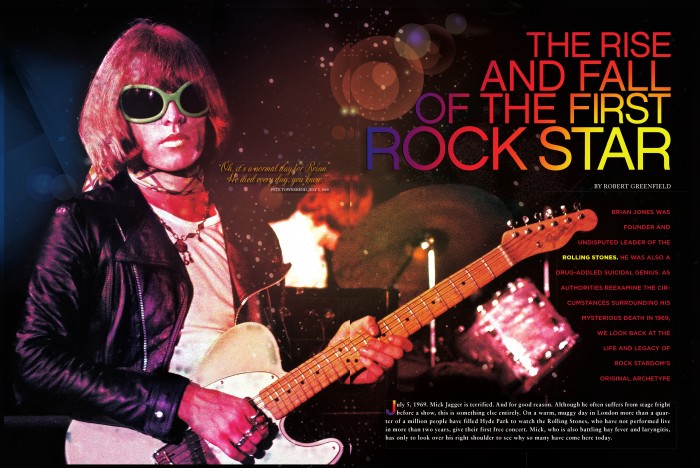
The Rise And Fall Of The First Rock Star
March, 2010
BRIAN JONES WAS
FOUNDER AND
UNDISPUTED LEADER OF THE
ROLLING STONES. HE WAS ALSO A
DRUG-ADDLED SUICIDAL GENIUS. AS
AUTHORITIES REEXAMINE THE CIR-
CUMSTANCES SURROUNDING HIS
MYSTERIOUS DEATH IN 1969,
WE LOOK BACK AT THE
LIFE AND LEGACY OF
ROCK STARDOM'S
ORIGINAL ARCHETYPE
uly 5, 1969. Mick Jagger is terrified. And for good reason. Although he often suffers from stage fright . before a show, this is something else entirely. On a warm, muggy day in London more than a quarter of a million people have filled Hyde Park to watch the Rolling Stones, who have not performed live in more than two years, give their first free concert. Mick, who is also battling hay fever and laryngitis, has only to look over his right shoulder to see why so many have come here today.
"Why don't we just stay home and read a good book...?"
From a large photograph on the back wall of the stage, Brian Jones peers at the crowd with his perfectly pleated blond hair in his eyes and a tight smile on his fine-boned face. Just two nights ago the man who founded the Rolling Stones and always liked to refer to himself as "the undisputed leader" of the band was found dead in his swimming pool at the age of 27. And so this concert has become a memorial for him.
As the crowd cries out for the Stones
to start playing, Mick steps to the micro
phone. Barefoot in a long white frock
with billowing sleeves and a gold-
studded leather collar around his neck,
he looks like a troubadour from the days
of old. In his hands he holds a book. He
tries to quiet the crowd by telling them
he wants to say something for Brian.
Astonishingly, Mick begins to read from
"Adonais," the poem Percy Bysshe Shel
ley wrote on hearing news of John Keats's
death at the age of 25. "Peace, peace! he
is not dead, he doth not sleep—/He hath
awakened from the dream of life "
As Mick reads, more than 3,000 butterflies that have been kept in cardboard boxes for hours at the side of the stage are set free. In a fitting analogy for the life Brian Jones led, many of the butterflies flutter briefly into the warm summer air only to then fall dead to the ground. With Mick Taylor—Brian's replacement—on guitar, the Stones go into their set.
Like the ghost of Hamlet's father, Brian Jones has somehow managed to make his way onstage today, which is just the way he would have wanted it. Insofar as the Rolling Stones and everything they have wrought upon this world are concerned, it all begins with him.
Forty-one years after his death, the ghost of Brian Jones is in the news again. In 2009, authorities in England began reviewing the evidence of his death, a prelude to possibly reopening their initial investigation. His body may soon be exhumed, and the cause of death listed on the coroner's report— "death by misadventure"—may be changed to homicide.
A musical genius who was tormented by demons, Brian created the doomed rock-star persona that has now become a media cliche. While Jerry Lee Lewis and Chuck Berry had the attitude before him and too many great musicians who died before they got old followed in his wake, Brian Jones was the prototype. No one ever did it all with his kind of style, grace
5i9
and madness. Along the way, he also created the Rolling Stones, |n''
"the world's greatest rock-and-roll band." »?'.¦*
Saturday night, April 7, 1962. A dank basement club near the Ealing Broadway tube station in west London. The crowd is mostly male and distinctly weird. Blues purists in hooded parkas have come to see Alexis Korner and Blues Incorporated, featuring Cyril Davies, a hard-drinking auto-body repairman who can bend notes on his harmonica like he was using a pair of pliers.
In the crowd are Keith Richards—an unhealthy-looking, rail-thin 18-year-oid working-class kid who will soon drop out of art school—and his new best friend, Mick Jagger, whom some people still call Mike. Also 18, and a student at the prestigious London School of Economics, Mick comes from a far more prosperous background than Keith and has borrowed his father's car for the 90-minute drive here tonight.
Although Mick and Keith have known each other on and off for years, they became inseparable a few months ago when they ran into each other on a train platform on their way to school. Mick was carrying a copy of a Chuck Berry record Keith had never seen before, and the two began to talk. They then started playing music together and are now so close that some people have trouble telling them apart.
Before Blues Incorporated ends its set, the band customarily invites guest artists onstage to jam. Alexis Korner introduces a person no one in the crowd has heard of. "This is Elmo Lewis," he says. "He's come from Cheltenham to play for you."
And there he sits—20-year-old Brian Jones with a stage name he made up for this gig, hunched over his guitar on a stool with a piece of pipe he
1
found in a garage and cut to fit his finger as a slide. Launching into "Dust My Broom" by Mississippi bluesman Elmore James, Brian starts playing like he just came out of some cotton field in the Delta rather than from Cheltenham, a genteel spa town where little old ladies still sip tea at four each afternoon with their pinkies curled properly in the air. As far as Keith and Mick are concerned, this guy is Elmore James.
After the show, Mick and Keith introduce themselves to Brian. Right from the start a weird chemistry develops among them that even they will never really understand. The bond becomes stronger when Mick and Keith turn
Brian on to Chuck Berry. "Look," Keith tells Brian, "it's all the same shit, man, and you can do it."
Brian is soon forced to make a choice. He can either play the real blues with musicians who are actually working for a living or he can waste his time with two skinny wannabe rock-and-rollers. "Fuck off, you bastards," he tells those who want him to stay with Blues Incorporated. "You're a load of shit, and I'm going to get it together with these cats."
And there it is. The life-changing (continued on page 118)
BRIAN JONES
(continued from page 51) moment that alters the history of rock, setting the stage for the creation of the band that becomes the Rolling Stones. Or as they were known back then, Brian Jones and the Rollin' Stones.
Winter 1962-1963. Because they are broke and have no other choice, Brian, Keith and Mick are forced to live together in an awful flat on Edith Grove in World's End, a disreputable working-class neighborhood in London. Surrounded by the stink of rot and mildew, with unwashed dishes piled in the sink and dirty laundry everywhere, Brian and Keith play together for hours in their freezing-cold flat, trying to get their guitars to blend as one as only the Everly Brothers have ever done before.
Brian and Keith have already been told they are losers headed directly for skid row. Living like punks long before the movement comes into existence, they regularly steal food to survive. Mick and Keith soon realize Brian is a musical genius who can play any instrument. One night Keith comes back to the flat to discover Brian blowing the blues on a mouth harp. Somehow he has taught himself how to do this in a single day. But even to Keith, Brian can sometimes seem distinctly weird. The life Brian has led to this point makes everything Mick and Keith have done appear tame by comparison.
After Brian's younger sister died of leukemia at the age of two, Brian's father, an aeronautical engineer, and his mother, a piano teacher, told him his sister had been sent away for being naughty. Brian, a strange child who once dyed their house cat blue with food coloring, suffered from the croup when he was four and later developed a severe case of asthma. Even as a child he had the sense he would never live to see 30.
When Brian was six years old, he began taking piano lessons from his mother. Unlike Mick and Keith, he learned to read music and was playing Bach and Chopin on piano before switching to the clarinet and alto sax as a teenager. By the time Brian met Mick and Keith, he had already fathered at least one illegitimate child (and would father as many as five more before his death) and had been disowned by his parents.
"Brian was so far ahead of them," singer Marianne Faithfull would later note. "Mick and Keith were still schoolboys. Brian was the one who did the hustling, getting people together and believing it, knowing it, unlike Mick, who couldn't make up his mind whether he wanted to be an accountant. Brian was the one saying, 'Look, it's going to happen!'"
At Edith Grove, Brian comes up with the name of the band. Down to pennies, with the water and gas in the flat cut off, Brian callsyazz News to place an advertisement for the band's first show. Asked for the name of his group, a clueless Brian sees a Muddy Waters album lying nearby with a track on
it entitled "Rollin' Stone" and blurts out, "The Rollin' Stones."
With Charlie Watts (formerly with Blues Incorporated) on drums, Bill Wyman on bass and Ian Stewart playing barrelhouse piano, the Rollin' Stones begin appearing regularly at the Crawdaddy Club in Richmond. Playing songs by Muddy Waters and Chuck Berry, as well as 20-minute versions of "Doing the Crawdaddy" and "Pretty Thing" by Bo Diddley, the Stones mesmerize the art-student crowd. Soon 400 people stand in line to see the hottest new band in London.
1963-1964. In May, Brian signs a disastrous three-year management and recording deal with Eric Easton and Andrew Oldham— whom Keith will later call "a sharp fucker and a right little gangster"—giving them 25 percent of all the money the group will earn. At a nearby tea shop where Mick and Keith are waiting, Brian delivers the news, neglecting to tell them that as the leader of the band he has negotiated an extra five pounds a week for himself. He also informs Ian Stewart that he is no longer an official member of the band but can still play with them onstage if he continues driving them to gigs.
When the Stones go into the studio to record for the first time, Brian tells the engineer exactly what he wants and how everything should sound. The Stones cut "Come On" by Chuck Berry with "I Want to Be Loved" by Muddy Waters on the B-side. The single stays on the charts for four months.
Working nonstop, the Stones begin playing church halls all over England. During the fall of 1963 they spend six weeks on the road with Little Richard, Bo Diddley and the Everly Brothers. Demonstrating an attitude Johnny Rotten and Pete Doherty will later do their best to emulate, Brian picks fights with drunken male fans. When the Stones learn Brian is being paid five pounds more a week, Keith goes mad.
"We don't need a bloody leader," he tells Brian. "We need to take that extra five quid a week and use it to fix our bloody amps, Brian, and you're a cunt for taking the money and never telling us about it." By then, the struggle for power within the band is already in full sway.
As the Stones begin their rise to bad-boy stardom in England as the dark counterpart to the cute and cuddly Beatles, Mick and Keith begin writing together and come up with one hit song after another. No matter how hard Brian tries, he cannot do the same. As Keith will later say, "Brian would become uptight about that because he couldn't write. He couldn't even ask us if he could come and try to write something with us."
To increase his hold over the band, Andrew Oldham pushes Keith to replace Brian as Mick's backup singer. In the studio, Oldham sometimes turns off Brian's microphone when the Stones are recording and then fades Brian's instrument during playback. Despite it all, Brian remains a consummate musician. "When he wanted to play," Keith will later say, "he could play his ass off, that cat." Getting him to do so, however, becomes more and more difficult with each passing day.
In May 1964, Brian goes to see a friend in the English countryside. Complaining
"How do I know it's mine?"
that no one in the band listens to him anymore, he says, "I'm fed up—this will show them." Grabbing a knife, he slashes his wrist. The cut is just a scratch, but Brian then throws himself out a window in a futile attempt to commit suicide only to find himself lying in the bushes.
By 1966, Brian is mixing uppers and downers while also smoking dope, drinking a bottle and a half of whiskey a day and doing amyl nitrite poppers. Not surprisingly, he begins to suffer serious bouts of paranoia. Unable to write new material as Mick and Keith do after shows when the band is
on the road, Brian begins hanging out with people the other Stones do not know. While jamming with Bob Dylan in New York, Brian plays mouth harp until his lips bleed. Dylan asks him to join his band and then entitles "Like a Rolling Stone" for him.
Creating a look Mick and Keith as well as Jimi Hendrix will later appropriate, Brian dresses as no one in rock has ever done before. Wearing a Day-Glo sequined collar, a bracelet made of watermelon seeds and lavender suede boots, he steps from his New York hotel room early one morning in 1967 with blood still oozing through his
hair from where a girlfriend cracked open his head with a bottle the night before. Explaining the wound, Brian says, "Well, what do you expect from a pop star?"
"Brian got very fragile...his personality and physically," Keith Richards will later say. "I think all that touring did a lot to break him. We worked our asses off from 1963 to 1966, right through those years, nonstop.... For a start, people were always laying stuff on him because he was a Stone. And he'd try it. He'd take anything. Any other sort of trip, too; head trips. I le never had time to work it out 'cause we were on the road all the time, always on the plane the next day."
After a show in Munich one night, Brian meets the woman who will change not only his life but the future of the Rolling Stones as well.
September 14, 1965. A killer queen with a face and body that will soon land her roles on the big screen, Anita Pallenberg is 21 when she meets Brian. Born in Rome, she is fluent in four languages and has studied art. As Christopher Gibbs, the well-known London antiques dealer who becomes one of Brian and Anita's closest friends, will later say of her, "I think in a more gracious age Anita would have been called a witch." Brian spends his first night with Anita in tears, complaining about how Mick and Keith are treating him.
In London, Brian and Anita become the first omnisexual stoned-out power couple in the history of rock, the archetype for Sid and Nancy, Kurt and Courtney, and Pete Doherty and Kate Moss. Long before anyone has ever heard of gender-bending, Brian and Anita regularly wear each other's clothes and jewelry in public. Their private life is just as strange. Dressing Brian up as French folksinger Francoise Hardy, Anita pretends she is Brian and then seduces him. Blond and beautiful mirror images of each other, they are both accustomed to doing just as they please without having to face the consequences. In London, they can now be seen driving about in Brian's brand-new Rolls-Royce with the license plate nil 666 ("Devil's Disciple" followed by the mark of the beast from the Book of Revelations).
During the summer of 1966, when LSD becomes the drug of choice in England for those with enough time and money to expand their consciousness, Brian and Anita take acid together for the first time in their funky flat on Courtfield Road behind the Gloucester Park tube. With scarves draped over the lamps and the smell of hash smoke always in the air, the flat soon becomes the place to be for the hippest people in London—Christopher Gibbs, art dealer Robert Fraser, Marianne Faithfull, Guinness heir Tara Browne and his model girlfriend Suki Poitier among them.
Once Keith sees what Brian and Anita are into, he becomes a regular on the scene and is soon living in the flat as well, crashing on the couch as Brian and Anita loudly make love in their bedroom upstairs. Although Keith is always cool when tripping, Brian becomes so paranoid on acid that he curls up in a corner of the living room while everyone else is laughing uproariously. Stoned on
"Call me hard-hearted if you will, Watson—but I can't run the risk of the country being terrorized by Baskerville puppies...."
LSD, he hears voices in the plumbing. On the wall just above the pillows on his bed, he begins to paint a headstone. Although Brian never puts his name on it, everyone knows the stone is his.
Fascinated by the relationship of the Elizabethan lute to Delta blues, Brian sits on a stool in the studio one night in a floppy white hat with scarves wrapped round it, playing a melody he has come up with on the recorder. When Keith asks him to play it again, Brian does so perfectly. He then proudly explains it is a cross between a work by the 16th century composer John Dowland and a Skip James blues. More than anything in the world, Brian wants Keith to tell him how much he likes the melody. Busy working out the tune on piano so he and Mick can write lyrics for it, Keith never gives Brian the approval he so desperately craves. "Ruby Tuesday" becomes one of the most haunting songs the Stones ever record.
Winter 1967. Suffering from asthma and pneumonia, Brian observes his 25th birthday in a hospital in France as Keith and Anita, who have long been attracted to each other, spend their first night together. When Brian leaves the hospital, he sets off with Anita and Marianne Faithfull for Morocco. As soon as they board the plane, they all drop acid.
Mick soon joins the party at the fashionable El Minzah Hotel in Tangier. Brian, who now knows that Keith and Anita have been together, picks up a pair of tattooed Berber whores in the street, brings them back to his
hotel room and insists Anita have sex with them. When she refuses, Brian goes berserk. Without telling Brian, everyone else who has come to Morocco with him checks out of the hotel the next day, leaving him behind to pay the bill. Totally distraught, he flies home alone in bedraggled lace and tattered velvet.
As Keith will later say, 'Just because a chick leaves somebody to go with somebody else is no reason to feel guilty. It could have been someone 12,000 miles away, but it happened to be the guy who stood on the other side of Mick onstage. And that was that."
Completely loaded one night, Brian returns to the flat on Courtfield Road, which he now shares with two beautiful lesbians whom he hates, and drops acid. Stoned out of his mind and weeping, he cuts up the tapes of the music he composed. After waking the next morning surrounded by yards and yards of tangled tape, he does some cocaine with his coffee and then slams his Rolls-Royce into a brick wall.
"They took my music," he says of Mick and Keith. "They took my band, and now they've taken my love." And then, when Brian is at his weakest, the law comes in to finish him off.
May 1967. Twelve detectives raid Brian's flat on Courtfield Road and find enough hash for seven to 10 joints, as well as some cocaine. By the time Brian is led into the Kensington police station, television cameras are already there to record his arrest. After being remanded on bail, Brian sends his parents a telegram that reads, "Please
don't worry. Don't jump to nasty conclusions, and don't judge me too harshly. All my love, Brian."
Instructed by his solicitors not to talk to the other Rolling Stones, Brian is terrified he will be sent to jail. Impulsively, he flies to the Monterey Pop Festival. Tripping, he walks onstage to introduce a new sensation named Jimi Hendrix to the crowd as "the most exciting guitarist I've ever heard." This is what Mick and Keith once said of Brian.
Freaked out by the prospect of prison, Brian is admitted to the Priory Clinic for psychiatric analysis. In court during Brian's trial, his psychiatrist testifies that Brian is "a very sick man" and a prison sentence "would be completely disastrous to his health and [would] mean a complete collapse." The psychiatrist adds that if Brian is sent to jail, "there might be an attempt to injure himself."
Sentenced to nine months behind bars, Brian is driven in a prison van past the Rolls-Royce in which he came to court five hours earlier. After he is set free on bail, his sentence is set aside and he is placed on three-year probation on the condition he continue to receive psychiatric treatment.
After the Stones finish the last track on Beggars Banquet on May 20, 1968, an album on which Brian plays slide guitar, mello-tron, sitar, tamboura and harmonica, he takes a sleeping pill and goes to bed only to be awoken in the morning by four policemen. In what appears to have been a setup, the police find a ball of blue wool containing a brown substance in Brian's bedside drawer. Despite his claim that the cops planted the stuff on him, Brian is again found guilty. After being told he will receive only a fine for the offense on condition he not violate his probation again, he sobs uncontrollably in his car.
"They really roughed him up, man," Keith will later say. "He wasn't a cat who could stand that kind of shit, and they really went for him like when hound dogs smell blood. 'There's the one that'll break if we keep on.' And they busted him and busted him...like they did to Lenny Bruce."
Spring 1969. After another stay at the psychiatric clinic, Brian invites Mick and Marianne Faithfull to dinner at Keith's country home. Clad in a floor-length gold brocade caftan, Brian greets them with a bottle of Guinness in one hand and tells them he is now off drugs and drinking again, just like the old days. After Keith's chauffeur puts an elaborate meal on the table, Mick announces he cannot possibly eat such food and goes out with Marianne to a restaurant. When they return a few hours later, Brian is in a rage.
Picking up a steak knife, he tells Mick, "I'm going to kill you. You don't deserve to live!" Brian lunges at Mick, but he sidesteps the blow. Flailing about, they begin hitting each other. Screaming that he does not want to live on the same earth as Mick, Brian runs out of the house and throws himself into a moat believed to be 20 feet deep. As Brian's
head sinks, Mick leaps into the water to save him only to discover the moat is just four feet deep and Brian has been bending his knees so he can pretend to be drowning.
Some months later at a recording session for Let It Bleed, Brian says he is thinking of leaving the band. Ian Stewart recommends that Mick and Keith bring in ex-Bluesbreakers guitarist Mick Taylor. On June 1, 1969, Taylor plays on "Honky Tonk Women." The Stones, who by now have long since cut loose Andrew Oldham and signed an even more disastrous management deal with Allen Klein, need money and are planning to tour America again. After mixing "Honky Tonk Women" in the studio a week later, Mick and Keith go with Charlie Watts to visit Brian at Cotchford Farm in Sussex. Brian, who always loved the Winnie
the Pooh books as ;i boy, has bought the two-chimney brick-mansion estate in which A.A. Milne set the world of Pooh.
When Mick, Keith and Charlie arrive. Brian is sitting by himself at the kitchen table. After Brian tells them he knows he cannot get a visa to join them to tour America because ol his drug busts, he says, "I'm out. I was dealt out a long time ago. I haven't been a Stone for years. I don't feel part of ii anymore." Promising Brian they will come see him in a couple of weeks, they all exchange embarrassed handshakes and leave. Returning to the dark kitchen, Brian sits down at the table and begins to cry.
In the statement he issues to the press, Brian says, "I no longer see eye to eye with the others over the discs we are cut-
ting. We no longer communicate musically. The Stones' music is not to my taste anymore.... The only solution was to go our separate ways, but we shall always remain friends. I love those fellows."
July 1969. On the last day of his life, Brian joins his Swedish girlfriend, Anna Wohlin, a builder named Frank Thorogood, who has been given the unenviable job of looking after Brian, and a nurse named Janet Law-son for dinner at Cotchford Farm. Brian then takes a powerful sleeping pill and goes to bed. He later gets up, has a few drinks and decides to go for a swim in the heated pool. Ten minutes later, Thorogood goes inside, leaving Brian alone.
When Lawson comes outside, she sees
Brian lying motionless at the bottom of the pool. Diving into the water, Thorogood and Wohlin pull Brian out. Lawson pumps some water out of his mouth while massaging his heart. Someone phones for an ambulance. A local doctor gives Brian artificial respiration for half an hour until he is pronounced dead.
Although Wohlin never testifies at the inquest and the postmortem report finds no illegal drugs in Brian's body, the coroner delivers a verdict of "death by misadventure." Many years later, Lawson says she saw Thorogood jump into the pool and "do something to Brian." She is convinced Thorogood killed him. After speaking to all the witnesses, the first policeman on the scene concludes Brian died as a result of a fight with the builder. The true cause
of his death remains a subject of debate-to this day.
After Brian's death becomes headline news all over the world, Mick says, "I just say my prayers for him. I hope he becomes blessed. I hope he is finding peace; I really want him to. I wasn't ever really close to him." Concerning the Rolling Stones' upcoming free concert in Hyde Park in which Mick Taylor will debut with the band, Mick adds, "We will do the concert—for Brian. We have thought about it an awful lot and feel that Brian would have wanted it to go on. He was music. I understand how many people will feel—but now we are doing it because of him."
In terms of how Mick and Keith treated Brian, Marianne Faithfull will later write, "When they found out he was right—that
they were going to make it and they did make it—instead of appreciating what he did, they resented it. And that's when Brian's doom really started. They had a vendetta, Mick and Keith, a real vendetta.... Brian's dying was something of a relief; it solved a terrible predicament for them."
July 10, 1969. In gently falling rain, a 14-car cortege arrives for the funeral service at the church in Cheltenham where Brian once served as an altar boy. His bronze casket is carried into the church through an eight-foot-tall arrangement of red and yellow roses sent by the Stones. The priest conducting the service quotes the telegram Brian sent his parents in which he said, "Please don't judge me too harshly." The priest
then criticizes Brian, the Rolling Stones and all those who follow them for having "little patience with authority, convention and tradition."
The scripture reading that day is the story of the prodigal son. This is also the name of a track on Beggars Banquet on which Brian plays mouth harp. On the inside cover of the album is the photo of him diat was used onstage at Hyde Park. Mick does not attend the service because he is starring as the outlaw Ned Kelly in a movie being shot in Australia. For reasons known only to them, Keith and Anita do not attend the service either.
In the final irony of Brian's life, a policeman salutes as his hearse goes through the cemetery gates. Charlie Watts, whom Brian once ordered to grow his hair long because he looked too respectable, laughs
out loud at the absurdity of it all. "The policeman saluted," Charlie says. "Brian's curlin' up somewhere, lookin' on and lovin' it."
Beneath the only stone that was always undeniably his, Brian Jones still lies today. Check him out playing harmonica on "Goin' Home," dulcimer on "Lady Jane," marimbas on "Under My Thumb," recorder on "Ruby Tuesday," sitar on "Paint It Black" and "Street Fighting Man," mellotron on "Two Thousand Light Years From Home" and "We Love You," and slide guitar on "Little Red Rooster" and "No Expectations." Although no one ever really understood Brian Jones, himself least of all, there is one thing about him that can be said for certain. That cat, man, he could play his ass off.
^V(/, iA/ U W/7M// //tiU/ tUCM« I// K
We dledeverii, (iau, uou^
PETE TOWNSHEND, JULY 3,1969
"I'M GOING TO KILL
YOU," JONES SAID TO
MICK JAGGER. "YOU
DON'T DESERVE TO LIVE!"

