The New Modern Art
January / February, 2010
There have been street artist as long as there have been streets. Traditionally they haven't had much choice. Playboy presents six artists, from Nara to Banksy, who take it outside
THERE HAVE BEEN STREET ARTISTS AS LONG AS THERE AVE BEEN STREETS. TRADI-ALLY THEY HAVEN'T HAD CHOICE. PLAYBOYPRE-
T
MIX
SENTS SIX ARTISTS, FROM
NARA TO BANKSY, WHO TAKE
T OUTSIDE BYDAVEHICKEY
Q ere's the difference: Gallery art can't go in the street, but street art can go in a gallery. Gallery an is taking on a pallor, while the an of the street is changing for the better. The latter form has evolved on a parallel track with the an it would like to replace: the art of fighting. In civilized fighting, the idea has always been to fight but not kill, because dead enemies can't improve their style. Until recently, however, we fought in ghettos to keep things nice. Gentlemen did not fight their lessers, wrestlers did not fight boxers, locals did not fight foreigners (if the outcome was in doubt), and foreign styles were banished. Oversight commissions abounded; intricate rules, class hatred and formalist criticism flourished. Then somebody said, "What if we promise not to kill or cripple our competitors? Couldn't we just have a fight and use the style that suits us?" We could, and today we have mixed martial arts: a two-level fight that blends boxing, wrestling
and the martial arts of Brazil, China, Japan and Thailand with the faintest aroma of video gaming.
The same has happened to the art of the street. There used to be ghettos of race, class and style. Then
the rules disappeared. The idea of the new street art is to compete but not fight. The only thing you can lose is respect, but you can still lose that, so it's the street and not Chelsea—even in Chelsea. There are no more ghenos, rules, classes or forbidden styles. You step off the tribal savanna into the arena of cosmopolitanism. You dance with the person who brought you. There is no predicting the competition or the direction from which it may come.
Banksy, the anonymous Brit, brings high theory, leftist politics and graphic wit to the street unadorned. Don Ed Hardy apotheosizes the tattoo with Zap Comix impudence, Japanese craft and
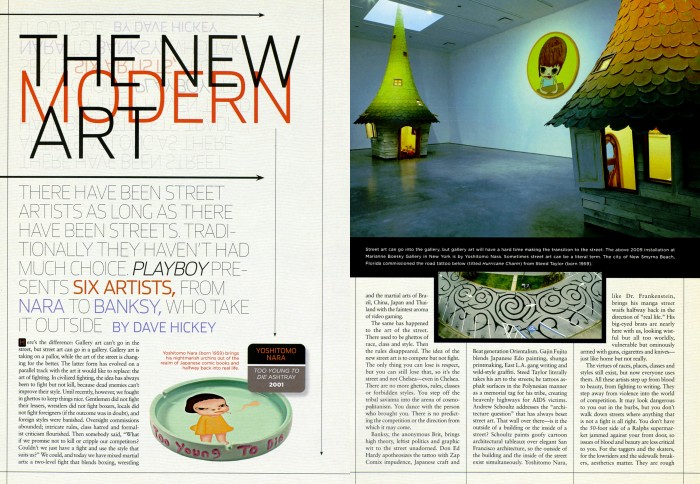
Beat generation Orientalism. Gajin Fujita blends Japanese Edo painting, shunga printmaking, East L.A. gang writing and wild-style graffiti. Steed Taylor literally takes his art to the streets; he tattoos asphalt surfaces in the Polynesian manner as a memorial tag for his tribe, creating heavenly highways for AIDS victims. Andrew Schoultz addresses the "architecture question" that has always beset street art. That wall over there—is it the outside of a building or the inside of a street? Schoultz paints goofy cartoon architectural tableaux over elegant San Francisco architecture, so the outside of the building and the inside of the street exist simultaneously. Yoshitomo Nara,
like Dr. Frankenstein, brings his manga street waifs halfway back in the direction of "real life." His big-eyed brats are nearly here with us, looking wistful but all too worldly, vulnerable but ominously
armed with guns, cigarettes and knives— just like home but not really.
The virtues of races, places, classes and styles still exist, but now everyone uses them. All these artists step up from blood to beauty, from fighting to writing. They step away from violence into the world of competition. It may look dangerous to you out in the burbs, but you don't walk down streets where anything that is not a fight is all right. You don't have the 50-foot side of a Ralphs supermarket jammed against your front door, so issues of blood and beauty are less critical to you. For the taggers and the skaters, for the lowriders and the sidewalk breakers, aesthetics matter. They are rough
customers, but they are aesthetes if you're interested. In the blink of an eye, bangers become auteurs, scholars and critics. They want to discuss Saber's giant tag on the concrete wash of the Los Angeles River. They wonder, Did it survive as long as it did because it was good, because it commanded respect? This would be the right reason, but maybe it survived because it was too expensive for the city to sand away and too big to bomb with other tags. Or maybe both. Maybe that was Saber's strategy. (The tag was finally buffed away after 12 years by the Army Corps of Engineers, thanks to federal stimulus funds.) In this spirit you discuss the aesthetics of scale and refinement in a work of art executed in darkness in a concrete wasteland. The artists just want more respect and less banality. They want to pose serious questions such as, "You put a wall in my face. Can I park my ride in your yard? Look at that stucco monster! Why is this blind corporate citizen free to ruin my view? Why is that wall the outside of his building and not the inside of mv livelv street? Or is this
wall a delicate membrane facing both ways where ownership is always contested, like my skin, my T-shirt and the paint job on
my Charger? So this wall? Does it have the right to bore me? Well, this is my tag, and it doesn't bore me. This is my tattoo, those are my flames and pinstripes, and this is my street. The wall? Does it include me or exclude me—extend me or limit me? We should talk about this fairly soon."
These are serious, global issues, and one evening flying into LAX from the west, away from the twilight, I saw it all:
CAJIN FUJITA
SLOW& EASY 2006
the vision of redemption. The sleek plate of ocean rushed up to the beach with surfers at its edge. The concrete badlands of
DON ED HARDY
Don Ed Hardy (born 1945) expands the Japanese tattoo aesthetic (at right, Sheya). Banksy (opposite page) uses his graphic wit to question the ownership of public space.
Los Angeles rushed away from the beach toward the mountains. Then I saw what the kids saw: the beach beneath the concrete, the piss-elegant Latino-Asian paradise immanent in the ugliest urban environment. 1 saw dead things brought to life, empty pools with wild-style decor being licked up by skaters. I saw lime paint jobs slithering down Pico. I saw
twining tattooed curves pouring down kids' arms out of tie-dyed T-shirts. I saw the arc of skateboarders flying out of plywood barrels, the arc of surfers slipping down saltwater barrels, the swoosh of ramp races in empty parking garages, bikes and skates, everything flying and landing with perfect aplomb in a filigree of elegant curves. The tagger's paint can sweeps across the blank wall, making a 15-foot periwinkle curve as sweet as Raphael's, as felonious as shooting a storekeeper. My vision needed only Steed Taylor to tattoo the streets, Banksy to do the signage and Andrew Schoultz to paint houses on all the houses. Los Angeles would blossom to life in the membrane that divides the street we share from the property someone owns. There are kids who think this will happen.

