Future Of New York
January / February, 2010
sBACK
GONJ THROUl
been asked lo jol down some recollections of my life on the occasion of my 100th birthday. Being a centenarian pis no threat shakes anymore: though it tvas kind of special at one lime, it seems what I'm really beinij honored for is my
ability to hang on to my apartment. Sou see. I still live in the railroad Hat where I was born. The bathtub is in the kitchen. the cockroaches are pedigreed, and the linoleum would be
fortune it n weren i n chewed. It's on Clinton Street in what used to be culled the Lower East Side and is now culled Cherry Hill—some real estute agent's ideu when they tore down the projects and tried to makr the place sound vaguely prosperous and traditional. My grandmother moved in around I9(i(): my mother was horn there in 1987—the place was rent controlled. When you had a rent-controlled apartment nothing short of an earthquake could get you to
leave it. Both ol them spent decades in housing court, fighting a succession of landlords for the place. When 1 was an infant I was once brought into court as an exhibit, and thai settled it. I finally bought the building for back taxes after the plague, when nobody wanted to live in New York City.
It was an old immigrant neighborhood. My grandmother was a hot-corn girl and danced in her underwear at Niblo's Garden before becoming a beatnik poet. Later she posed for Life magazine in a stolen car with Murph the Surf and six of the Fugs. She remembered the pushcarts and the old elevated trains and Herman Melville shuffling by looking morose. By the time my mother was born the East Side had become a dangerous place, prowled by gangsters wielding zip guns and selling headache powder. Then, not long before I was born, it became fashionable.
which is why landlords kept trying to evict my family; they could sell apartments fur huge sums or tear the whole thing down and put up a skyscraper. For years running my mother fed my sister and me on leavings from the fancy restaurant downstairs, and we pirated our utilities from the neighbors. My uncle made a good living slipping things into people's drinks. But that period didn't last either, not that anything ever does in New York. When I started school—the old 1\S 112. on Attorney Street—the neighborhood was half eniotv. Evervthinir was for sale, but nobodv
could afford lo buy. The restaurants closed: the fancy people from Europe and California went away. There were a few years when kids could actually play in (he street and nol worry about getting run over.
But there wasn't any work, and no money either, and consequently no upkeep. That's when everybody found out exactly how shoddy all that boom-town construction had been. I think it first happened on Orchard Street— an eight-story apartment buildingjusl collapsed like a house of cards. I actu-
ally fell oul of bed from the tremor. And then it happened again and again. It happened so often—all over town but especially in my part—that the government sent in the National Guard, along with implosion teams. School was closed for two months. The) ran emergency rations up to us on a pulley, and we got our lessons on the computer—those early things you had to lug around. It was fun for about a week.
You'd think it would have been a gold rush for developers—all those fresh new vacant lots. But there was little money still, and with so many new laws pertaining to construction in place and strong indications those laws might actually be enforced, it cost a fortune to build anything. Besides which, so many people had been killed and so many lawsuits were in progress that developers were about as popular as terrorists had been a decade earlier.
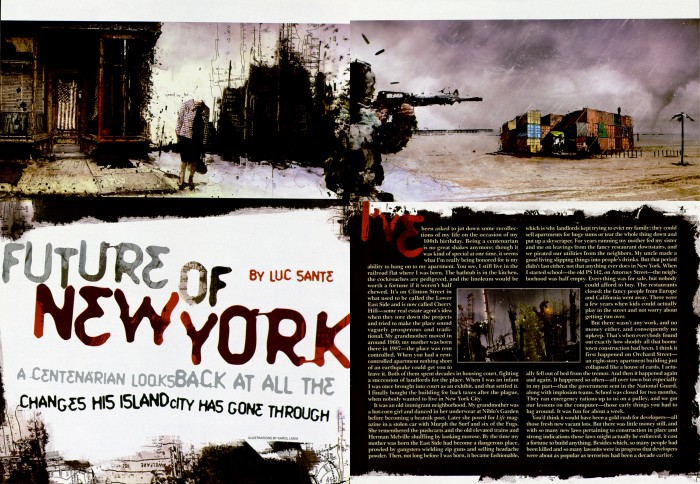
So the vacant lots remained unbuilt for years. They didn't quite stay vacant, however, since they were swiftly converted into campgrounds and eventually tiny villages by an army of what were then called the homeless—people who had lost their apartments or houses through some concatenation of bad luck. Their new homes were initially dirown together from cardboard and plastic sheeting, but there happened to be a huge surplus of shipping containers everywhere, owing to the trade deficit, and those made excellent dwellings—they could even be stacked. The shippers—that's the origin of the term—raised chickens and goats, repaired bicycles, did some plumbing, made and sold street food, played music and manufactured a wide
1
variety of items from discarded office furniture. Before I was in long pants I was working as a runner for my friends in the Ridge Street village, in exchange for which they taught me three-card monte, a skill that has proved valuable over the years.
When I first began to run around outside the immediate neighborhood there were still quite a few private cars on the street. With very little law enforcement, traffic on the main arteries was unhinged. Both Houston Street to the north and Delancey Street to the south were terrifying, and it would be years before I crossed either of them on foot As a result I spent a great deal of time on the subway, which, also because of the scarcity of cops, was free—at least in those stations that still featured the old-fashioned turnstiles. It ran irregularly and unpredictably, however, so my
friends and I often gave up waiting and took off through the tun-neb. But if we were lucky, or patient, we had access to the entire city. We could lose ourselves in the vast aimlessly circulating mobs in Times Square or wander cautiously through midtown office buildings that had been looted of everything but their walls and floors or brave the trash to wade into the surf at Coney Island or sneak into the Metropolitan Museum of Art through an air-conditioning vent nobody else ever seemed to have noticed. It was on the side of the building, luckily, since the rear would have been impossible—the park, like all parks, was an armed camp.
The city in general was a dangerous place in those years—our neighborhood alone, maybe because it was ours, seemed like an island of safety— ^r
but let me emphasize: It was fun. Nobody cared much where we went or what we did, and most things that cost money were cheap since otherwise they would go unsold. Back then a bag of peanuts cost just $5, and it was easy enough to pick up a five spot by bonking a sailor on shore leave over the head with a brick in a sock. One time we saved the mayor's dog from a crowd that looked as if they wanted to have it for dinner—some of them were carrying forks—and he had us over to Grade Mansion for cheesecake and told bad jokes and gave each of us municipal bonds that turned out to be worthless. Those were some good times. We were still small enough to worm our way into dance clubs by crawling in between people's legs—looking up skirts as we went—and all of us were adopted at one time or another by
rich people who thought we were homeless urchins and then udke up one morning to find us gone ulong with the silver. We laughed a lot in those days.
Everything changed right around the time I hit puberty. Money came back to the city. It was when they first started tap-
ping the asteroid belt for minerals, but in effect what that meant was the developers came back, free of stigma owing to the brevity of popular memory. The shippers were evicted—some of them fighting, some switching sides—and new skyscrapers went up, and they demolished all the projects along the river and erected that line of twisted towers people started calling the Corn Row, though its official name was Corlears Esplanade—I'm sure you've seen pictures. The zoning laws were essentially vacated during that time. People put up 50-story buildings on lots the size of thimbles or on supports over avenues or on top of older buildings loo lucrative to tear down or in what used to be parks. Then one neo-trillionaire, whose name I can't quite recall, decided to buck the trend by demolishing a 42-story residential edifice, built in 1996 and showing no signs of disrepair—he did have the delicacy lo get the residents out first—and in its place con-
struct ing a simple three-story. 12-bedroom, 16-bath Georgian Revival country house, complete with lawn, fruit trees and electrified iron fence. Then that became the trend. .Soon entire blocks of midtown began to look like hamlets in Connecticut; it could be only a matter of time before someone put in a golf course and a Congregational church. Meanwhile, the region below 14th Street had become an impenetrable thicket of glassy spines.
It's a miracle my building survived, or maybe not quite a miracle—I no longer recall whether the matter involved
violence, blackmail or simple dumb luck—but it was already the oldest house in the neighborhood by then, and it looked like a chokecherrv bush in a grove of sequoias. At a time when every human being in the city was worth his or her weight in shares of Tycho Brahe Ventures Preferred A, we were beyond
poor, but that itself gave us an advantage, since consumers everywhere discarded whatever bored them, from food to furniture, and we had little competition for trash picking. My clothes were always last month's, but even as a teenager I learned not to care and eventually found it conferred some kind of weird distinction, helping me run through a succession of girlfriends from the country-house gentry. To them I was rough trade, and they enjoyed the cloak-and-dagger of letting me into their houses by means of the underground passageways—which all connected to the old Rockefeller Center tunnels, familiar to me since childhood. I became adept at systematically removing from these houses small but valuable items that would not be missed for months: a watch, a ring, a pre-Columbian figurine lost among bureau-top detritus. My fence, who lived in a hollowed-out split-level at the edge of the Westchester
my best intentions I did fall in love, with a girl whose father controlled most of the world's supply of vishnapradamite and had converted the Frick Museum into a private restaurant. She was a beauty with raven tresses and a bottom that looked remarkably like a quince. We would sail up the Hudson in her family's nuclear-assisted catamaran and be gone for a week, living fin farm produce we liberated from estates along the water's edge. To this day I can't look at the river without
recalling her soft moans merging with its sighing rise and fall. But those were also the days when the ocean was rising alarmingly and the Great Wall was constructed around the island
rers were trucked in trom the slums that by then ringed the city 50 miles deep—the indescribable shantytowns that had once been the McMansion suburbs of the tristate region—and were treated like chattel. Hundreds, possibly thousands, died in the process, from drowning, from equipment failures, from the bends, from getting trapped between enormous wedges of reinforced concrete being assembled at reckless speed. It was true that speed was of the essence, but cost cutting was uppermost, which is why ostensibly expendable human labor was used in preference to the latest available technology. Many workers ended up buried in the wall, but none was commemorated—ironically, since the wall doubled as a cemetery for the high and mighty, the first new graveyard opened in Manhattan in 200 years. As luck would have it. the cemetery did not have to wait to acquire custom, since it was right then that the nlacue look hold. Afterward every-
despite the fact that the city was infected long before the slums were and that medical researchers had gathered evidence— quickly suppressed—that the epidemic was almost certainly of extraterrestrial origin. The plague, I will venture to say. came from the very rocks on which the city's wealth depended. With a sense of justice seldom found in nature, it began by targeting the very class that had unleashed it.
I'm not sure how I survived. Maybe I had a genetic advantage, maybe the fact that my house and belongings were older
and dirtier than anyone else's assisted my immune system, maybe I just got lucky. Anyway, everyone in my family survived, including my grandmother, who must have been nearly as
as i am now. we were also iortunate in being poor, since we always had on hand things like oatmeal and rice in bulk quantities, whereas the rich dined out or had groceries flown in from France or Sichuan or wherever. When the city came to a squealing halt, supplies disappeared, and starvation did not slow the spread of the disease. You'll recall that it was actually in a restaurant—the one in Belvedere Castle in Central Park, in fact, renowned for its honey-dipped ortolans—that the first recorded victim blossomed in purulent carmine splotches, rapidly swelled to twice his si/e. then burst, expelling slime in all directions and setting off a panic. Everyone in the room was dead within 24 hours. The disease spread with baffling irregularity, decimating entire streets overnight, then lying dormant for a week. Fear ruled. Everyone thought everyone else was a carrier, and nearly as mam' people died from preemptive gunfire as from
the sickness itself. We went to ground in our apartment, nervously listening to the shots and explosions and occasionally peering out the window at the space-suited emergency medical and security forces patrolling below. For two months we were besieged while the plague ravaged Manhattan and spread to the surrounding region—where it ebbed and then vanished, as mysteriously as it had arisen, although most accounts omit that compelling but perhaps inconvenient fact.
Then came the leveling. Authorities determined that infectious matter remained bonded (concluded on page 152)
N£WYORK
(continued from page 120) to all surfaces that had come into contact with the disease, not excepting stone and metal, and that the only means to root out the viral agent was fire. So it was that fully three quarters of the island was incinerated in controlled burns—houses, office buildings, hospitals, churches, down to the streets and sidewalks. Many of the remaining inhabitants fled Manhattan, even those whose dwellings were spared. We held firm, talking our way out of a single half-hearted attempt at forced relocation. When we could walk around outside again we were stunned by what we saw. The city looked like footage of Berlin or Dresden after the Second World War. Block after block lay empty; others were heaps of blackened rubble. A pall of smoke hung in the air and made the sunset look like the end of the world. An indescribable stench wound its way through the shattered streets. There were only a few recognizable standing structures; all had been built of brick or stone, mostly in the 19th century. For a while we were convinced we were die last people in the city—maybe in the world, for that matter, since communications had been severed—Just die four of us and the neighbors.
For quite a long time most people were afraid to come anywhere near the city, and developers consequently shunned it, so the reconstruction went slowly. Little by litde, groups trickled in, in old trucks full of lumber and bricks or homemade cans pulled by horses. They cleared rubble, salvaged what they could, built cabins, planted trees and crops, erected windmills. We acquired two cows and tended 40 acres of farmland over by the East River. Before long die soudiem end of the island looked quite a bit like New Amsterdam in the early 17di century, at least if you kept your back to the Woohvorth Building and die Brooklyn Bridge. The idyll lasted only a couple of years, of course, since some of die setders wanted electrical power restored, and so word got out. Surveyors and then construction crews were soon everywhere at once, rebuilding widi a vengeance. That was right about when China's economy collapsed and the United States stepped into die breach, so money was plentiful once again. Exact replicas of die Empire State and Chrysler buildings were among die first to go up, to be followed by clones of many of die ugliest, most faceless high-rises diat had formerly stood. In no time all traces of die plague and its consequences had been utterly eradicated, aside from die massive black marble cenotaph erected in the middle of Columbus Circle, and die city looked altered by no more dian time from a decade or two earlier. The word new appended to die replicas—as in die New Times Square— disappeared within six months.
I had become used to diose cycles of rise and fall and rise again, or so I thought- This time die triumph seemed particularly hollow. It felt as if die whole city was a pallid remake of itself. I was well into my 30s by dien, and my energy was flagging. I had no desire to find a place for myself in die new order. My grand-modier had recendy died, at die age of 110,
and without her stabilizing influence I began to drift off course. I gravitated to a crowd that ingested crispix and strontium, sheltered in the hollows of the disused subway station beneath City Hall and preyed on tourists staying in the various BedLocker franchises around town—they weren't rich, but they were easy. I kept away from my mother and sister and the Clinton Street tenement because I couldn't face them. My skin had taken on the distinctive greenish crispix pallor, my clothes were rags, and I had ballooned grotesquely from the strontium. I robbed, drugged and tried to sleep. An unknown amount of time slid by in this fashion, maybe years, as I weakened daily from the ravages of the substances I abused, my condition not assisted by the daily eruptions of violence among my crowd, since people were continually trying to hijack one another's supplies. I probably would have had no more than six months of life left to me had it not been for the war.
In our condition we were oblivious to the workings of the world, and it was only much later that 1 recalled signs I had peripherally registered that would have shown me that conflict was imminent—or at the least that strange things were at hand. Bearded men carrying regulation-size crosses began appearing on the avenues, apparently crushed by their burden, bleeding from thorns bound around their heads, escorted by small bands of weeping followers. Repentance preachers were of course nothing new, but this sort of spectacle upped the ante somewhat. Then groups of people started materializing here and there around town, wearing large crosses on their chests and brandishing hammers. At first they concentrated on destroying graven images. All representations of human figures were fair game—church statues, advertising screens, terra-cotta reliefs, shop-window holos, paintings in museums—though diey reserved their greatest wrath for the unclothed body. Matters took another turn when they began attacking the living, bursting into commercial establishments that dealt in matters they apparently considered sinful and aiming for heads with their hammers. The police always seemed to get there too late. The body count escalated daily.
You know the backstory, of course, so I won't bore you. The call for holy war had come from the high plains, and cities were aflame from coast to coast. New York was actually left for last. The city had been on alert for weeks, but nobody knew what form the attack would take. The hammer wielders were an advance guard meant to induce panic and distract attention from the main thrust, which soon enough came from the sky. I slunk to a place only I knew about—a forgotten underground storage room once attached to the old Macy's, accessible through a series of abandoned rail-freight tunnels— and there I underwent withdrawal while listening to the explosions overhead. After nine days I was able to limp back to Clinton Street through the immobilized subway lines and joined the resistance. The four years that followed were the harshest of my life. They are a blur in my mind now, but I can't forget the incessant Bible broadcasts in the streets
or the intoning of "Only God can judge" during the executions or the golf-pro outfits of the top brass in their open hovercars or the vacant-eyed night raiders with verses from John tattooed across their foreheads or the house-to-house fighting when we briefly took back East Broadway or the day I realized our oldest neighbor had been turned or the day my mother was killed crossing the street by a remote sniper from an unmanned turret. By the rime the Euros came in I weighed half what 1 had in my prime. After the liberation I slept for most of a month.
When New York was declared a city-state I was approached to run for public office, but I've always been bored by politics, and I declined in favor of a Job on the planning commission. We had our work cut out for us. I can say without bragging that I had more experience with ruins than anyone else in the government, which was handy since once again half the city lay in charred heaps. We remade the parks, reconstructed the Brooklyn Bridge from Roebling's blueprints and replaced the other spans, saved the Paramount Hotel from imminent collapse, reconfigured the zoning laws and imploded everything put up by the occupation forces. It took a decade to get the Statue of Liberty back from Lake Havasu, Arizona It was too late to do anything about the Empire State Building, but then I considered it a fake anyway. We decided to preserve the Washington Square Arch intact as a memorial—those two square pillars missing their top do an admirable job of standing for everything the dry has been through. We got rid of all the remaining expressways, sealed the tunnels and banned private transportation from the city altogether. We reopened the harbor and reinstalled a beacon atop One Times Square. Then we turned the churches into dance halls. I wrote the provision myself.
Many things have happened over the past 30 years, but they've mostly passed me by. I'm old and frankly don't understand modem technology, let alone modern culture, so I've left them strictly alone. People want my opinion about these new mutable structures or those flying wedges or the things that look like giant uncooked rotini, but they scare me and I don't like to think about them. Most days I walk slowly down to the Battery, look out at the bay and walk slowly back. Every street I pass I see as a succession of images, from 90 years ago, 80,70,60 and so on. I see old brick tenements followed by thin shiny slivers followed by twisted girders followed by huge pulsing cubes followed by smoking rubble followed by some other glass cubes—you get the idea. I keep thinking that this island city has seen enough drastic changes in its life and should try staving the same for a few years, just as a diversion. But I'm aware that is never likely to happen as long as there are human beings with ideas and conflicts and egos and varying sums of money. I live in the last remaining tenement in the city, and I know no one will ever live in it after me since they couldn't Gt their gizmos in, so they'll either tear it down or turn it into a museum, and I've made my peace with that I live in the past now, and that past will die with me.
JfJZ COULD L05J 0UR5&VJ5 IN ,...
" OF T1M£5 5QUARJ OR WANDJR THROUGH MID- '
TOWN OfFlCS BUILDINGS THAT HAD BKN LOOTJD.

