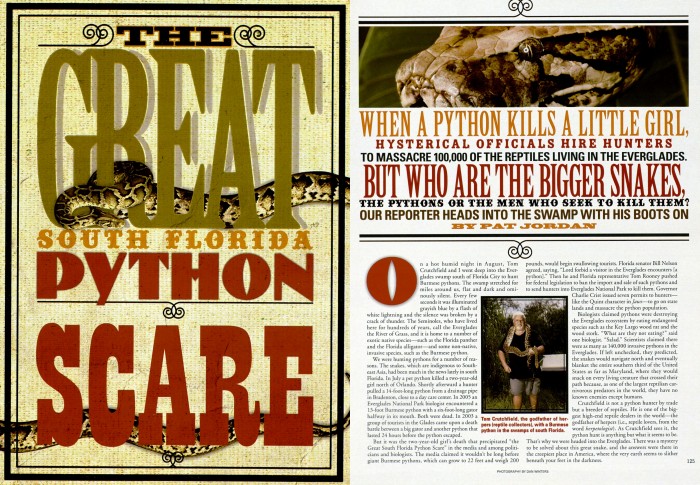
The Great South Florida Python Scare
December, 2009
WHEN A PYTHON KILLS A LITTLE GIRL,
HYSTERICAL OFFICIALS HIRE HUNTERS TO MASSACRE 100,000 OF THE REPTILES LIVING IN THE EVERGLADES.
THE PYTHONS OH THE MEN WHO SEEK TO KIM* THEM?
OUR REPORTER HEADS INTO THE SWAMP WITH HIS BOOTS ON
n a hot humid night in August, Tom Crutchfield and I went deep into the Everglades swamp south of Florida City to hunt Burmese pythons. The swamp stretched for miles around us, flat and dark and omi-
nously silent. Every tew seconds it was illuminated grayish blue by a flash of white lightning and the silence was broken by a crack of thunder. The Seminoles, who have lived here for hundreds of years, call the Everglades the River of Grass, and it is home to a number of exotic native species—such as the Florida panther and the Florida alligator—and some non-native, invasive species, such as the Burmese python.
We were hunting pythons for a number of reasons. The snakes, which are indigenous to Southeast Asia, had been much in the news lately in south Florida. In July a pet python killed a two-year-old girl north of Orlando. Shortly afterward a hunter pulled a 14-foot-long python from a drainage pipe in Bradenton, close to a day care center. In 2005 an Everglades National Park biologist encountered a 13-foot Burmese python with a six-foot-long gator halfway in its mouth. Both were dead. In 2003 a group of tourists in the Glades came upon a death battle between a big gator and another python that lasted 24 hours before the python escaped.
But it was the two-year-old girl's death that precipitated "the Great South Florida Python Scare" in the media and among politicians and biologists. The media claimed it wouldn't be long before giant Burmese pythons, which can grow to 22 feet and weigh 200
pounds, would begin swallowing tourists. Florida senator Bill Nelson agreed, saying, "Lord forbid a visitor in the Everglades encounters [a python]." Then he and Florida representative Tom Rooney pushed for federal legislation to ban the import and sale of such pythons and to send hunters into Everglades National Park to kill them. Governor
Charlie Crist issued seven permits to hunters— like the Quint character in Jaws—to go on state lands and massacre the python population.
Biologists claimed pythons were destroying the Everglades ecosystem by eating endangered species such as the Key Largo wood rat and the wood stork. "What are they not eating?" said one biologist. "Salad." Scientists claimed there were as many as 140,000 invasive pythons in the Everglades. If left unchecked, they predicted, the snakes would navigate north and eventually blanket the entire southern third of the United States as far as Maryland, where they would snack on every living creature that crossed their path because, as one of the largest reptilian carnivorous predators in the world, they have no known enemies except humans.
Crutchficld is not a python hunter by trade
but a breeder ot reptiles. He is one ot the biggest high-end reptile dealers in the world—the godfather of herpers (i.e., reptile lovers, from the word herpetologist). As Crutchfield sees it, the python hunt is anything but what it seems to be.
That's why we were headed into the Everglades. There was a mystery to be solved about this great snake, and the answers were there in the creepiest place in America, where the very earth seems to slither beneath your feet in the darkness.
How did these pythons end up in the Everglades, which stretch from the southernmost tip of Lake Okeechobee to the southernmost tip of the peninsula, 150 miles south? Should state and federal agencies spend vast amounts of time and even vaster amounts of taxpayer money to purge the pythons from the Everglades? Is such an undertaking possible?
As it turns out, the story of the python hunt is one that is quintessentially south Florida, involving lots of money, crackpots, scammers, dangerous reptiles and even cocaine cowboys.
I had arrived at Crutchfield's reptile farm in the flat, desolate farmland west of Florida City on a sunny afternoon. He was outside, showing three "herp nuts" from Ohio the exotic reptiles he
keeps in outdoor cages (if they are nonvenomous) and locked in his four outbuildings (if they are venomous). One of the men, a breeder of boa constrictors, called Crutchfield "a legend in this business. I'd get price lists from him and dream about buying his reptiles.' Another breeds Cuban crocodiles in his basement.
Crutchfield is a short, stocky man of 61, with white hair, a white goatee and riveting blue eyes. He's a sixth-generation Floridian who can trace his ancestry to the Seminoles, the first "invasive species" to inhabit the Glades. On this day he wore a sweat-soaked T-shirt and baggy shorts. He gave me a tour of his reptiles. Fred, his giant rhinoceros iguana with canvas-like dark gray skin, was about 25 pounds and looked like a dinosaur in a 1950s B movie. Crutchfield showed me a pair of albino iguanas
that looked as if they had been hand-painted a brilliant yellow with pink markings. He was taking the albinos, along with some other reptiles, to a show in Daytona the next day. He hoped to sell them to some Japanese buyers for 5250,000.
Then he led me to one of his outbuildings with a sign on the door: dangerous! venomous reptiles. He unlocked the door. Inside, the room was warm and smelled of reptile scat. His reptiles were in glass drawers lined floor to ceiling against the walls. He pulled out a drawer to show me a pure white young albino ball python with rheumy pink eyes.
"Go ahead, smell it," he said.
He held the snake close to my nose. Its pink eyes studied me wearily. I leaned my face closer to its skin and sniffed.
"No odor," I said.
"Snakes don't have any odor," he said.
He opened another drawer with an albino southwestern rattlesnake in it. The snake rattled its tail. "Very rare and expensive," Crutchfield said. In another drawer, a yellow-and-pink cobra rose up and flared its neck, hissing its darting tongue. Crutch-field tapped the glass with his fingers. The cobra's head darted at the glass, hitting it with its fangs. White venom dribbled down the glass.
"Do you have a Burmese python?" I asked.
"Outside,' he answered.
We stood in front of a cage in which a 10-foot Burmese python slithered with such excruciating slowness that it was mesmerizing. Then it coiled itself and was perfectly still. Burmese pythons are ambush predators, not hunters. They coil and wait for their prey, then grab them in their mouth with their inward-slanting teeth and coil their bodies around and crush them. Crutchfield said they can grow as much as 10 feet in a year—which is the problem with unsuspecting people who buy 12-inch baby pythons from Pet Supermarket for about S50. They are usually not warned about the animal's growth spurt, and before long they have an unmanageable 12-foot, 120-pound snake in a tiny cage, (continued on page 145)
PYTHON SCARE
(continued from page 126)
Today there are almost 1 1 million captive pythons and other reptiles in America, and each year, when they become too big, some are released into the Everglades, which has the perfect temperature, swampy environment and ecosystem. No one releases a python into the woods in Michigan in December.
Pythons became popular with the south Florida cocaine cowboys of the 1980s, who saw exotic and dangerous pets as proof of the macho nature of their business. These lough-guy wannabes couldn't afford lions and tigers (a la Tony Montana in Scarface), so they bought Burmese pythons, which were cheap to buy, feed and maintain. By the late 1990s a lot of people were taken with the big snakes.
Crutchfield said he doesn't believe pythons are dangerous as pets. "They can be trained to be tame," he said. "They're not harmful unless they mistake you for food. Pythons kill only what they can eat." Then he said, "Adrenaline junkies own snakes. The attraction is it's something beautiful that can kill you. But snakes don't have enough personality to be good pets. They're not smart. They don't respond to you. Now, lizards and iguanas like to be petted. Gators are smart too and have interesting personalities."
Crutchfield opened the python's cage and took it out. He held it up to me with both hands, like an offering. The snake lay draped over his arms like a long, thick rope. It was a beautiful, powerful-looking animal. Its skin was olive colored and dotted with large gold rectangles outlined in black. Despite the reptile's beauty, python leather is not much in demand by the fashion trade. A large skin will not even fetch $100.
"Go ahead, pet him," said Crutchfield. I petted the python. Its skin was soft despite the scales, and very loose, like the skin of an old man. The loose skin allows its body to expand when it swallows something big.
Reptile lovers like Crutchfield believe the whole south Florida python scare is a political ploy to get federal funds to restore the Everglades from destruction caused not by pythons but by humans. They also believe biologists precipitated the scare to get federal grants, a.k.a scientific welfare, which could support their snake studies for years. As for the seven licensed hunters, the herps claim they are motivated not by the danger of these snakes or by a sense of civic duty but by a desire to escape the anonymity of their lives, to get their face on TV and their story in magazines like The New Yorker.
"It's a joke," Crutchfield said. "So they're eating Key Largo wood rats. It's a goddamn rat! Feral cats are a bigger ecological threat. They kill just to kill. And Nile monitor lizards—they're finding them in Cape Coral now. They're a greater threat than pythons."
Florida authorities disagree.
In May, Senator Nelson tried to persuade United States Interior Secretary Ken Salazar to allow hunters to trap and kill pythons on federal lands (where hunting is normally prohibited). To make his point, Nelson invited Salazar to the Everglades to witness the python threat firsthand.
Forty people, including Salazar and Nelson, went out on airboats but came across no pythons, or maybe they did but couldn't see them. Pythons are almost impossible to detect because they blend into their environment. Once, a captured python was fitted with a tracking device and released into the Glades. Sometime
later, biologists tracked the python through the transmitter, and when they came to the exact spot where the transmitter indicated the python was, they couldn't see the snake at their feet.
Skip Snow, an Everglades National Park biologist, was prepared when Salazar didn't see any pythons on his airboat trip. Snow brought one of his own, a 16-footer, to show Salazar how big and dangerous they are. He and two others wrestled the big snake while Salazar watched. He was impressed.
Two months later, after the death of the two-year-old girl, Salazar announced a plan to rid the Glades of pythons. It had many parts: (1) Allow hunters on federal land like Everglades National Park to kill pythons with firearms; (2) organize a python response team; (3) study pythons; (4) trap pythons (Nelson's spokesman, Dan McLaughlin, said, "You could spend the next 10 years setting traps"); (5) fly drones over the Glades and use thermal imaging to spot pythons; (6) study pythons' diet; (7) institute a python hotline. One biologist said of all these plans, "Stop studying [pythons] and start killing them." The best way to kill pythons is called the "rapid-acceleration removal method." That is, run them over with a car when they try to cross a road.
Snow, 57, is the poster biologist for poli-
ticians like Nelson who want to publicize the great south Florida python scare. Snow is a master of street theater (e.g., bringing a python for Salazar) and keeps his own python skin in a laundry bag to impress people. He is also a media master, eminently quotable. His name and comments about the python threat have appeared all over the media these past months. Among Snow's quotes are the following:
"[Pythons are] an experiment run amok."
"[Pythons are] almost equivalent to a large Russian roulette game.... We just continue to fire away."
"[Pythons are] a species that is really made for invading."
"Invasives are the gift that keeps on giving."
"You never bet against a snake."
"Do you really want a snake that may grow more than 20 feet long or weigh 200 pounds, urinate and defecate like a horse, live more than 25 years and for whom you will have to kill mice, rats and, eventually, rabbits?"
So I called the Everglades National Park office and asked to speak to Skip Snow. I was put through to Linda Friar, the park's public information officer. She told me Snow was no longer allowed to talk to the media. But she would talk to me. She told me that if ENP workers find
pythons in the park, they can catch them and euthanize them. How? "We tend to gas them." she said. I tried to picture how one would gas a python. Stretch its mouth around a car exhaust?
"Our scientists don't believe they're easy to eradicate," she said. "They're difficult to find. They consume native species, but there has never been an incident in the park where they attacked a human." Then she sighed as if exhausted by, or maybe disgusted with, the great python scare. "The pythons have been getting an awful lot of media coverage," she finally said, "but I don't think they're a big threat."
Crutchfield and I drove down a rough, narrow dirt road in the heart of the Everglades on our own python hunt. Thunder cracked and lightning lit up the swamp stretching for miles around us. He drove slowly, hunched forward in his seat, his eyes studying the embankments on either side of the road, which were illuminated by his headlights.
I asked him when we were going to get out and hunt for pythons. 1 had dressed for an excursion into the swamp: boots, jeans and long-sleeve shirt to fend off mosquitoes. He said, "We are hunting for pythons. This is the best way to find them." Most of the swamp is a river of grass that hunters
can't walk on. And even if hunters could follow solid ground, it would be impossible to find a hiding python in the dark. So Crutchfield and most of the seven state-permitted python hunters just drive up and down swamp roads, hoping to catch sight of a python on an embankment.
"It's nol very sexy," I said.
Crutchfield, peering out the window, said, "It's an exercise in futility. You drive for hours, waste gas, pollute the environment just to catch one every few days. You're never gonna get rid of them anyway."
Jeff Fobb, a permitted hunter, described python hunting as "like finding a needle in a haystack." Another python hunter claimed he had trained his beagle to sniff them out. Mis dog. Python Pete, got a lot of publicity until it was revealed he had never sniffed out a python in his life. Crutchfield laughed and said, "Python Pete is a fucking joke. How many snakes you gonna find with a dog on a leash in the swamp? Let the dog loose and a python will eat it." Another python hunter had already thought of that. He hunts with a dog he calls his Burma-bait Dog.
The most successful of the python hunters is Bobby Hill, a grizzled old-timer with a goatee. Hill hunts pythons with his 12-gauge shotgun for the South Florida Water Management District. He claims he has killed more than 300 pythons since 2004. The Miami Herald ran a front-page story about Hill, "Stalking the Everglades Python," complete with a photograph of him and his shotgun. Hill's narrowed eyes and grimly set mouth made him look menacing. His secret to python hunting? He can smell them. "The guy has a gift," said his boss, Dan Thayer.
Crutchfield made a sound of disgust and said, "Bullshit! You can't smell a python. You're never gonna find a lot of them."
We drove through an abandoned guard gate and headed down a long paved road that led to the little burg of Flamingo at the tip of the Florida peninsula. "I have noted a paucity of small animals in the swamp," said Crutchfield. "Possums, coons, rabbits. But the effect on the ecosystem is still unknown. Man killed predators, which caused an infusion of small game. Maybe the pythons are bringing the small game back to the level they should be. Let's face it: Pythons are here. Who gives a luck?"
We drove up and down that paved road for an hour. We saw a few low-flying birds, owls and the brilliant lightning, and we heard the racket of insects. But we saw no pythons. I relaxed and smoked my cigar.
Crulchfield's obsessive adventures in the world of rare and dangerous reptiles have landed him in hot water at times. In 1999 he pleaded guilty to seven counts of smuggling Madagascar tree boa constrictors and Madagascar ground boas into the United States. He had previously been convicted, in 1995, of smuggling Fiji Island iguanas. He was sentenced to 30 months after he admitted he had smuggled more than 200 reptiles into this country. The assistant attorney general for environment and natural resources at the time, Lois Schiffer, said, "Trafficking in
rare species threatens our environment."
I asked Crutchfield about reptile smuggling. He said most illegal species were smuggled into the States in the 1980s as breeding stock. "Now a lot of reptiles, like pythons, are so cheap, there's no point in smuggling."
Like most herpers, Crutchfield believes pythons were released into the Glades en masse after Hurricane Andrew in 1992. The hurricane devastated the area around Homestead and Florida City, which was home to a hundred reptile farms and zoos. According to Crutchfield and others, the hurricane blew away the cages and released thousands of pythons into the area. The small ones, he claims, were picked up by hurricane winds and deposited deep in the ENP. As proof of his thesis, Crutchfield points out that most of the captured pythons today have the same DNA.
Crutchfield also disputes biologists' claim of 140,000 pythons in the Glades. But even if these numbers are accurate, he said, "Pythons won't destroy the ecosystem. They'll evolve into it. Did you know the ENP even uses a picture of a python on its brochures to attract tourists?"
I asked him what he thought was the worst-case scenario for pythons in the Glades. He said, "Millions of dollars of taxpayer money will be wasted trying to get rid of them. This is all a waste because Senator Nelson and the biologists want Everglades restoration money and grant money."
"Gator" Tim Schwartzman knows a few things about the great south Florida python scare. A 26-year-old snake lover with an earring and a black goatee, Gator Tim took me inside a six-by-eight-foot python cage at Sawgrass Recreation Park, a reptile zoo outside Fort Lauderdale that he co-owns. Once inside, I almost stepped on a 10-foot male python coiled at my feet.
"They do blend into the surroundings, don't they?" Gator Tim said. "But don't worry; they're docile. They're just not affectionate. They won't cuddle and wag their tail when you come home."
I asked him why people get snakes. "I don't know," he answered. "Some people think they're kind of creepy, slithering with no arms or legs. In Jamaica the natives hang snakes from trees to scare-away unwanted visitors. I think fear of snakes comes from Adam and Eve and the devil. But when I handle pythons for little kids, they're fascinated. Cute little girls go, 'Wow! Cool! Can I hold him?' They haven't been imbued with fear yet, until they become teenagers."
He then said sharply, "I'd move back if 1 were you." He pointed to a second, much bigger python slithering toward me, a 13-foot, 80-pound female with milky blue eyes. I stepped back from the snake, which was flicking its tongue at my bare ankle as if to see if it were prey. "Their eyesight's not very good," said Tim. "Pythons have heat sensors on their face that see like an infrared camera, like in the movie Predator." I stepped farther back. Tim said, "When she wraps up prev. I can hear the bones cracking."
Pythons in captivity are fed once every two weeks, usually dead rats, rabbits or chickens weighing up to three pounds. Some python owners get their kicks by feeding their pets live mice they buy from Pet Supermarket. "It's disgusting," a girl at the cash register once told me. "I hate to sell those mice." In the wild, however, pythons can go as long as six months without eating. They prefer smaller prey to conserve their energy, but they can eat whole anything that is one and a half times their body girth. Their jaws are not solid like man's but hinged; they can stretch their mouth wide enough to swallow a deer.
I asked Tim if the male and female could mate. "Theoretically," he said, "but they haven't in two years. Maybe she's waiting for him to take her out to dinner first." When pythons mate, they intertwine like the medical symbol for up to an hour. A female can have as many as 80 eggs at a time, which is why they breed so successfully in the Glades.
Tim said the major misconception about pythons is that they are aggressive man-eaters. "Pythons fear people," he said. "They shouldn't be viewed as our enemy. Without them we'd be overrun with rats." He added, "If a dog kills a kid, we don't kill all dogs."
I asked him what the biggest threat to the Glades ecosystem was, if not pythons. He said, "Man. Man's been destroying the Glades for hundreds of years."
Before I left Sawgrass, Tim wanted to show me something. He went into a building and returned with a small snake wrapped around his hand. It had big, cute eyes and greenish-brown skin decorated with orange and black polka dots—a baby
anaconda. "She's been hand raised," said Tim. "She's very mellow. They live mostly in water, unlike pythons, which prefer dry land. They've already found a few in the Glades. A green anaconda can grow to 30 feet in length and weigh between 450 and 600 pounds. They are very aggressive. They have been reportedly eating people in South American jungles." Maybe so, but in the movie Anaconda, no matter how big the snakes get, it seems they're still unable to ingest Jennifer Lopez's booty.
Tim looked at the cute baby anaconda and said, "This could be the next invasive species in the Everglades."
Before I left I passed the dock where Tim keeps the park's airboats for excursions into the River of Grass. A six-foot gator was swimming around one of the boats. I barely paid attention. Gators are so commonplace in south Florida many people don't fear them. They are Floridians" state reptile. A road is named after them, Alligator Alley. A college football team is named after them, the Florida Gators. They are a major attraction at zoos and out in the Glades, where Seminoles wrestle them, to the delight of tourists. Yet the Florida gator is far more dangerous to man than any python.
Herpers in the United States have their own organization to help them combat the efforts of politicians like Nelson and Rooney and biologists like Snow to put restrictions on the import and sale of reptiles. It's called the United States Association of Reptile Keepers, and its president is a loquacious man named Andrew Wyatt. It was Wyatt, 45, a python breeder, who first put me in touch with Crutchfield when I called Wyatt's home in the Outer Banks
of North Carolina. At first Wvatt was nervous about talking to the media, assuming I had already made up my mind about the great south Florida python scare. After a few minutes he started talking fast without letting me ask a question.
Wyatt said the python scare was a "fairy tale promulgated by the media and politicians, a circus to demonize pythons. Biologists like Skip Snow spout off about irresponsible reptile keepers with no evidence. They appeal to Americans' morbid pleasure in the thought that exotic snakes are out to kill them, this scary, deadly beast lying in wait to eat their children. In captivity, pythons are puppy-dog lame."
I asked him about the two-year-old girl killed by a python. He said. "That python was nine years old and only eight feet long and 15 pounds. He was emaciated. That animal was abused. Maybe it wasn't the snake that killed the girl. The story is fishy." (The Sumter County sheriff's office assured me it was the python that killed the girl, despite her stepfather's shady reputation for drug dealing and domestic disturbance calls. In fact, he was recently arrested for trying to sell drugs to an undercover officer. A neighbor described him as the kind of man who gets his rocks off standing in his front yard with his albino python wrapped around his neck, as if to show passersby how fearless he is.)
Wyatt isn't the only person who thinks there is something fishy about that little girl's death. Crutchfield and Cator Tim do too. And oddly enough, so does Kenneth Krysko, a herpetologist at the University of Florida.
"I think someone else did it," Krysko told me over the phone. "1 think there's a cover-up. There's no way an eight-foot python would try to eat a child. Pythons kill only to eat, and he didn't try to eat that little girl. There's no documentation a python ever ate a human." Pythons have killed people, however—12 since 1980, to be exact. In the first eight months of 2009, 20 people were killed by dogs, and more than 10 are killed by horses every year, according to Wyatt.
Krysko does think the herpers' claim that Hurricane Andrew seeded pythons in the Everglades is "a joke." He said, "It takes only a few people to let them loose for them to breed." As for the possibility of removing pythons from the Glades, Krysko said, "There's no magic bullet. The worst case is we'll never manage them. They'll expand their range north. The python hunters? They can't catch anything. In their first six weeks of python hunting, the slate's seven permitted hunters found six pythons, and three of them were hatchlings."
The fear of little children being eaten is what has fueled the Florida python scare, first with the two-year-old girl and then with the python caught in a drainage pipe near a day care center in Bradcnton. But that scare was even fishier than the two-year-old's death. It seems that one self-appointed python hunter, Justin Matthews, staged the scene. After the girl's death he put his own pet python, Sweetie, in the drainage pipe and then "captured" it to publicize the danger.
"I wanted to get some press," he said, "so they knew there was a place you could take them"—meaning people could bring the snakes to him—"and to let people know what can happen if they are released. So I staged the capture of the 14-foot python."
"Now it's time to feed the python," said Crutchfield. I followed him across the yard to a big plastic tub with a screen on top. Crutchfield pushed the screen aside to reveal about a dozen white rats with pink tails and eyes. He reached in. They scurried away, but finally he pulled out three of the squirming rats by the tail.
We walked back to the python cage. Crutchfield opened the door on the sleeping snake. He threw the rats into the cage, and in a blink of an eye the docile python snatched a rat in its mouth and instantly wrapped it up in its body. It held the rat's head still with its fangs while its powerful body squeezed. The rat's legs and tail twitched as the life was squeezed out of it. The look on my face prompted Crutch-field to say, "What's the matter? This is the way nature works."
It took 10 minutes for the python to suffocate the rat. When it was sure the rat was dead, it opened its mouth wider and wider, almost in a reptilian smile, and put the rat's head into it. It still held the rat wrapped up in its coils as it began to gulp it down slowly, in stages, like Linda Lovelace deep-throating Harry Reems. The two other rats scurried around the cage, sniffing the python's skin, oblivious of their fate.
Almost an hour later, all three rats had been devoured. I could see them as three distinct lumps inside the python's body, like three biceps on an extraterrestrial bodybuilder.
The python looked at me. It uncoiled itself and slithered over to the cage. It rose up and flicked its tongue to see if I was prey. It was still hungry. I stepped back.
Late that night I drove back to my home in Fort Lauderdale. On a whim I called James Billie, a former Seminole chief famous for his hunting prowess in the swamp. I asked Billie if he had ever encountered a python there.
"We caught a 12-footer once," he said. "He became part of our tourist attraction. The pythons are just another species that's been added to our repertoire in south Florida. I don't think they'll do any damage. But they scare the heck out of me. My boys too. They'll be in the swamp, cutting trees for my chickee business"—Billie builds chickees, open-sided Seminole huts that people use in their backyards for barbecues and as bars—"and all the while they're listening for hissing sounds."
Billie then said that a year ago a friend of his was fishing in the swamp when a snake swam by that was bigger than his boat. "A python?" I asked. Billie said, "No. It had round, black spots on it. It was an anaconda."
"PYTHONS HAVE HEAT SENSORS on THEIR FACE
THATSEELIKEAN INFRARED CAMERA," SAID GATOR TIM. "LIKE ffl THE MOVIE /Wf/MTHT

