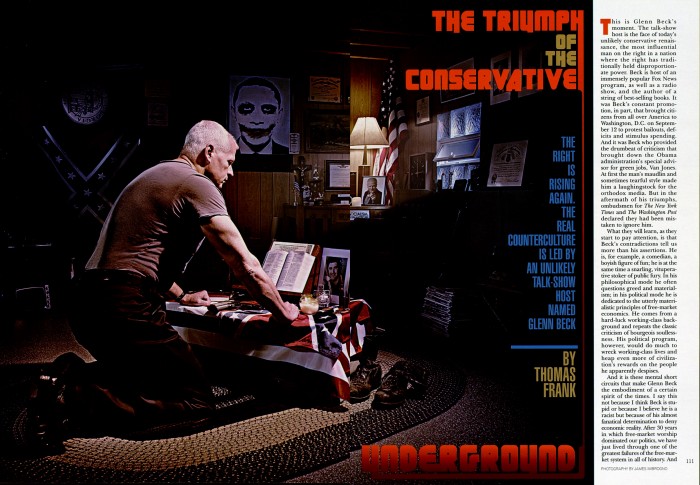
The Triumph Of The Conservative Underground
December, 2009
The Right is rising again. The real counterculture is led by an unlikely talk-show host named Glenn Beck
RIGHT
AGAIN.
COUNTERCULTURE
IS LED RY
AN UNLIKELY
TALK-SHOW
MIM
NAMED GLENN DECK
This is Glenn Beck's moment. The talk-show host is the face of today's unlikely conservative renaissance, the most influential man on the right in a nation where the right has traditionally held disproportionate power. Beck is host of an immensely popular Fox News program, as well as a radio show, and the author of a string of best-selling books. It was Beck's constant promotion, in part, that brought citizens from all over America to Washington, D.C. on September 12 to protest bailouts, deficits and stimulus spending. And it was Beck who provided the drumbeat of criticism that brought down the Obama administration's special advisor for green jobs, Van Jones. At first the man's maudlin and sometimes tearful style made him a laughingstock for the orthodox media. But in the aftermath of his triumphs, ombudsmen for The New York Times and The Washington Post declared they had been mistaken to ignore him.
What they will learn, as they start to pay attention, is that Beck's contradictions tell us more than his assertions. He is, for example, a comedian, a boyish figure of fun; he is at the same time a snarling, vituperative stoker of public fury. In his philosophical mode he often questions greed and materialism; in his political mode he is dedicated to the utterly materialistic principles of free-market economics. He comes from a hard-luck working-class background and repeats the classic criticism of bourgeois soulless-ness. His political program, however, would do much to wreck working-class lives and heap even more of civilization's rewards on the people he apparently despises.
And it is these mental short circuits that make Glenn Beck the embodiment of a certain spirit of the times. I say this not because I think Beck is stupid or because I believe he is a racist but because of his almost fanatical determination to deny economic reality. After 30 years in which free-market worship dominated our politics, we have just lived through one of the greatest failures of the free-market system in all of history. And
the greatest political superstar of this age is a man who has made it his business to root out and assail critics of the free-market system. What's more, he does so as a self-proclaimed friend of the common man.
We may be living through a mild version of the Great Depression, but we have little of that era's radicalism to show for it. Instead we have Glenn Beck, a sort of Huey Long in reverse, a one-man Popular Front demanding defiandy that we be given more, more, more of the same.
A BRIEF HISTORY OF WHERE WE ARE TODAY
(1) Banks and mortgage lenders, left pretty much to their own devices after decades of deregulation, came to misbehave in a spectacular manner. They handed out mortgages to anyone. They handed out bonuses to the most reckless mortgage-granting employees. The credit-rating agencies then proceeded to slap triple-A labels on trash mortgages, repackaged as investments. The smartest B-school graduates in die world, when dieir turn came, snapped up those securities for the Wall Street banks where they too pulled down monumental bonuses every year. Then, when real estate prices stopped growing, it all fell apart. Credit markets froze. Stock markets plummeted. Banks failed. And finally, government stepped in to keep the system from collapsing completely.
The story has its complicated aspects and its technical details, but on the whole it isn't historically unique or dif-
ILIII Illl II IIT I IIIIIIIL Nllll.
ficult to understand. It repeats, on a vastly larger scale, familiar patterns of bubble-and-bust misbehavior from the 19th century, the Roaring Twenties, the savings-and-loan failures of the 1980s and the Enron collapse.
The lesson it teaches is also simple: From the raft of Wall Street disaster books to Alan Greenspan's confession of "shocked disbelief," most people who have studied the question believe we have come to the end of an era of de-supervision. Markets do not self-regulate. Government must be involved to prevent this disaster from repeating itself.
(2) Enter Glenn Beck and the right-wing revival he leads. For Beck, only one of the stages of the disaster that I lay out above holds any interest worth more than a joking sentence or two. This is the final step, in which government stepped in to avert disaster. The rest of the long story is of no consequence except for the various ways in which blame might somehow be pinned on government.
But the bailout, the Obama administration's stimulus package, and then the push for universal health insurance— this is something far worse than misguided policy making. This is tyranny aborning. This is "the road to socialism." This is a monstrous power grab by the people Beck calls Progressives— always with the capital P—who have bided their time for decades, waiting for their chance.
IT COULD BE WORSE
To write a serious critique of Beck is almost a waste of time. After all, the man has referred to himself as a "rodeo clown" and a "recovering scumbag." He has commented at length on his scuzzy former life in the professional radio fast lane—his onetime drug use, his former alcoholism, his assholish-ness. But it's not all in the past. Fans of his radio show appear to cherish, among other things, the moments when Beck is moved to incandescence by a liberal caller and shouts, climac-tically, his signature line: "Get off my phone," a phrase memorialized with the acronym GOMP.
On TV Beck routinely works himself into tears. He barks with fury. He seethes. He dreads. He weeps for his nation. He worries about imaginary betrayals. He is a buffoon. And his great vision for America is some kind of goo-goo civic togetherness in which we overcome various plots "to keep us from uniting," in which we get together and realize we "are not alone." References to the transformative power of brotherhood are one of Beck's great set pieces.
repeated in all manner of contexts. However, the only mass social movement in American life whose members actually address one another as "brother." who actually believe they can change the world through solidarity—organized labor—is an institution Beck despises with a surpassing ferocity.
Beck's books are boring stuff. If you've read much conservative literature, you've heard it all before. Beck reproduces standard-issue conservative talking points, bemoaning crazy lawsuits or the 1992 House banking scandal in precisely the same way you have seen crazy lawsuits or the House banking scandal bemoaned a dozen times already. He is given to preposterous numerology, reminding us how patriotic we all felt on September 12, 2001 and then insisting that 9/12 actually stands for "Nine Principles" and "12 Values," the latter of which turn out to be a virtue list in the manner of the Boy Scout law. All of which might lead a fan to conclude it was lucky the 9/11 terrorists attacked when they did instead of, say, February 24, because then they wouldn't have affirmed our nation's timeless principles and values.
And you could write an entire essay about the damage the man has done to journalism. According to the liberal media watchdog group Media Matters for America, the unfounded rumors to which Beck has given encouragement include: The Obama administration is supposedly setting up a secret, parallel army; the Treasury is possibly issuing secret bonds; the secret motivation for the Democrats' health care initiatives is an urge for "reparations." The grand conspiracy that fathers all others is invisible, of course, and Beck is always careful to acknowledge he doesn't know for sure, but he seems to find clues everywhere: in offhand statements by the president, in the board members of liberal groups, in the art found in and around Rockefeller Center in New York City. (My own conspiracy theory: Beck is just maybe a shill for gold interests, which prosper when disaster fears run wild, inflation seems imminent and the price of gold rises. As I write this, gold is trading near its all-time high, and Beck is appearing in ads for something called Goldline International.)
But here's the thing: For all his raving, Glenn Beck is not a marginal figure. His ideas are embraced by leaders of the Republican Party. He is defended by prominent conservative pundits and columnists. Men who held positions of enormous public power in the Bush administration appear regularly on his program, where they never seem to resent (continued on page 157)
CONSERVATIVE
(continued from page 112) Beck's fulminations against deficits or bailouts. And a publishing company owned by the Mormon Church issued the DVD in which he tells the story of his conversion to that faith.
Another thing: Beck may be misinformed, but he is not an idiot or an empty windbag. On the contrary, he is a highly talented performer. His TV monologues go seamlessly from juvenile sarcasm to genuine outrage, ascending always to stratospheric indignation before returning the viewer to the terra firma of low TV humor. He is self-deprecating and, at times, genuinely funny. He tells the story of his conversion to Mor-monism with real humor and no trace of
his usual viciousness. Beck is also fantastically prolific, issuing books of serious nonfiction, humorous pastiches in the familiar TV-comedian mode and fiction, too. The dude cranks text: In 2009 he published two books proper, one audiobook, one introduction to another author's (awful, conspiracy-minded) book and one older book reissued with a new introduction. In 2008 he published a work of fiction, a DVD of his election year "comedy tour" and another DVD in which he tearfully tells an auditorium lull of people the story of his sad and cruel life and his eventual conversion to Mormonism. This in addition to his constant churning of words as a TV host. He also spent part of last summer on another "comedy tour," which I'm sure will someday be made available for purchase in some manner.
DREAD WITH A SMILE
Maybe it is an unwritten rule of celebrity that all famous people are required, at some point in their career, to write a spiritual self-help book. Still, I was surprised to discover one penned by Beck, a man whom I knew, when 1 began working on this article, only as one of the meanest bastards of all times. I was further surprised to find that this particular how-lo-be-happy book—it's called The Christmas Sweater— was a thinly disguised account of the broadcaster's childhood. I mean, do bullies like Beck even have childhoods?
And here is the bit of advice that concludes the climactic scene of The Christmas Sweater, delivered by a wise, angelic stranger
to a teenage ingrate, a Beck figure known as Eddie: "You are joy, Eddie. You are joy."
Glenn Beck is joy? The guy who invented the GOMP? The man who once thought to while away his hours on the airwaves with fantasies of killing various liberals with a shovel?
How very strange this is. The Christmas Sweater is a mixture of nostalgia, confession and heavy-handed symbolism. The book was no doubt meant to be an addition to the heartwarming middle-class Christmas genre, with a blurb comparing it to the kitsch classic The Five People You Meet in Heaven and extolling it as "the best kind of gift." (My copy of The Christmas Sweater, which I bought secondhand for $4, carries an inscription commending the book as "a new Christmas storv tradition!" and is
signed "Grandma.") It is awash in cheap profundity, with grand revelations about the nature of happiness (clue: material things don't cut it) and hackneyed teachings about personal responsibility (insight: we choose whether or not to be happy). The book's climax, however, is basically borrowed from the movie version of The Wizard ofOz: The troubled teenager's epiphany comes when he decides to "come home" by walking through a swirling storm, leaving behind an awful monochrome cornfield for a beautiful Technicolor landscape. As he makes this journey, the juvenile Beck figure is guided by God instead of Glinda the Good Witch, but the story still ends with the teenager waking up from a deep sleep and realizing it was all a dream.
Then again, The Wizard of Oz is one of
Beck's favorite references, a work he apparently regards as one of timeless genius. Generally speaking, the anchorman is a great fan of sentimental kitsch. The Christmas Sweater looks back fondly to the days of the Firestone Christmas albums. On his TV program Beck frequently pays homage to Norman Rockwell and Jimmy Stewart.
Now, there's nothing new about spokesmen for the middle class loving Norman Rockwell, of course. But a cardinal feature of the warm old middlebrow aesthetic is its lack of critical edge: It is warm, enveloping, affirming. Yet here we find it dished up with a huge side order of scoffing, mockery and hate. Beck's TV program, on the other hand, is probably the most negative and manipulative bit of dread mongering ever broadcast. Every
episode of his show brings more tales of indoctrination in the schools, the coming of Obama's private army, the infiltration of government by men of crazy, alien views. Treachery is everywhere. The world is surely ending. According to Time magazine, he calls his studio the doom room. Beck doesn't want you to be happy; he wants you to shake with fear.
Just think about the contrast: Beck, the boyish and lovable comedian, relates the story of his childhood—and then damns and double damns the treacherous "socialists" among us. Beck, the tearful patriot, extols the heartland—and then heaps calumny upon politically correct euphemism. His precious American things (the Constitution, the founding fathers) are invio-
lable, always to be revered; the objects of other Americans' reverence (Franklin Roosevelt, public schools) are to be ripped into whenever convenient. It's like the story of the John Birch Society as told by Frank Capra. It's Babbitt with a stiletto.
ANCESTOR WORSHIP
Beck has described his political epiphany as follows. Back in 2007 or 2008 the TV host was walking down a street in New York City, worrying about "the economic nightmare that is on its way" thanks to the federal deficit, a fairly routine concern for him. Then the answer came to him, "and best of all, the thinking and worrying had already been done for me." It was this: "The questions we face were foreseen by the greatest group of Americans to ever
live, our founding fathers." They were a really smart bunch, and "they knew we would be grappling with issues like the ones we face today at some point, so they designed a ship that could withstand even the mightiest storm."
As far as I know. Beck has never accused one of the country's founding fathers of having been a secret socialist, although it would not be a hard case to make, given, say, Alexander Hamilton's ideas about industrial development and Beck's extremely low standard of proof. (He does accuse the English colonists at Jamestown of this sin, however. The initial failures there were, per Beck, "pure socialism in action.")
No. The founders were virtually incapable of error in Beck's mind. They knew how society should be organized, and they drew up a plan that was well-nigh perfect: the
Constitution. (In Arguing With Idiots, Beck admits there is a punctuation error in the Constitution. This is a big admission coming from him.)
Beck knows it is perfect for two reasons. First, because America is rich, with Americans inventing lots of things over the years. The Constitution thus gives us "prosperity principles," like a really good self-help book or something. (Elsewhere, of course, Beck scoffs bitterly at worldly success, but we don't have time for that now.)
Second, we know it's perfect because the founders were basically stenographers for the Almighty. "The words contained in our Constitution, while written by our founding fathers, come directly from God," Beck writes, "as do the rights they grant us."
What the founders and the Constitution
were all about is pretty simple: free-market economics. Do as the founders say—or as Glenn Beck thinks they say—and you will gel rich. Deviate from the founders' God-prescribed course, and you will have problems. Simple, right?
When Beck writes "We have no idea who our founders really were." I am in hearty agreement. There is something so brain-ratllingly foolish about his understanding of history that it embarrasses me merely to set it down among the shapely babes of piAVBov. The Federalist period was a lime of robust, freewheeling debate, with voices from all sides advocating this course or thai. The founders themselves disagreed all the time—among other things, over the issue of a national debt. (Jefferson feared it, Hamilton didn't.) But here in Beck world they speak with one mellow voice; they are puppets of God, automatic writers for the divine will.
The funny thing is, Beck's political views and even his vision of the founding generation are actually repudiated by the very founder Beck loves most. I refer to Thomas Paine, the Revolutionary War pamphleteer upon whom Beck and so many other wingers these days are weirdly fixated. Beck named one of his 2009 books after Paine's famous 1776 pamphlet. Common Sense—not because of any specific insight, it seems, but because he likes to imagine we are living today under an "out-of-control government" every bit as offensive to "common sense" as that of George III. During his Common Sense Comedy Tour last summer Beck reportedly took to the stage dressed as Paine.
But Paine gave the world more than those two words. And when we open Paine's even more famous work. The Rights of Man, a defense of the French Revolution, we find that it begins with a denunciation of the very idea of one generation binding future generations. "You must heed the call of generations past," Beck pontificates in his homage to Paine. "The vanity and presumption of governing beyond the grave is the most ridiculous and insolent of all tyrannies," I'aine slapped back in 1791. "Man has no property in man; neither has any generation a property in the generations which arc lo follow."
Should we read The Rights nf Man all the way to the end, we find Paine calling on the F.nglish government to furnish the public with old-age pensions, subsidies to the poor, payments lo mothers on the birth of children (welfare!) and guaranteed employment for everyone in the large cities. Should we carry our interest in Paine so far as lo read his 1797 pamphlet. Agrarian justice, we will find—I hope you are silting down for this. Beck—that Paine proposed a national pension system based on a property tax! Now, hating Social Security is such a no-brainer on the right—the host himself has called it a Pon/j scheme—thai perhaps Beck's followers can be excused for assuming that old Tom Paine was right there with them down to the last shake of their Ayn Rand placard. Still, they might have bothered to consult the Social Security website, where they will find Paine's pamphlet reproduced as one of the "key early documents" in the struggle for old-age security.
And there is something more than a little peculiar about a devoted Mormon like Beck being a Paine fan. Until a short while ago Paine was mainly remembered as the man who despised organized religion. Debunking religion's historical claims was, in fact, the subject of Paine's most famous work, The Age of Reason (1794), in which the pamphleteer trashes the Bible book by book, describing the story of Jonah, the virgin birth and the crucifixion all as bad jokes on a gullible mankind. In a famous passage this scoffing founder wrote, "Of all the systems of religion that ever were invented, there is none more derogatory to the Almighty, more unedifying to man, more repugnant to reason and more contradictory in itself than this thing called Christianity. Too absurd for belief, too impossible to convince and too inconsistent for practice, it renders the heart torpid or produces only atheists and fanatics."
But the contradiction simply passes. It carries no penalty. Thomas Paine savages
your worldview, and so you don tricorn hats and declare yourselves modern-day Paines. Deregulated capitalism crashes and our Internet-age right persuades itself that what we need is more deregulation.
GOD, NATURE AND THE MARKET
Glenn Beck's understanding of politics is a simple one: We have the owner's manual God gave us, the Constitution. Through the political system it established and through "marketplace realities," we once obeyed the "laws of nature." We didn't do this through some intellectual scheme, either: Our otherworldly founders "understood that WE are an intuitive people." (And as the hero of The Christmas Sweater was told, "You have to stop thinking so much and instead start feeling again.")
Ah, but today our leaders are not "intuitive"; they do not do things by feel. They are intellectuals, "experts and elitists." Thinking so much is precisely their problem. They believe they are smarter than everyone else. And with their fancy ideas and brilliant schemes they have led us astray. "These people could not
be more out of step with the Founders if they tried," Beck cries at one point.
It is not enough to describe Beck's understanding of politics as one in which liberals vie against conservatives; it's earthier than that. It's nature vs. artifice, the public vs. government, capitalism and freedom vs. socialism and tyranny.
Now, you may be aware that the grand sweep of global history has for decades been running capitalism's way. The Cold War ended iti the late 1980s; free-market economists soon established such a lock hold on the world's political imagination that for a while it seemed as though the prominent ones were issued their own former Kastern bloc or third world country to remake in Milton Friedman's image. Tuned-in types talked about the "Washington consensus" in trade matters, and just about every pundit was required to write a Tom Friedman-style book about the miracles of the freewheeling global marketplace.
But maybe that was all just propaganda, designed to lull our modern-day patriots back to sleep. If you listen to Beck, what you know is that socialists have actually been winning for a very long time. Secretly, of course: The correct term for our rulers' ideology, Beck instructs us, is progressivism. It is a diseased doctrine that holds the state above the individual, that reveres "experts," that controls both parties and that is "taking us down a subtle road to tyranny."
Actually, it's not so subtle; it's more of a loud and obnoxious road, a road that rears right back and slaps you in the face. At some point in 2008, for example, Beck noticed that the Treasury Department was bailing out American banks. This confirmed the worst: Socialism was almost here! We were about to nationalize the banks! In his book-length homage to Paine, Beck asks, "Did all of those companies really need that money, or was it in the government's interest to force it down their throats so they'd have some control over them?" A person who reads newspapers may be troubled by the bailouts but may also consider, when answering Beck's question, that the government refused to put the "zombie banks" into receivership and that the government has so far declined to vote its shares in the banks it partially owns. But such a person would have failed the quiz: Of course the government bailed banks out in order to tighten its grip on us.
Everywhere in Beckland we encounter ulterior motives, sneaky maneuvers, treachery and plots—plots so big they stretch across the centuries, resurfacing here and there as the generations pass and the opportunities present themselves.
The political system, for example, is a scheme so malevolent it's barely comprehensible: "Political parties are intentionally causing problems so they can later attempt (and fail) at fixing them," Beck writes. "The greater our problems, the more we're supposed to need them around."
Federal regulations are also maliciously conceived. Such rules aren't about making the economy safer or better. Beck assures us; "they're about breaking your spirit. They're about sending you the message that you arc no more important or
significant than the spotted owl or a salt marsh harvest mouse.'
Meanwhile, the oppressors are scheming to get us. "For those who continue to fight and resist, the government is watching," Beck warns. "It doesn't matter if common sense or even facts are on your side—if something goes against the Progressive agenda, it will be targeted."
The political tradition from which Beck arises is not conservatism per se; it is the famous paranoid style. Beck's favorite political theorist, apart from the founders, is the late conspiracy theorist W. Cleon Skousen, whose many demented works Beck frequently promotes. Beck has suggested that modern art is a communist trick, along with the dismantling of the European colonial empires and the termination of the House Un-American Activities Committee. Viewers of his TV program know of his frequent episodes of fear about the coming totalitarian takeover. They have been dazzled by the charts with which Beck links all the sinister liberal organizations that have come together to deliver us into the hands of Obama. Indeed, he embraces the paranoid style so reliably that he even makes jokes about it himself: A Beck book chapter about the coming "continental government" in which U.S. sovereignty is to be surrendered to a Canadian-Mexican super-stale controlled by evil elites is also cluttered with sidebars teasing Beck for his paranoia and offering advice about tinfoil hats.
Even so, the omnipresence of conspiracy is central to Beck's act. When Beck smirks and giggles while the footage rolls and the liberals blab, it's because Beck sincerely thinks he's onto them. He knows their secret. And his audience knows too.
ME SURROUNDS US
So what is it about this preposterous man, crying and raging as he spells out his flimsy ideas? In his 2003 book The Real America, Beck devotes a few sullen pages to the subject of his predecessor, Senator Joseph McCarthy, the notorious Red-hunting demagogue of the 1950s. Beck admits McCarthy was "one of the worst things that ever happened to America" but not for the reasons agreed on by everyone else. Beck's objection is that McCarthy "made cries of communism a joke." He discredited Red hunting so thoroughly that "Nowadays when you say, 'Urn, you know, So-and-So is a Socialist,' everybody laughs.' (Generally speaking, however, while McCarthy denounced "subversives," he did not hunt socialists, only members or former members of the Communist Party. Beck may find socialism and communism indistinguishable, but the Socialist Party, although feeble, was above ground and perfectly legitimate in McCarthy's heyday.)
Pity Glenn Beck, laughed at by the crowd merely for engaging in the all-American pastime of singling out the pinkos. And pity him even more for having to get a Red scare going when there is no Soviet Union to make the whole thing seem plausible.
But where did the Red baiters of yore actually go astray? Beck partially rules out the standard charge—that they recklessly
accused innocent people—but he doesn't say much more than that. The rest of Beck's work, however, suggests an answer: It's that the Red hunters of the past were far too fastidious in their accusations.
Newspaper readers among us may recall that some of our greatest anticommunists were liberal Democrats (Lyndon Johnson, Harry Truman); they may also remember that our allies in the Cold War (Britain, France, Germany, Israel, Italy) were periodically ruled by socialist parties. If Beck is aware of this, it must strike him as a particularly cunning bit of Progressive duplicity: In much of his oeuvre, after all, communism and socialism are interchangeable names for the same thing, while "a Trojan horse called 'liberalism'" is identified in his 2003 book as communism's vehicle of choice. These are views the great Red hunters may have held privately but that would have sentenced them to the Birch Society fringe had they stated them outright.
Which brings us to the most perplexing question about Beck's meteoric popularity. How can you have a Red scare with no Reds? How can you pump up fear of a communist takeover when the Soviet Union has disappeared and Red China is even more capitalist than we are?
The answer is simple—if you feel rather than think: The absence of actual communists simply frees the Red hunter from scruple. There are no bright lines separating liberals from communism anymore, and the whole political spectrum to the left of pure laissez-faire libertarianism blends into one Red mess. It's like the photos that illustrate Beck's 2009 book, Arguing With Idiots: a Soviet military officer who makes stupid arguments (opposing private schools, for example) and a founding father in a powdered wig who slaps him down ("Frankly that sounds a little socialist"). Soviet communism versus 18th century federalism is the only choice out there. The grand sweep of politics can now be seen as a whole: Liberals are socialists; socialists are communists; welfare-state France is not appreciably different from Mao's China; Hank Paulson's TARP equals Joe Stalin's USSR.
And the rest of us? Why do we make Glenn Beck's books into number one best-sellers? Why do we tune in every day to hear the latest installment in the "march to socialism"?
Because it's fun to have those tricky commies back. It is thrilling to imagine that everyday liberalism is secretly a form of totalitarianism, that just under that friendly politician surface lies a monster who will enslave us and that you alone, with your band of brothers, know the secret. It is fun to think that you are a modern-day Tom Paine when you denounce the "public option" on a blog's comments page. It makes you feel heroic when you stand up and insult the Democratic member of Congress who you have convinced yourself is scheming to indoctrinate your child. And it is flattering to believe that when you grumble about your overpaid union workers, you are really speaking up boldly for human freedom itself.

