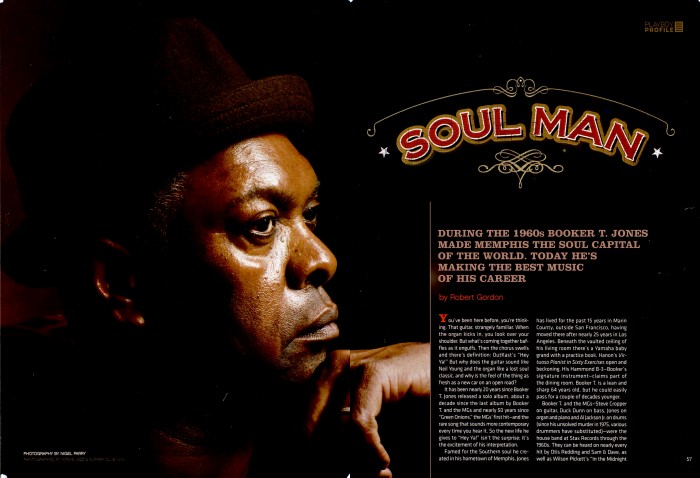
Soul Man
June, 2009
DURING THE 1960s BOOKER T. JONES MADE MEMPHIS THE SOUL CAPITAL OF THE WORLD. TODAY HE'S MAKING THE BEST MUSIC OF HIS CAREER
ou've been here before, you're thinking. That guitar, strangely familiar. When the organ kicks in, you look over your shoulder. But what's coming together baffles as it engulfs. Then the chorus swells and there's definition: OutKast's "Hey Ya!" Gut why does the guitar sound like Neil Young and the organ like a lost soul classic, and why is the feel of the thing as fresh as a new car on an open road?
It has been nearly 20 years since Booker T. Jones released a solo album, about a decade since the last album by Booker T. and the MGs and nearly 50 years since "Green Onions." the MGs' first hit-and the rare song that sounds more contemporary every time you hear it. So the new life he gives to "Hey Ya!" isn't the surprise; it's the excitement of his interpretation.
Famed for the Southern soul he created in his hometown of Memphis, Jones
has lived for the past 15 years in Marin County, outside San Francisco, having moved there after nearly 25 years in Los Angeles. Beneath the vaulted ceiling of his living room there's a Yamaha baby grand with a practice book. Hanon's Virtuoso Pianist in Sixty Exercises open and beckoning. His Hammond B-3-Booker's signature instrument-claims part of the dining room. Booker T. is a lean and sharp 64 years old, but he could easily pass for a couple of decades younger.
Booker T. and the MCs-Steve Cropper on guitar, Duck Dunn on bass. Jones on organ and piano and Al lackson Jr. on drums (since his unsolved murder in 1975, various drummers have substituted)-were the house band at Stax Records through the 1960s. They can be heard on nearly every hit by Otis Redding and Sam & Dave, as well as Wilson Picketts "In the Midnight
Hour," Rufus Thomas's "Walking the Dog" and their own hits, among them the instrumental "Hip Hug Her" and "Time Is Tight." Their soulful versatility made them the obvious selection as house band at Atlantic Records' 1986 celebration, which led to a gig as house band at Madison Square Garden's Bob Fest honoring Bob Dylan's 30 years in music; there they backed up Neil Young, who asked them to tour and record with him. They were also the house band for the grand opening of the Rock and Roll Hall of Fame, and Eric Clapton enlisted them to back everyone at his first Crossroads Festival. Booker T. and the MGs have been inducted into the rock Hall of Fame and received a Grammy Lifetime Achievement Award. They bring out the best in a musician.
Known for being able to play anything with anyone, Jones finds a new direction with his latest release, the smoking-hot Potato Hole. One
of the most famous organ players of all time, Jones has made his first guitar album. Potato Hole is as funky as most anything he has done, and as soulful, but the mass of rocking guitars is new territory and thrilling. "Neil Young was the main influence for this record," he says, also citing Lynyrd Skynyrd. Jones composed the songs on the guitar, and to get the attack he needed he brought in the three-guitar army of the Drive-By Truckers, fueled further by Mr. Young himself-on guitar only and ready for bear, just wailing. "Booker's ear is so fine-tuned," says Patterson Hood of the Truckers. "We'd be rehearsing, and he'd say, 'If you would move your index finger up one fret, and you [another guitarist] move down one, let's see what happens.' The whole thing would open up in new ways."
"I was surprised he wanted so many guitars," says Truckers guitarist Mike Cooley. "Then I heard the demos. His guitar was all fuzzed out, and I knew why he was coming to us. The opening song-that's how you make an entrance. Bam! This is going to rock."
"Pound It Out," that first track, opens with a riff of classic organ notes and then a guitar so crunchy it sounds like the speakers are disintegrating. Before you can check for damage, it repeats itself: classic organ, arena guitar. "It's a call-and-response," says Booker. "I ask, 'Are you there?' And they answer, 'Yeah, we're here.' It's definitely a testing of the boundaries and a pushing back." That's the Booker T. Jones story: Test the boundaries, find a new place to go.
Booker T. Jones comes from a family of pursuers. His grandfather owned land in Mississippi when few blacks could, and on it he built not only a home but a school in which he taught others. Jones's father moved to Mem-
phis and taught math at Booker T. Washington High School, the neighborhood institution from which many of the Stax players graduated.
Jones heard his own calling in elementary school, and though fourth-graders were too young to join the school band, he got in by taking the instrument no one else wanted-oboe. He shifted to clarinet, then piano. The movement from a C instrument to a B-flat and back to a C inscribed a strong sense of musical structure early.
One sound, however, remained unfamiliar and intriguing. Jones would stand outside the neighborhood's sanctified church he was afraid to enter, and outside the Club Handy he was forbidden to enter, listening. "I wasn't sure what it was," he says of the Hammond organ, which emanated from-and seemed to function similarly in-both places. "You talk about making the room (concluded on page 118)
BOOKER T.
(continued from page 58) pulsate: Blind Oscar on the organ could fill up that Club Handy with sound."
In the late 1950s Memphis was the capital of groove—big bands, small bands, rock bands, rhythm and blues. Before he could legally drive, Booker T. Jones had become the go-to guy for Memphis"s best R&B bands, a multi-instrumentalist with a deep feel for the guitar. "The bandleaders had to persuade my mom and dad that they were okay," he says. "I'd play baritone sax, piano, and I had that Sears Silvertone guitar and a little amp. We'd be in these cow-pasture joints, playing uptempo blues, and when it gets a tittle too late and a little too loud and the sheriff is in there and everybody's dancing and it's hot and it's grinding and the guitar gets turned up and it starts to crunch—I could make that guitar do that. Those were the beginnings of rock and roll. But you didn't do that at Stax Records."
His introduction to Stax, which would become the chief purveyor of sweet soul music in the 1960s and 1970s, came when the label was renovating his neighborhood's movie theater, making it into a recording studio. Rufus Thomas, who lived nearby, walked in with a song idea that needed a baritone sax. The bandleader got Booker from his 11th-grade algebra class; he borrowed the school's horn. "Before I left that session," says Booker, "I let diem know I played piano, too."
Stax turned out to be a great opportunity. Most of the grown-up musicians worked day jobs and had families, so once Booker finished his paper route, he'd play sessions all evening. One Sunday he and some other guys grew tired of waiting for rockabilly singer Billy Lee Riley to show up. They cut a blues number popular in the clubs, "Behave Yourself." To release it as a single, they needed a B side. Steve Cropper reminded Booker of a piano riffhe'd been fooling widi, and Booker tried it on the organ. Not long after, disc jockeys were favoring the flip side, and "Green Onions" became an international hit. Happenstance formed Booker T. and the MGs; serendipity made them an integrated band.
"If you think about it, you'd be stupid to try to start something like that in 1962 in Memphis," Booker says. "In those days in Memphis some terribly inhuman acts happened. The emotion was extreme in the South and in this country—it was out of control. If we'd thought about it, there'd be no way the band could work." Memphis was their home, but the city each member lived in was vastly different. The musicians built a rare bridge between their cultures that has since been trod across and danced on by generations. "I think our purpose was so true that the racial issue just became secondary."
That focus on the music kept them together as Stax went through a variety of growing pains and ownership turmoil, and it allowed them to continue as a group even after Booker moved away from Memphis. In 1967 the MGs and Otis Redding stole the show at the Monterey Pop Festival. But in turn, California stole Booker's heart. "I stepped on the street in Monterey, and it changed my life," he says. "For the first time I saw restaurants giving out food for free. People were sharing hotel rooms and
disregarding money. I never felt an attitude like that before."
Three years later, when Stax was temporarily run by absentee owners whose memorandums stank of greed, Jones remembered die generosity he'd witnessed out West—and he moved there. The MGs then recorded Melting Pot, the title song of which has often been sampled. But when Jackson died, the group disbanded. Cropper and Dunn were in demand as producers and session players; Booker, who had produced Bill Withers's debut album, including "Ain't No Sunshine," and played with Bob Dylan on die soundtrack to Pat Gar-rett and Billy the Kid, was living in Malibu. He and neighbor Willie Nelson had begun playing guitar on each other's decks at the ocean, and they found a shared admiration for some of pop's classics. People tried to dissuade Nelson from pursuing it, but Booker recorded Nelson in Emmylou Harris's Beverly Hills home, and soon even the execs couldn't deny die magic of what became the multiplatinum-selling Stardust. Jones has remained the go-to guy for musicians of all genres.
"Rock and roll is all about politics to me," Jones says. "Music of the status quo and the establishment is quiet and polite, and rock and roll is anydiing but polite." The songs on Potato Hole gestated while the American status quo was changing, while Barack Obama was establishing himself as a contender for a job held for 200 years by a white-skinned person. "This music came from that attitude. I can feel proud of America because I've been ashamed of America. I've been in Europe and wished 1 could speak a different language. The men who wrote die Constitution were some of the smartest and bravest who ever lived. Since we've elected a black man as president, we've become a beacon to the world. We actually do live our creed."
This soul man's venture into rock and roll, then, is less a genre jump than a divining of the change in the world around him. The intensity of the music—and its accessibility—is his reflection of a changing America. "The actual music can mean an emotion—they can be one and die same," he says. "A piece like Fin-landia by Sibelius—how does a man write that? His country has been taken and belongs to another country. When an artist can put an emotion in a piece of music and a listener feels the same emotion, then it has been transferred. That's just a real true diing you can't touch."
That real true thing is elusive and difficult to create, but Jones strives for nothing less. "The creative process can be almost divine in its beauty if it's allowed to reflect its source," he says, "but so many things can get in the way. You can forget your idea. You can be unable to re-create it. It may not be recorded correcdy." He thrives on the generosity of music—sharing his interpretations. "The Drive-By Truckers let me have the reins. They understood this music and diey put their own personality into it, and I was inspired to go further with diem."
In an album full of surprises, one of the biggest is die cover of Tom Waits's "Get Behind the Mule." "My family comes from the backwoods of Mississippi, and diat's what they did for years—got behind the mule. My uncle took me out in die field, put my hands up on the
plow and said, 'This is how you do it. You've got to keep it right in the row here." And the mule can be stubborn. And when it's raining, when the sun's shining, when it's hot. when it's cold—you're looking at a mule's ass. This is your life. But the verse that got me was that someone committed a murder and didn't run. You've got to pay for it. Got to get behind the mule. It's just a few words, but it says a lot."
The album's name. Potato Hole, comes from Booker T. Washington's autobiography. Up From Slavery, a book Jones was recently reading. It refers to a hole in a cabin's earthen floor where food was kept. "I recall that during the process of putting the potatoes in or taking them out," Washington writes, "I would often come into possession of one or two. which I roasted and thoroughly enjoyed." Similarly. Jones considers this album "a place where you deposit a group of happy feelings. We used to have a joint back in college where all the blacks would hang out. We called it the Hole. It was a party place with dancing, and the music also came from thinking about that."
The conversation has subsided, and the sound of Booker's wife, Nan, preparing a meal in the next room emerges—to me. To Booker, the sound gavottes. Something is being chopped, a plate is lifted from a stack. The living room is bathed in light. The bookcases reflect interests in history and music. Booker says, "We're sitting here now, hearing these sounds. There's nothing distracting us. Suddenly you begin to feel her. You look at this place; you look at me, what she has done for me, the family, and you begin to feel Nan." For Booker T, the world is a constant inspiration for music, and tuning in can result in, for example, track five, "Nan," on Potato Hole. A part of him is always ready for melody, rhythm and perception to gel.
The food is ready. "I think the reason any of the artistic process works for me," he says, "is I have learned to shut off the creative ideas and the constant flow of music in my mind at the right times. You have to function in the real world. You can't always be in your studio. The trick is to shut the valve off and deal with it."
He rises and leads the way toward the dining room, the creative switch flipped off. But after one step, he turns and snatches a nearby book, The Golden Ratio, from a table and says, "Music gives you a way to organize not only notes but all sorts of ideas that fit into that framework. You think of 12 notes in the scale, 12 colors in the spectrum, 12 months in the year and 12 bars in blues. That's Western music, but what about Eastern music? What if you have 16 bars or 13? Thirteen is the magic number if you use it in conjunction with eight and five. And that's the golden ratio." He smiles. "There are so many possibilities to link music with mathematics and beauty, with nature and art."
That switch is never really turned off. He glides on the currents of music, seeing and hearing the world as the elements of a composition. Memories, politics, family, mathematical theory and a field's furrowed rows, the grind of an old roadhouse, the crackling of a purloined potato as it cooks—everything makes a meal for Booker T Jones.

