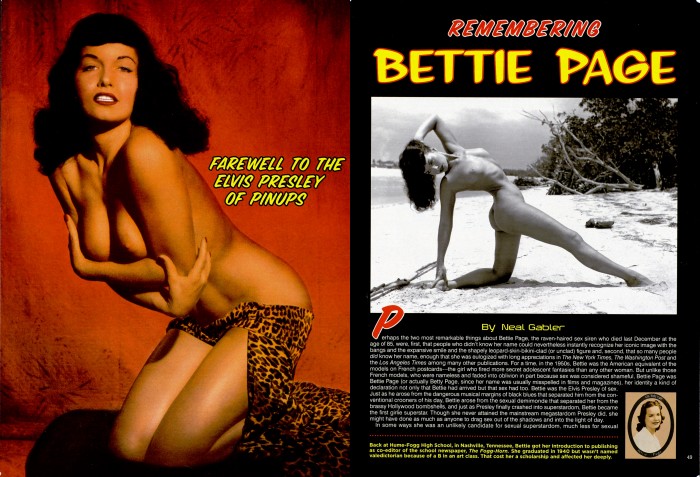
Remembering Bettie Page
April, 2009
n/ erhaps the two most remarkable things about Bettie Page, the raven-haired sex siren who died last December at the age of 85, were, first, that people who didn't know her name could nevertheless instantly recognize her iconic image with the bangs and the expansive smile and the shapely leopard-skin-bikini-clad (or unclad) figure and. second, that so many people did know her name, enough that she was eulogized with long appreciations in The New York Times, The Washington Post and the Los Angeles Times among many other publications. For a time, in the 1950s. Bettie was the American equivalent of the models on French postcards—the girl who fired more secret adolescent fantasies than any other woman. But unlike those French models, who were nameless and faded into oblivion in part because sex was considered shameful. Bettie Page was
eclaration not only that Bettie had arrived but that sex had too. Bettie was the Elvis Presley of sex. Just as he arose from the dangerous musical margins of black blues that separated him from the conventional crooners of his day, Bettie arose from the sexual demimonde that separated her from the brassy Hollywood bombshells, and just as Presley finally crashed into superstardom. Bettie became the first girlie superstar. Though she never attained the mainstream megastardom Presley did. she might have done as much as anyone to drag sex out of the shadows and into the light of day. In some ways she was an unlikely candidate for sexual superstardom, much less for sexual
SMS-PRESLEY
—OF'PtNUPS
trailblazing. Though pretty, she wasn't classically beautiful. One eye drooped slightly, and both eyes were smallish under high, arching brows that made them seem even smaller. She wasn't statuesque, either. If anything, she was lithe. Her figure was a perfect 36-23-35, but her breasts were not hard and bomb shaped like today's silicone versions, and she confessed that before her period they could get soft, as she lamented they had been for her famous playboy Centerfold of January 1955. (It takes a real professional to be that aware of her body.) She didn't have the typical attitude of the girlie star. In her movies she doesn't undulate so much as wiggle. She wasn't pouty, sultry, coy or seductive, though she occasionally affected those poses. But when she narrowed her eyes, puckered her mouth and cooed, she seemed to parody sex rather than embody it. At best she was what used to be called saucy.
Still, Bettie did have something beyond sauciness that catapulted her into stardom from the ranks of the girlie models who pranced about in their lingerie in Titter, Flirt, Stare, Bold Girls! and the other declasse men's magazines of the 1950s. What Bettie had in abundance was joie de vivre. This was a girl who clearly liked being in front of the camera, liked to show herself off, liked her body, liked the whole idea of men watching her and liked sex. Her most prominent feature wasn't her bosom, though her bosom was certainly attractive; it was that vast smile of hers, her lips glistening with lipstick and revealing an expanse of perfect teeth. In her films and photos Bettie is almost always smiling. She is one happy, happy lady.
From her personal history, Bettie Page would seem to have had nothing much to smile about, which is one reason why her joy was so powerfully expressed. She was born on April 22, 1923 in Nashville, but her family was nomadic, moving wherever her auto-mechanic father could find a job to support his wife and six children. Trying to get from Texas back to Tennessee during the Depression, Roy Page stole a police car, was arrested and was sentenced to the penitentiary in Atlanta. To add to the Dickensian drama, Bettie would later claim he had molested her. After his incarceration Bettie and her sisters were placed in an orphanage because their mother couldn't support them. It was here, Bettie said, that she learned how to pose by playing a game called program, in which a girl would stand in the center of a circle while other girls called out roles for her to play.
She eventually found her bliss not in her beauty but in her brains. She was the salutatorian at Hume-Fogg High School in Nashville, losing valedictorian because of a B in an art class. She called this a life-changing event because the valedictorian received a full scholarship to Vanderbilt. Losing the scholarship, Bettie said, she lost her ambition and
will. Instead, she attended the lesser George Peabody College for Teachers, directly across the street from Van-derbilt, graduated and briefly taught school, admitting she had a hard time keeping the boys in line.
Her life took an important turn right before she left for Peabody, when Billy Neal, a local high school football star, wolf whistled at her while he cruised by in a convertible with a friend, beginning a romance that culminated in marriage. (She was wed in a black dress in a five-minute ceremony on a Saturday morning, which, she would say, clearly expressed her ambivalence about her matrimony.) She joined Neal in northern California, where he was stationed during World War II before he shipped out with the Navy to the Pacific, and it was while she was in San Francisco, working as a secretary and doing some modeling, that she was discovered by Art Grayson, a window washer who had done some directing in silent movies. Grayson sent Bettie's photo to 20th Century Fox and got her a screen test, which she failed because, she said, they made her up like Joan Crawford, in an exotic, glamorous look that contradicted her homespun beauty.
Bettie never made it in Hollywood—to her everlasting regret, she ignored an invitation from Warner Bros.
for another screen test, opting to return to Nashville with Neal—but the movies were never really her metier anyway. She was probably too unaffected for Hollywood, too joyously unself-conscious. The mainstream Hollywood sex symbols at the time were bigger and brassier than Bettie and more outre; it was almost as if a woman had to be blonde, buxom and bejeweled to broadcast her sexuality and warn mortal men of her danger—a stereotype Marilyn Monroe eventually managed to spoof and defuse. The bombshells were also more self-aware than Bettie. Monroe may have been typecast as a dumb blonde, but on-screen and off she was always alert to her effect, always sensitive to her needs; she was clever and surreptitiously willful. Bettie, however, was openly compliant, both in her life and in her photos. There was no calculation about her, not even much intention. "After losing out as valedictorian, for some reason I took whatever life gave me," she once said. Another time she said she had
started modeling only because "I could make more money in two hours as a model than in 40 hours as a secretary." Despite appearances on The Jackie Glea-son Show and in several off-Broadway productions, she dismissed ideas that she ever had any ambitions as an actress or as anything else, for that matter.
Bettie's real medium was photography, in which her compliance was a virtue. After the war, she and Neal divorced, and Bettie wound up in New York, where she was spotted in Central Park or at Coney Island or on Jones Beach (the stories vary) in the early 1950s by Jerry Tibbs, a muscular policeman who was also an amateur photographer. Tibbs introduced Bettie to "camera clubs" where models posed
for members. He also convinced Bettie to mask her high forehead with the bangs that would become her trademark.
As a poser, Bettie was a natural. The seductiveness in her photos might have been faked; the joy was real. Bettie found liberation in front of the camera, and her pictures were her fantasy just as surely as they were the fantasy of the men who looked at them. Her own romantic life was bleak. The love of her life, a handsome Peruvian, turned out to be married, and during her peak years as a model in New York, Bettie later said, "I had less sex than at any other time of my life." The camera was her sex and her release. "Nobody knew it, but sometimes
I used to imagine the camera was my boyfriend and I was making love to him," she told playboy in 2007.
It showed. What Bettie couldn't achieve in Hollywood, she achieved in the world of silent girlie films and bondage photos and movies in which her playfulness distinguished her. The Josef von Sternberg to Bettie's Marlene Dietrich was a portly, balding entrepreneur named Irving Klaw, who, with his sister Paula, made his living in an office on New York's East 14th Street, selling photos of movie stars until the Klaws discovered a market for silent films and photos of young women in lingerie gyrating for the camera or of women bound and gagged. Bettie began as a Klaw model in 1952. Within a short time, though, Klaw's customers recognized the woman with the long black tresses falling halfway down her back, the bangs, the smile and the palpable sexual joy as the Queen of Curves or the Dark Angel or the Queen of Bondage or Miss Pinup Girl of the World,
in the same way an earlier generation of moviegoers had identified an unknown comedian as the Tramp or a winsome young actress as the Girl With the Curls. And inevitably, just as the Tramp rapidly emerged as Charlie Chaplin and the Girl With the Curls as Mary Pickford, the Queen of Curves became known as Bettie Page. Her fans discovered and anointed her. "Page is the rage" was how one magazine put it.
But it was by any standard an odd sort of stardom, the stardom of the sexual netherworld. There would be no big-budget Technicolor movies for Bettie Page. (There was barely a talkie, only Klaw's cheesy Variefease, a burlesque film in which Bettie does a dance of the four veils, and its equally cheesy sequel, Teaserama.) There would be no publicity campaigns, no interviews in glossy
magazines, no gossip about her in the major columns, not even the kind of tittering mainstream notoriety that strippers Lili St. Cyr and Gypsy Rose Lee attracted. The general public wouldn't know her name. Bettie was a star sub rosa—a star of eight-millimeter peep-show movies and tawdry men's magazines. She wasn't fit for polite society.
Viewing Bettie's short Klaw films today is like taking a time machine to an ancient past. Even the titles seem antediluvian: Peppy Graceful Dance, Joyful Dance by Betty, Betty's Clown Dance (with a clown doll), Betty's Lingerie Tease Dance, Return of the Teaser Girl. Despite those titles Bettie really doesn't dance. She shimmies, shakes her rump, kicks her legs, bumps and grinds, tosses her head and runs her fingers through her hair, blows kisses to the camera, fiddles with her nylons and, of course, smiles—always smiles. She typically wears black nylon stockings, stiletto heels, evening gloves and a brassiere and panties, both generously cut to (concluded on page 92)
BETTIE PAGE
(continued from page 53) leave a great deal to the imagination. She isn't nude or anything close to it. She just seems like a very pretty girl, comfortable in her own skin, having a grand time alone in her basement rec room—which is what passed for risque in the 1950s, when Bettie reigned. Or put another way, the prurience of her day is the prudery of ours.
Though Bettie may seem like an anachronism, she served as a bridge between those naive 1950s and the much more sexually open and explicit period that followed, between the downscale girlie magazines in which sex was still vaguely taboo and the more respectable magazines like playboy in which sex was an accepted facet of a healthy, normal life. That's what made her a sexual pioneer, as well as a star. By the mid-1950s she had graduated from the amateurish Klaw films to the photographs of Bunny Yeager, a model turned photographer. Yeager upped the ante. If KJaw had been Bettie's Von Sternberg, Yeager was her Picasso. Yeager recognized that Bettie's appeal was her joyous abandon, and she mined it in numerous photographs of Bettie both clothed in bikinis and unclothed: Bettie on the beach, Bettie in the woods, Bettie aboard a ship, Bettie splashing in the water. But Yeager also did what KJaw had resisted. She domesticated Bettie, photographing her in arty studio beauty shots far removed from the KJaw bondage photos. When Yeager photographed Bettie as a winking Santa Claus for playboy, both joyous and arty, she effectively signaled the beginning of a new era for Bettie and for erotica generally. Bettie Page, die Queen of the Girlies, had risen from her netherworld. In a way, she had become respectable, albeit sexually respectable.
The transition, however, was fraught with cultural tensions. It was one thing for sex to occupy the demimonde, another for it to slither into mainstream America. Bettie was that slitherer. Attempting to face down the threat and also to burnish his credentials for the 1956 Democratic presidential nomination, Senator Estes Kefauver of Bettie's own Tennessee launched a congressional investigation into the pornography industry, subpoenaing both Irving KJaw and Bettie as witnesses. Under the advisement of his attorneys, KJaw invoked the Fifth Amendment. But the Furies would not relent, and he eventually wound up destroying most of his photographs in a deal with prosecutors. (Thankfully, sister Paula covertly saved many of them, which is why we have so many Bettie images today.) Thus the King of Pinup ended his empire.
Bettie never actually testified—she cooled her heels outside the hearing room for hours—but she was just as fraught as the culture. Marilyn Monroe was dichotomized between her brain and her body; Bettie was dichotomized between her prosaic real life and her happy life before the cameras, between her small-town scruples and her smiling sexuality. Real Bettie certainly
wasn't ashamed of Naughty Bettie, but she did draw a bold line between her pictures and what she called pornography, which she defined as photos with "open poses." Real Bettie was a teetotaler. Real Bettie didn't smoke. Real Bettie disdained curse words. Real Bettie didn't have the foggiest notion why men liked bondage. As for sex itself, Real Bettie never had intercourse before her marriage and claimed to have had only three orgasms during intercourse in her entire life. As writer Buck Henry, who had met Bettie in the 1950s, described her in the pages of this magazine, "She was polite, friendly, a good girl, a sweet girl, a trusting girl"—which may have been the problem. Bettie didn't always seem able to reconcile this Bettie with the one men adored and the one she enjoyed playing any more than her society could reconcile its warring halves.
So both Betties simply disappeared in 1957. She said it was because she was 34, too old, she thought, to be sexy. For nearly 40 years Bettie Page was missing in action.
Rumors abounded: Bettie had married a maharajah. Bettie had been rubbed out by the Mob. Bettie had become a nun. The truth was more mundane but also much more tragic. Bettie had decamped to Key West, Florida and married a man 12 years her junior who, she said, was obsessed with two things: sex and hamburgers. Then came another turning point in her life—Bettie's very own road-to-Damascus moment. She said her husband was out quaffing beers with his buddies when she grew restless and went for a walk. "And it was as if someone had taken me by the hand and led me to a litde church on White Street with a white neon cross on top," she later told playboy. She was drawn in to hear the sermon and instantly decided to repent of her sins, which, depending on when Bettie was talking, included her photos.
Bettie took to religion the way she had taken to bondage—rapturously. She threw away her lingerie and her bikinis. She attended Bible school in Los Angeles, Chicago and Portland. She divorced her young husband and temporarily returned to Billy Neal, then married again, to a divorce with three children to whom, she said, she tried to be a good stepmother. The trouble was that Bettie was almost too good a religious convert. She heard voices—angel voices, she said, and God's voice demanding that she purge her demons—and was arrested after brandishing a pistol and screaming at a religious retreat. She divorced again and, at least by one account, threatened her stepchildren and her ex-husband with a kitchen knife, insisting that either they prayed or she would "cut their guts out." That night her ex-husband called the police, beginning a series of Bettie's confinements in various mental hospitals. The diagnosis was acute schizophrenia. The two Betties just couldn't coexist.
Betue left Florida on October 9, 1978— she remembered the exact date, though she garbled almost everything else in her chronology—and settled in a trailer in Lawn-dale, California, where, unable to find a
job, she lived off Social Security. She had made next to nothing from her modeling, she complained. But Bettie's troubles followed her. She had run-ins with her landlady (she was accused of threatening the woman with a knife because she thought the woman had been spying on her) and was confined to the Patton State Hospital in San Bernardino. After her release and yet another dustup with yet another landlady (Bettie was accused of straddling the woman in bed, yelling that God had told Bettie to kill her, and then slashing her with a bread knife) she was sentenced to eight and a half more years in the mental institution.
After all that time she reemerged in the 1990s, not only back into society but into a kind of pop-culture pantheon where the onetime star of sex was now treated as a saint of sex even more popular than she had been in her pinup heyday. Comic-book artist Dave Stevens had incorporated her as the hero's girlfriend in his retro Rocketeer series. Another artist, Greg Theakston, had launched The Betty Pages, a magazine dedicated to images of Bettie. There were Bettie Page postcards, Bettie Page look-alike contests, Bettie Page lingerie, Bettie Page calendars and, later, a Bettie Page biopic, The Notorious Bettie Page, starring Gretchen Mol, whom Bettie described as "too tall, but she had a pretty face." And girls wrote to her now, she would say, thanking her for helping them shake their inhibitions.
The appeal of Bettie Page to later generations—the reason she was rescued from exile—isn't hard to fathom when you watch her. If her joy was eternally alluring, she also had a look that was quintessentially 1950s and a spirit to match; they made Bettie retro, almost kitschy, like tail fins on cars or ducktails or Tupperware. You could take Bettie out of the 1950s, but you couldn't take the 1950s out of Bettie. For all her blatant sexuality, she still projected innocence. She couldn't help it. She was a model at a time when so little overt sex was allowed in popular culture that what Bettie provided, even in her lingerie and bikinis, much less naked, really meant something, which made Bettie Page both the victim and the beneficiary of a prudish hypocrisy she had herself internalized. In effect, a sexual adventurer in her own time, she is a sexual artifact in ours.
What Bettie Page came to signify in later years was a certain nostalgia for the sexual naivete of the 1950s, a longing for a time when sex was discreet and mysterious and often unnervingly funny, a time when fully clothed girls who giggled while they bound and gagged one another could actually be a turn-on, a time when the word naughty had sexual connotations, a time when sex magazines had to be smuggled into the house. Even as she was crashing through sexual barriers Bettie spoke to the old excitement of the forbidden, which is why she remains so powerful as an image and a symbol. Bettie Page reminds us of everything we have gained sexually, but she endures because she also reminds us of all we have lost.
El

