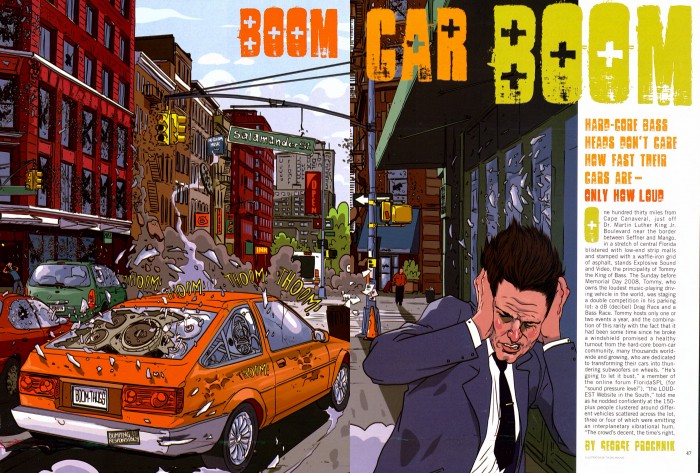
Boom Car Boom
March, 2009
BOOM
to*
ie hundred thirty miles from Cape Canaveral, just off Dr. Martin Luther King Jr. Boulevard near the border between Seffner and Mango, in a stretch of central Florida blistered with low-end strip malls and stamped with a waffle-iron grid of asphalt, stands Explosive Sound and Video, the principality of Tommy the King of Bass. The Sunday before Memorial Day 2008, Tommy, who owns the loudest music-playing driving vehicle in the world, was staging a double competition in his parking lot: a dB (decibel) Drag Race and a Bass Race. Tommy hosts only one or two events a year, and the combination of this rarity with the fact that it had been some time since he broke a windshield promised a healthy turnout from the hard-core boom-car community, many thousands worldwide and growing, who are dedicated to transforming their cars into thundering subwoofers on wheels. "He's going to let it bust." a member of the online forum FloridaSPL (for "sound pressure level"), "the LOUDEST Website in the South," told me as he nodded confidently at the 150-plus people clustered around different vehicles scattered across the lot, three or four of which were emitting an interplanetary vibrational hum. "The crowd's decent, the time's right,
he can control it—I mean, why wouldn't he break his windshield today?"
My journey to Explosive Sound and Video was the product, in part, of several months spent reading posts on Noise Free America, an anti-noise pollution Listserv, for which boom cars constitute the incarnation of absolute evil. Every few days on Noise Free America a thread of e-mails chugs out of a link to a story involving the arrest of someone somewhere for assaulting a person who complained about the noise of a car, or an attack on a police officer who stopped a vehicle for loud music, or the announcement of a new link between boom cars and drug dealers, or the discovery of guns inside a boom car, or the passage of a new anti-boom car ordinance. The tone of the threads is always of the highest dudgeon—boom-car owners are invariably referred to as thugs or "boom thugs"—and the posts often drip with lathery bile, typified by one from Catdaddybaycali that went up the week before I traveled to Tampa. It linked to an article about a multiperson assault on a woman in New Mexico, occasioned by her protesting against noise (from a neighboring house, not a car): "These criminals are the sort of human garbage that are the life's blood of the boom-car pestilence. Unfortunately, it's not legal to shoot them all and feed their rotting corpses to wolves. The wolves could use the food, and we could use the peace and quiet." The posting was applauded by other forum members. Unquestionably, the assault by four individuals on one woman is abhorrent. But were the "human garbage" who perpetrated the crime really the "life's blood of the boom-car pestilence"? And is the rage of the online anti-loudness soapbox even its own form of noise?
Around the time of the passage of a new Sarasota noise ordinance specifically intended to muzzle boom-car drivers, the name FloridaSPL cropped up on Noise Free America. The SPL forum describes itself as the home of "all the latest news, events and talk about the Florida car-audio scene." When I began to read postings on this site, I found that, while riddled with even more spelling and grammatical errors than their anti-noise counterparts, the comments were generally characterized by a quiet, respectful tone.
I contacted the site administrator, Casey Sullivan, in an effort to hear SPL's side of the story. Casey presented the Memorial Day event at Explosive Sound and Video as an ideal fact-finding opportunity and arranged a rendezvous with an SPL member for a drive around Tampa the night before the show.
We were to meet at a Shell station off 1-75, where I was to keep my eyes peeled for what my new contact had described
as a "tangerine-colored" vehicle. When I reached the gas station on Saturday night and spotted the one car that had something like a citrus hue, I thought there must be a mistake: The vehicle was hardly bigger than a Matchbox car. It was just a small, sporty, slightly soiled-looking burnt-orange auto. This could not be the machine of a boom thug. The gas-pump hose was stuck in the tank, and there was no one behind the wheel. I slammed out of my car and walked closer. The windshield was finely cracked in many places, creating an effect, in the overhead fluorescence, of delicate ice-crystal calligraphy. A moment later a large man in long shorts pushed out of the station store, sucking meditatively on the straw of a tall soft drink, and began heading toward me.
Robin Butler, a.k.a. MP3 Pimp, is an ample man of mixed race in his mid-20s
with honey-brown skin, light eyes and a softly curling beard. He looks like a biblical patriarch, only gentler and more self-conscious. We shook hands, and he invited me into the car. The second I yanked open the passenger-side door (it was broken) and swung inside. I realized I was entering a whole new realm. This was not a car interior in any sense I'd ever experienced. Everything was at once stripped of its original elements and reconstituted Frankenstein-style—swollen with foam, fiberglass, black speakers and a profusion of colorful wires. The entire rear half of the car behind our seats was obscured by immense black audio equipment; the dashboard seemed to consist only of dark metal cavities, coils and protrusions with a little digital box glowing moon-white at the epicenter like the control panel of a retro sci-fi vessel. MP3 Pimp turned on the engine. I reached across for my seat belt.
"No belts." MP3 Pimp commented, and we pulled out onto the highway.
As we drove and talked, MP3 Pimp occasionally reached up two fingers to push back against the duct tape propping up different sections of the windshield to prevent it from falling in across our laps. I asked him what had triggered his involvement with car audio.
"Just hearing people with bass driving around. Just ever since I can remember hearing it. I remember responding to that sound. And I've had something since I was 17. Nine years. But as for something as ridiculous as this...maybe two years," he said.
And was it true his windshield had cracked because of sound?
"Yup," he nodded. "Fourth windshield this year. See these dents in the metal?" He pointed at the ceiling. "Also audio-related."
"And what is the police response to something like this vehicle?" I inquired.
He shrugged. "They don't really bother you too much as long as you're respectful. If you drive by a cop with your music on and you turn it down when you see him, he knows it's you but you're being respectful. They don't do much. They might pull you over to check your registration, make sure everything's in order...." He told me the people who participate in the shows are rarely the ones creating a public nuisance.
"So the ones creating the problem are a minority?" I ventured.
"Well—actually...no. The people who go to shows continuously—most of us are respectable. They call it 'bumping responsibly.' That's what we do. But you get the kids, and they have a loud system in their cars and they want everybody to know, so they play it loud all the time. Unfortunately, they're in the majority, because a lot of people who have car stereos (continued on page 102)
BOOM CAR
{continued jrom page 48)
don't come to shows. They don't even know the shows exist. Some people do it for fun. Some people just like it loud, like me. And some people do it to impress other people, like girls or whatever. Some people abuse everything."
"And would new noise ordinances make a difference?" I asked.
"You know, it changes everything once you have the law looking at vou." He glanced over at me. "Especially when you're breaking the law." I nodded thoughtfully. He glanced at me again. "Anytime you want me to turn it on. let me know."
"Crank it up," I cavalierly encouraged. .After all, the sound itself was why I was there.
MP3 Pimp bent forward and began pushing buttons on the lunar panel. Numbers and words lit up and disappeared.
For the first few seconds of music, I felt very pleased with myself. It was loud, but I could take it, and I enjoyed the rap bass line. I did. I got it. It was fun. MP3 Pimp was still fiddling with buttons. And then, suddenly, the system turned on. I felt as if I had been launched in thunder and fire from an ejector seat—only the seat hadn't ejected, and I remained inside the thunder and fire. I felt my organs collapsing. I didn't hear sound. I just experienced my bones and heart erupting and bursting apart through my skin. My hands slammed to the sides of my head, and I bent forward, vaguely aware of MP3 Pimp's finger pulsing a button near my temple. The sound declined.
"I don't want to cause you pain." he said.
"Thank you," I managed.
Slowly, recalling a study by some behavioral psychologist who declared that the only two forms of fear we're born with are the fear of loud noises and the fear of falling, along with the sober audiologist who had recently told me that a single exposure to 140 decibels can cause permanent hearing loss, 1 straightened back into my seat. "How loud was that?" I finally asked.
"Oh. it gets a lot louder than that." MP3 Pimp chuckled.
"How loud?"
"I don't know exactly. The loudest I ever heard it is 158.6. and that's on average, over 50 seconds. What you heard right then is 141. 142. It's definitely loud. But it gets louder."
Only then did it begin to dawn on me that there are boom cars and then there are boom cars. I was still a long way from grasping that SPL car-audio competitors are, in the words of one FloridaSPL member, "the loudest community on earth except for military operations."
Some perspective on those numbers: A pneumatic riveter at a distance of four feet produces 125 decibels. The decibel system is logarithmic, with every increase of 10 decibels signifying a tenjold increase in sound. If you are three feet away from a rifle muzzle when the rifle goes off, the sound you hear is approximately 140 decibels. If you are 75 feet away from a jet at takeoff, you are exposed to 150 decibels. Standing 30 feet from a jet at takeoff, you hear 160 decibels.
The explosion of Krakatoa from 100 miles up in the air, or a jet engine heard from one foot away, is 180 decibels.
The highest recorded score to date in dB Drag Racing is 181.7 decibels.
"What do you think of the forums that basically say all boom cars are evil?" I blurted out.
"I've never looked at one of the forums before, to be honest. I've read some e-mails that I guess a guy from one of them was sending out, and the things that they were saying.... It's kind of funny because they have no idea what they're attacking. They don't even know who they're trying to be at war with." I asked him what he meant. 'Just because somebody has a gun—like a hunter, say—doesn't mean they're going to shoot at people. And just because I have a stereo in my car doesn't mean I'm going to drive by your house every night and bother you." He took a phone call and then turned to me.
"But I look on it as a sport. Not an athletic sport, obviously. It's a hobby that became a sport. It keeps me entertained and busy when I'm not working or with my family. Some people bring their kids out to the shows. Meet a lot of people. Make a lot of friends."
A single headlight of a police helicopter beamed down over us, the chopping of its blades drowning out the highway. "They're looking for somebody," MP3 Pimp said. "They're looking for somebody." He sighed. "Let me show you the car."
He pointed at the inside of the door. "Took the stock panels and turned them into something they're not. Took fiberglass and molded it. Cut out the rear deck with an angle grinder. We use, like, spray foam everywhere and whatnot. You want to seal off everything as much as you can to keep all the pressure up front. And then...." We walked around back, and he opened the trunk. Five car batteries festooned with red-and-blue wires were wedged into the space.
"Wow."
"There's another one under the hood and one in the corner by the passenger scat, so seven batteries total. They're pretty heavy— they weigh about 40 pounds apiece. It actually weighs down the car a lot. If you look over here, you see the difference between the tire and the—it caused everything over
here to drop about four inches. We also paint all the windows black. Keep the light that's inside in. Keep the light that's outside out. That way nobody can see in."
Explosive Sound and Video sits next to a hair salon, an ice-cream shop and Tire Kingdom in a parking lot that was already-blasting with heat by the time I arrived at 10:30 on Sunday morning. A couple of blue tents had been set up to shade an assortment of high-caliber sound-measuring equipment and laptops. Over the course of the next couple of hours, the participants' vehicles rumbled into the lot along with spectators who clustered around the champion cars, waiting for audio demos and gazing hopefully at the dark-tinted windows to try to glimpse the special "something" each had hidden inside. There were lots of long shorts and loping gaits, and the men, clutching giant plastic cups or dark bottles, seemed to fall generally into the category of short on neck and bald (save for a sneeze of facial hair) or stringy and towheaded. There were plenty of women as well, but with one or two exceptions they were all there in the capacity of girlfriend, wife or the catchall "lady of." Everywhere there were tattoos and T-shirts emblazoned with multiple skull or single crucifix motifs.
By noon a critical mass of participating vehicles had arrived in the plaza. Every 10 minutes or so, one of them would begin to demo its "something," releasing a swarm of sound that swallowed the lot for a few-moments before stopping dead again. On the tapes of my interviews, the car-audio blasts do not sound like noise; they simply cancel out the voices—cancel out the soundscape altogether—in a low, humming void that suggests the recorder simply gave up the ghost.
I wandered around and found MP3 Pimp about to perform what is known as "hair trick." Hair trick involves finding a long-haired woman who will lean her head into the window of a car demoing its audio. A young woman with very lengthy red hair was just bending over the passenger side of MP3 Pimp's vehicle as I approached. He turned on the audio, and her orange hair began flying up in the air in every direction, like a free-floating wildfire.
"I love it," she squealed when he turned the car off. "That's the best feeling in the world!"
"Why?" I asked.
"Cause your whole head tingles, and all your hair's moving and you can see it all moving!"
"And you can finally justify having so much hair," a spectator observed.
"I can finally justify having so much hair!" she concurred.
The dB Drag Racing qualifications were at last getting under way. For the onlookers, this process consisted primarily of watching a huge bald man with a shredded auburn goatee, in a tank top that read i.okii.i.a HKAWwtu.Hi, lumber over to cars and stick a sound meter on a hose through the windows of dozens of them one by one. as if he were hooking them up to an IV in preparation for a transfusion. Once Gorilla Heavyweight had positioned the tube, the window rolled back up from the inside, and at the conclusion of a countdown from the judge, who held his ringers above the decibel-monitoring laptop, the audio behind the dark glass switched on to strike a tone barely audible from outside the car.
After watching this for a time (qualifications were to continue for the next four and a half hours), I finally met Casey Sullivan, the administrator of FioridaSPL. Casey, a gangly guy who looks all of 16. wearing a black Kickit Audio baseball cap, walked up to me with his partner. Buzz Thompson (owner of Calusa Custom Concepts), who resembles a somewhat shorter, no less voluble but considerably more coherent version of the Dennis Hopper photographer character in Apocalypse Now. But before we got into conversation, 1 glimpsed the man I suddenly knew to be Tommy "The King of Bass" McKinnie. He had just emerged from the garage of Explosive Sound and Video and was walking to a low, gleaming black-and-silver truck sitting under its own special canopy, with the words no problems stamped across the front windshield and king ok bass on both sides.
Even watching Tommy the King of Bass move from a distance, one knew oneself to be in the presence of a master of something. A handsome, mildly pumped-up black man in his 30s, wearing a black Explosive Sound
and Video T-shirt and matching black baseball cap with the brim reversed, he had that hunter's poise, that charged balance—of complete alertness and utter relaxation—the self-assured elan of a successful professional athlete who knows his body will perform exactly as it has to when it has to. Only in this case that body is prosthetic, the chassis of a low-slung 1995 Isuzu packed with enough audio equipment to kill by sound alone.
Tommy has been competing for 10 years and purports to be undefeated in all major car-audio competitions. He has taken his truck everywhere across the United States and prevailed at the world finals four years in a row, from 2005 to 2008. In 2007, for the first time, the finals were hosted over the Internet, with three locations in the United States (Florida, Indiana and California) going "face to face" live online with France, Greece and, perplexingly, Norway, to see who had the earth's loudest vehicle. Answer: Tommy the King of Bass. A lot of times. Tommy told me. "they call the King of Bass 'the Case' because I have 24 of everything. Twenty-four midis. Twenty-four tweeters. Twenty-four woofers and 24 amplifiers." His truck is known as the Loch Ness Monster "because you always hear stories about it, but you never see it." Nine tenths of the year the Loch Ness Monster remains deep within Tommy the King of Bass's garage. He never drives it or brings it out unless it's going up on his trailer to a show. When I looked inside, it was like looking into Ali Baba's cave rather than a car—a black vortex gleaming with countless silver cones, odd lustrous discs, a gorgon's head of wires and plates of dark metal.
The truck can hit in the 160s constantly for a minute straight. But no judging category technically goes that high, so Tommy runs it in the 150-to-159 class. "What we call balls to the wall," he nodded. "You know, "Run what you brung, and I hope you brung enough."' There would be no point in going higher than 159, since he would be competing against himself, and besides, he doesn't want people to know how loud the truck can get, because that "sets the par" for the season much higher than it needs to be for him to win—which in turn means unnecessary breakage. Instead, he does a lot of "sandbagging," that is, holding back from what he's capable of to confuse his competitors. "I sandbag all the time," he said.
"I'd say my entry into the sport began when I was in junior high, before I got my first car," Tommy explained. "Guys that considered they were loud in the neighborhood—or considered they were loud in the streets—every time they would drive by I would run to the door, and my parents would think I was crazy. I'd just run to the door and see what the car was, how loud it was, and I said, 'One day that's going to be me, riding around shaking everybody's house and restaurants.' I just always wanted a loud stereo." He added that once he had his first car with his first audio system, he drove it loud enough that he was barred from every restaurant in town on account of shattering their glass—Burger King. McDonald's. Taco Bell. F.ven the car wash ("which I actually never used, because my
truck was always too low") banned him because he drove by one time and broke its window with the power of his sound.
Tommy's story reinforced what I'd heard from MP3 Pimp the night before and what I would hear from a dozen competitors—longtime and first-time alike—over the course of that afternoon. Everyone involved with FloridaSPL whom I spoke with had craved a loud stereo more than anything in the world basically ever since they could remember wanting anything. Some had purchased their first car stereo before they could drive, let alone own, a car. The crowd was not especially thuggish. It was on many levels diverse—amazingly so, racially—peppered with both more and less aggressive sorts, mostly in their 20s and 30s (with a handful of exceptions on either side of the age divide) and making more or less money (though less was certainly the rule). I came away from the show thinking not about what drives some people to annoy others but about the wondrous weirdness of the human animal as such, with its Russian-doll subsets within subsets of desires and its endlessly peculiar needs. When I pressed Buzz Thompson to say what hooked people, he moaned, "It's just so sensual. It's sound! It's feeling! It's the attention you get! There's so much to what you're doing when you add a subwoofer to
your car. And once you do it you always have a taste for it. You find someone with louder, and you say, 'Wow, that louder is better than my louder.""
But of course this sensuality, the sensuality of hair trick and balls to the wall, was not. to put it mildly, everyone's sensuality. And to an extent, Buzz's analysis amounted to saying, "These people are just born this way." Cultural, sodoeconomic and personal history may have fed the obsession, but it was there to begin with. These people were carriers of the noise gene. Was my own hunger for silence, in the last anaJvsis, any different?
On the previous night MP3 Pimp had begun to give me a history of the sport's evolution from a technological standpoint. Buzz later filled some of the gaps in this version, out in front of Explosive Sound and Video. I say "version" because it is, in the main, an oral history still in a molten state, with competing, not altogether consistent narratives expounded by different pioneer participants and competition sponsors.
Car-audio competitions began in the early 1980s, and although there were always extemporized "boom-offs," along with more esoteric contests such as car-alarm meets—in which challengers matched up to determine who had the biggest, loudest alarm gadgetry in their vehicles—one of the first nationally popular competitions
was the Rolling Thunder contest, launched by George "Doc Thunder" Reed. George was an audio sales rep who wanted to boost car stereo sales, and the Rolling Thunder contests judged cars on three counts: sound pressure level, sound quality and installation finesse. Sound quality tended to get the most attention from car-audio buffs precisely because, as Buzz put it. a car is "such a tackling environment to create quality in. As you're loo close to the speakers, you have glass by your ears—that's reflective. You have carpet and leather cushions by your feet—that's absorptive." But the intensity of that challenge also helped limit the appeal of the contests.
Over the next decade, two things happened. First, a new generation of speaker and amplifier technology powerful enough to survive multiple high-volume sessions— and loud enough to excite audiences in ways that quality never quite mustered— began to appear on the scene and to torque the focus of the sport toward bass. Often the men behind the new subwoofers were garage-based tinkerers who never wrote down their secrets and who made their mark by, as Buzz put it, "getting dirty, spending money and taking time." Eventually, if they were lucky, they got recruited by major manufacturers who helped make a handful of American companies the elite standard of the car-audio scene. Second, sometime in the 1990s a new strain
of powerful subwoofers from China began swamping the markets. Suddenly there were scores of companies churning out audio equipment that, if not as refined as the sub-woofers used in high-end SPL competitions, still had enough kick to make your skeleton shake. Because they were so strong and, relatively speaking, so cheap, they helped provoke a surge in fans that drove the sport's popularity to new heights.
The next game-changing innovation in car audio was "the burp." One dav in 1994 Tim Maynor, with Jonathan Demuth in tow, showed up at a bass competition. They blew everyone else away by playing a single note, one ultra-low-pitch frequency, and drowning out all the other competitors in their decibel class. At that time sport participants were reauired to compete bv nlavini: ;i song
the match sponsors had chosen for them, which happened that particular afternoon to be the first song on the Flashdance soundtrack. Driven by the desire to annihilate their sole rival for the championship, Maynor and Demuth had analyzed the first track of Flash-dance pulse by pulse to find the frequency at which it peaked and where the peak occurred. By abandoning all pretense of playing a recognizable snippet of the song and instead hitting a button at the exact second when the music was loudest and playing only that one tone, they immediately gained three decibels of sound. The crowd, which Demuth told me numbered in the thousands, went wild. Their discovery opened the floodgates. Everyone started converting their cars into "one-nnlr wonders." or
"burp vehicles." A car-audio guy named Wayne Harris, who had won the first Rolling Thunder National Championship with the Terminator, a reconfigured four-ton I960 Cadillac hearse, founded the first SPL-dedicated venue. The same year Maynor's burp vehicle changed the terms of car-audio engagement, Harris promoted his first dB Drag Racing event. Copycat and offshoot sponsors proliferated, each with its own name and marginally different rule book. Soon thereafter. Tommy related, "dB Drag Racing got out of hand. Everyone lost the highs, lost the pretty stuff, the pretty-looking stuff, and it was all about how loud can you make your car be."
dB Drag Racing cars can't even play music. If they do, they will break their
speakers. And their battery-charging systems do not last longer than the three seconds they're required to compete at their maximal amplitude. (Sometimes destruction is the goal. The world finals occasionally include a Death Match class, in which competitors run head to head for five minutes. The last car standing wins, and both cars get buried in smoke from frying audio innards.) Indeed, the vehicles themselves, let alone the audio systems, cannot withstand the pressure exerted by the burp button. It's not coincidental that Maynor and Demuth were also the first team to replace their vehicle's factory-installed windshield with a steel plate. And yet, for a three-second single-note competition based entirely on loudness, the rules of dB Drag are unbe-
lievably complex. The official guidelines consume 15 long sections of fine print translated into four languages and ranging from descriptions of the admissible amplifiers (a typical clause of which reads, "The amplifiers used in the sound system should be designed for audio reproduction. For clarification purposes, the amplifier's output waveform should be a close facsimile to that of ihe input signal. In addition, the amplifier's output magnitude should be proportional lo that of the input signal. All of these guidelines apply to frequencies between 20 and 80 Hz") to an enumeration of the competitor code of conduct, which stipulates, "Any team member who acts in an offensive or disruptive manner may be ejected from the
event and could face possible disciplinary action from the dBDRA. Examples:
• Throwing a 'fit' in the judging lanes.
• The circulation of or participation in petitions regarding dB Drag Racing.
• Mob-type behavior."
dB Drag Racing continues with head-to-head competitions in which competitors park side by side for three seconds, burp their cars and wait for the laptop readout. But a few years ago the hosting organizations (of which there are several) went through a crisis. They began losing competitors. They started losing manufacturer sponsors because, as Tommy said, "the manufacturers were like, "All these guys are doing is putting tons of amps, tons of speakers and tons of woofers into their vehicles and just breaking it all in three seconds.'" Thev were los-
ing spectators as well. Demuth told me that in putting too much "scientificness into it," they took the fun out of it. "It was too boring," Tommy summarized. "Basically, you'd see some guy pull up in his vehicle with a bulletproof black windshield, bulletproof black side windows, concrete all in it, and you'd see these numbers painted on the side that say this guy does a 180. Then he closes the door, and all you hear is this little quiet dzzzz. To me, 1 know what it is, but you ask a customer and he says, 'What just happened?' No one wants to watch that. Not compared to my truck, that can put on a real show. That's when the organizations approached me and told me they'd come up with a new format—Bass Racing— and they wanted me to compete. It's gonna be no more
burping your car. No more one-note wonders. You gotta play music for 30 seconds. You've got to remain within a certain decibel range the whole time, and your peak average becomes your score. I liked the concept. I knew my truck—which I had all the time but which had been sitting in the garage, since it couldn't compete in SPL—could grab a crowd."
Bass Racing, as Buzz explained, was made less rule restrictive in order to make it more exciting. But it is also a much harder competition to win. Music is obviously dynamic. How do you stay near the top decibel number of your class while playing 30 seconds of commercially available music with all sorts of different frequencies and pitches? Competitors have learned to
search for the music that resonates best with the contours and materials of their particular vehicle. They've learned to identify 30-second stretches of music with minimal dynamic variation. They may wait at the starting line with their fingers on the pause button of their audio machines set 21 seconds into a given song because they know between 22 seconds and 52 seconds that particular piece of music will stay near a maximal amplitude output. The return of music does not. then, mean the "pretty stuff," like the high ranges, is coming back.
As Bass Racing and its equivalent in the domain of another organization, Bass Boxing, became the rage and other dB Drag racers began crossing over. Tommy announced himself to be—and set about actually becoming—the King of Bass. (The difference between Bass Racing and Bass Boxing can be confusing, but it boils down mostly to methodology of measurement: Bass Racing uses an official Term-Lab SPL meter to assess the competition: Bass Boxing picks the winner based on how much crowd applause a car can ignite.)
It should be noted that, for all its musical appeal, Bass Racing is not appreciably quieter than SPL. Last year Tommy broke 30 windshields. (He told me regretfully
that insurance in Florida would cover only three a year.) In fact, while the current peaks of Bass Racing may be closer to 161 than to the 181-plus top scores of dB Drag, the bodily experience of Bass Racing for everyone involved may well actually be louder. This is because, in the modified cars of dB Drag Racing, a range of materials, including three- to six-inch-thick windshields and special reflection panels, guides the energy wave to the exact spot on the dashboard where the judge's microphone is grounded. Three feet down from where Heavyweight Gorilla props the mike, the sound pressure level may drop 20 decibels. Recent changes in regulation have begun to factor in the catastrophic consequences of car-audio showdowns for the hearing of participants. In dB Drag, competitors in the classes of 140 decibels and above are now required to operate their cars from outside, remotely. "Adequate hearing protection" is required if you remain inside at lower decibel levels. Similar rules have come into play for Bass Racing. But I didn't see any Bass Racers standing outside their cars the day I was at Tommy's—and they were hitting some seriously high numbers. The windows and doors were left open. The protection-free crowd got to "feel the vibe," to merge with
the full blast of music, to punish the hell out of their auditory systems.
A little while after we spoke. Tommy the King of Bass at last gave a demo of the Loch Ness Monster, playing his signature song, Phil Collins's "In the .-Kir Tonight."
I was standing about 25 feet away at the time. In the first few seconds I had the uncanny experience of knowing I was listening to music but being unable to hear the sound as music, to experience it as anything other than pure vibration. This is like hearing music if you're deaf, I thought to myself. My pant legs and shirt suddenly felt loose and began fluttering wildly free of my body—somehow as though the wind were coming from inside me. I had a cell phone in one front pocket of my jeans and my recorder in the other, and they both began massaging my thighs like mini vibrators. It was extraordinary. Not exactly exhilarating but electrifying. I saw the opaque panes of glass in the hair salon—covered with decals reading I'krms, ianmng, coloring—begin flapping like black sheets. Someone pointed up at the floodlights on poles probably 20 feet overhead: the bulbs appeared to be unscrewing from their sockets. It was like standing on the lip of the apocalypse.
After the demo Buzz and Casey spoke about other milestones in the sport, like the time pioneer Richard Clark, for whom Demuth served as an apprentice, drove up to a competition in a bread truck packed with 60-inch woofers he had hand-built out of titanium and magnesium and powered with six amplifiers designed to motorize hospital beds. It hit 172 decibels. And about Alma Gates, who began her career as a way of spending qualitv time with her kid and ended up with the nickname Boom Car Granny. One day, in Buzz's account, this kid told his mother, a lady old enough to be his grandmother, ""I'm into car stereos, and I like this one in the window here.' She said, 'Well, that's interesting, son. I could be interested in that too.' She bought the system, and they built a couple of cars together. One year they flew out to the world finals. The kid says, "Look, there's my hero—Mark Fukuda.'' (Fukuda—another car-audio idol.) "Mom says. 'Well, let's go meet him.' So they go up to Mark, and when her son tries to look inside Mark's vehicle, Mark shuts the door in his face. He's a total jerk to them. He's rude. Mother's feelings get hurt. She says, 'You know what? We're going to beat that guy.' She takes all her money out of her schoolteacher retirement funds, buys a Ford Bronco and builds one of the loudest vehicles ever made." The next year. Alma Gates returned to the world finals. Fukuda, alas, had retired, but his heir apparent, Tim Maynor, was there. As Maynor and the crowd watched in jaw-gaping astonishment, the Bronco drove into the competition plaza with what appeared to be a giant fish lank lodged inside the cabin—and a pint-size pilot behind the steering wheel. A door like a submarine hatch popped open, the pilot hopped out of the fish tank, and
the chamber vacuum-sealed shut again. Forty-six 10-inch speakers and 23 amplifiers switched on to full power. "And (he old lady just spanks Tim Maynor," Buzz concluded. "Destroys him in a great revenge-and-vindication story." Alma continued to compete for several years, coming back each time with something louder.
There are also the pioneers of the increasingly important YouTube-ification of the sport, such as Steve Meade, who was famous for "reaction videos," like the one in which the glass eye of a woman leaning into the window of his truck pops out into the vehicle after he turns on his 20,000-watt car-stereo system. Even though she's a few inches from his head, he can't hear her shouting that her eye has fallen out of its socket because of the power of the sound. So he just sits there staring at the windshield while her mouth writhes and she points frantically at her socket and the floor of his car.
I asked Buzz whether the natural development of the technology combined with the catalytic power of the Internet to accelerate that development would mean the decibels competitors can hit will just keep getting higher.
He reminded me that there is a problem with the dream of perpetual progress in the sport, since it is approaching a realm where the physics of sound begins to create its own threshold limitations. .Already, he said, when you're in one of these cars and it's doing 163 or above, there is so much pressure inside that the air molecules cease to behave like air. The air becomes so thick, you feel as if you're moving underwater. Come to think of it, much of the music I'd heard sounded as though the speakers were submerged. Essentially, Buzz said, at 163 and higher the air has ceased to be air. Competitors today are already hitting the low 180s. But once you hit around 194 decibels, sound ceases to be sound. A sound wave is made of two alternating cycles—a compression cycle and a rarefaction, or decompression, cycle. Basically, sound crunches the air and then releases it as it travels. At approximately 194 decibels the pressure is twice the pressure of the atmosphere. That means there are no more air molecules to disperse. There is no more back-and-forth cycle. There is no more sound. There is only a forward-driving force of further compression. If SPL or Bass Race competitors one day hit 194 decibels, they will succeed in creating a shock wave. This is the realm of sonic booms and earthquakes.
Loud cars. Ego. Materialism. The extremes of sound and the imposition of the self on the world through noise—it sounds like a stereotypical American commercial niche. Yet as I'd already learned from Tommy, in 2007, for the first time, a "live on the Internet" world finals was held in real lime at three points in Europe and three in the United States.
Buzz described how, when he was posted with the Army in Germany in the early 1990s, the Germans were back where the Americans had been in the 1970s. The equipment was newer, but they weren't thinking about sound staging or creating bass accurately. "They were just sticking a
lot of speakers into weird places in their cars." But today, 15 years later, there are more car-audio competitions in Germany alone than in the entire United States, and across the continent the Europeans are getting better and better. They now regularly win in the lower-decibel classes, which favor smaller cars. Recently the Australians also became involved, along with the South Africans and the Brazilians. The Brazilians, Casey and Buzz exclaimed, arc incredible. They now hit in the 180s. While most components are produced by American companies manufacturing their products in China, the loudspeakers firing under Tommy's truck are made by Selenium, a Brazilian company. In 2008 the Brazilians competed in the world finals as well, so the event was live across three continents. "Asia's next!" Buzz prophesied. "Asia's already buying up every audio device we put on eBay and paying way more money than anyone else would. It's already happening in Thailand. We're just waiting for the Japanese. Everybody knows what happens when the Japanese start reengineering things.'
Car audio has become a global phenomenon. "It's just like what happened with rock and roll," Buzz observed. "The U.S. has influenced the rest of the world. People want to be like we are here, without any real understanding of why we are what we are."
In the end, Tommy the King of Bass elected not to compete in the show he hosted in front of his shop. He didn't even bother to break his windshield, confining his demo to a handful of blasts that got the employees from the drive-through McDonald's, more than 50 yards away, storming into the parking lot to complain they were unable to take orders from customers. I suspect, in forgoing the competition. Tommy had looked around and decided there just wasn't enough in it for him to hit a competitive decibel level that day. Why go through the hassle and expense of replacing his glass with nothing significant to gain? Indeed, at this point.
having won every competition that exists in Bass Racing and dB Drag Racing, Tommy sees only one more category continuing to hold out a challenge: sound-quality competition. When we spoke about this, for the first and only time a note of anxiety crept into the confident voice of Tommy the King of Bass. He had given a speech in Daytona the year before in which he announced he was through with SPL and would switch over and make an "SQ car" because he had accomplished everything else there was to accomplish in the loudspeaker world. But now he was not so sure he would follow-through with his vow. "A lot more things come into play in sound-quality competition," he conceded. "The way everything is installed, how it looks—all the imaging—the way it sounds. And that would probably be hard for me since I'm sure I've damaged my hearing. It would probably be hard for me to build an SQ car. Because my hearing is damaged, what I think sounds good doesn't really sound good. Because my ears are already gone from dB Drag Racing."
•
Tommy's truck remained intact on May 25, 2008. But just as Buzz was finishing his explanation of Bass Racing and dB Drag Racing as global phenomena, I noticed a Lexus parked halfway across the lot from us, a newish one belonging to a guy named Jesse who'd recently gloated on Fox News about having received 75 tickets for playing his car stereo too loud. The Lexus had had its roof ripped apart at a competition a few weeks back and now had some kind of temporary fiberglass plug in place of it. Jesse turned it on. And turned up the audio. The windshield splintered. I could not hear the roar of the crowd above the sound, though I could see, through the rising arms and clapping hands, a vein-riddled, striated circle trace across the glass like the web of a psychopathic spider. For a second or two, it seemed, I could not hear anything at all.
HABS-GBBE BASS HEA9S SQN'T GABE HOW FAST TREIB GABS ABE-ON1Y HBW LBUB
heab sbinb. i just
EXPEBIENGfB MY BBNES SNP HEABT EBUPTINU m BURSTING APART
TKBBUGH MY SKIN. MY KAN?S SUMMER TB TRE SIBES 6F MY KEB9.

