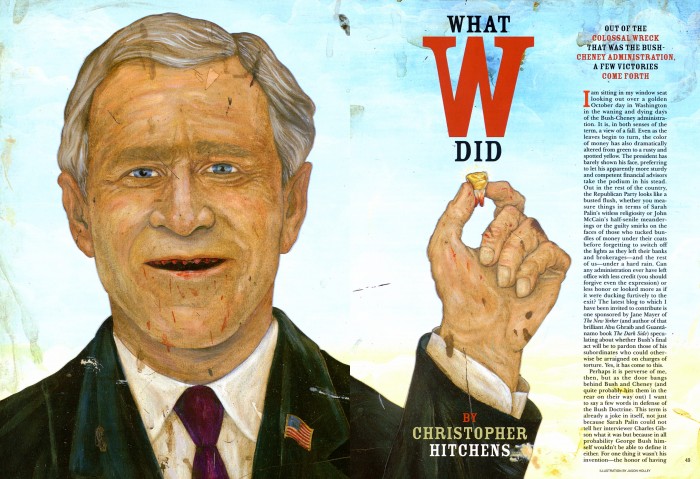
What W Did
January, 2009
Out of the colossal wreck that was the Bush Administration, a few victories come forth
I am sitting in my window seat looking out over a golden October day in Washington in the waning and dying days of the Bush-Cheney administration. It is, in both senses of the term, a view of a fall. Even as the leaves begin to turn, the color of money has also dramatically altered from green to a rusty and spotted yellow. The president has barely shown his face, preferring to let his apparently more sturdy and competent financial advisors take the podium in his stead. Out in the rest of the country, the Republican Party looks like a busted flush, whether you measure things in terms of Sarah Palin's witless religiosity or John McCain's half-senile meander-ings or the guilty smirks on the faces of those who tucked bundles of money under their coats before forgetting to switch off the lights as they left their banks and brokerages—and the rest of us—under a hard rain. Can any administration ever have left office with less credit (you should forgive even the expression) or less honor or looked more as if it were ducking furtively to the exit? The latest blog to which I have been invited to contribute is one sponsored by Jane Mayer of The New Yorker (and author of that brilliant Abu Ghraib and Guanta-namo book The Dark Side) speculating about whether Bush's final act will be to pardon those of his subordinates who could otherwise be arraigned on charges of torture. Yes, it has come to this.
Perhaps it is perverse of me, then, but as the door bangs behind Bush and Cheney (and quite probably hits them in the rear on their way out) I want to say a few words in defense of the Bush Doctrine. This term is already a joke in itself, not just because Sarah Palin could not tell her interviewer Charles Gibson what it was but because in all probability George Bush himself wouldn't be able to define it either. For one thing it wasn't his invention—the honor of having
named it appears to belong to the columnist Charles Krauthammer—and for another the 43rd president of the United States was almost certainly unaware when first elected that he was even supposed to have a doctrine named after him.
There are a few versions of the idea, and so I feel free to improvise my own, perhaps even improving on Krauthammer's original formulation. The reason I feel the need to do so is that I am reasonably sure in a fairly short time I shall feel nostalgic even for the simplistic version. Here's what I think any democratically elected president ought to be able and willing to say: The very existence of the United States of America is in the long term incompatible with that of totalitarian, theocratic or expansionist regimes and, even in the short term, incompatible with regimes that either give hospitality to terrorists or attempt to pirate the technology of nuclear warfare.
This is not a statement of American superiority, either moral or physical, as much as it is a statement of fact. Winston Churchill, who was nothing like as pro-American as people would have you believe, once observed sourly that Americans always ended up doing the right thing but only when they had absolutely exhausted every alternative. And this in turn is echoed by a remark made in more recent times by the French intellectual Bernard-Henri Levy, who said that the United States rescued Europe from Prussian militarism in the First World War, from Nazi imperialism in the Second World War and eventually from the oppressive stupidity of Soviet communism and that all else is basically "boring." Does this oversimplify matters? Yes, but perhaps not by all that much.
If you just think of the causes that have animated liberals, humanitarians and human-rights activists over the past decade (Burma, Darfur, Zimbabwe), you have to concede that without the American presence at the United Nations all mention of these outrages would have been allowed to fade from the international agenda. The veto of the Russians and Chinese, always reliably deployed in defense of such regimes, would have buried the issue. The same goes for the nuclear ambitions of two sadistic governments run by psychopathic criminals: those of Iran and North Korea. Both regimes have made a few pretenses of negotiation and concession and have also pretended to do so while sitting down with the European Union, the International Atomic Energy Agency or some other, informal group of countries or institutions. But does anyone seriously believe they would have negotiated at all—or in the first place—if they were
not uneasily aware of the power of the United States? Get real.
Of course the very mention of the nuclear threat appears to summon the specter of the Bush-Cheney administration's most humiliating defeat: the abject failure to uncover actual stockpiles of weaponry of mass destruction after the intervention in Iraq. But even here there is more to be said than some people will concede. Saddam Hussein had in the past (a) concealed his plans to build nuclear weapons and (b) made no secret of his delight in using chemical weapons on neighboring countries and Iraqi civilians. His government made no attempt to come into compliance with the United Nations resolutions. Which would you really rather have: an American government that said that's enough of that or an administration that offered to take Saddam Hussein's claims at face value?
Moreover, the removal of the Ba'ath Party dictatorship, which did at least allow us to do what the UN inspectors could not and actually certify Iraq as disarmed, had some other positive features as well. The first of these was that the erratic dictator of Libya, Colonel Qad-dafi, threw in the towel and decided his own WMD program was more trouble (and risk to him) than it was worth. Did he send his surrender signal to the UN or the European Union? No. He sent it to George Bush and Tony Blair and handed over his own stockpile—which really did exist and which was much larger than we thought—to the United States. Analysis of diis trove yielded a crucial finding: Some of the stuff, it turned out oddly enough, must have come from our "ally" Pakistan. And so it was that we walked back the cat and found the A.Q. Khan "Nukes R Us" black market operating at full blast. Not everything about this terrible network has yet been uncovered, but at least A.Q. Khan himself is under house arrest. In fact, in terms of nonprolifera-tion, the Bush-Cheney regime is the first in memory to have brought about any actual nuclear disarmament.
This can't disguise the fact that Iran and North Korea are both rather nearer to declaring themselves nuclear powers than they were when the Bush administration took office. But the irony here
need not be entirely at the administration's expense. It was only when it followed the advice of the so-called realists at the State Department and the CIA— the ones who are always for more talking and less action and who always favor the UN or some other forum as a way of neutralizing an issue—that the Bushies came to grief. Take North Korea, for example, where the population is being systematically starved to death in order to feed a hysterical leader-cult and a menacing military-industrial complex. You will find that in the early days the Bush-Cheney administration talked openly about regime change. It invited a survivor of the North Korean gulag to the White House and stressed the connection between the Dear Leader's blackmail on one front (his threat to test more devices and missiles) and his related blackmail on another (his implied threat to let "his" people starve even more if food aid was not sent to him as a sign of goodwill).
By the end of 2008, after a change of strategy determined by the usual suspects at State and with Condoleezza Rice having publicly slapped down her own North Korean human-rights envoy Jay Lefkowitz (whose job was established by Congress), we were back to the same old Lucy-grabs-the-football-at-the-last-minute. As ever, the North Koreans backed out of signing any lasting deal. As ever, they backtracked on their promises to shut down their reactor at Yongbyon. As ever, they played cat and mouse with the inspectors and continued to treat their wretched serfs and subjects (who are now four inches shorter on average than their South Korean counterparts) as expendable.
It was much the same with Iran, whose open contempt for the inspectors and for all the international agreements signed by the mullahs is now an international scandal. Most informed observers now agree that Tehran is much closer to acquiring the makings of a nuke than was admitted by the farcical National Intelligence Estimate, to which the administration was forced to defer in 2007. Once equipped with a bomb, the Iranian clerics are unlikely to commit suicide in a blaze of religious fervor by launching an attack on Israel or the United States (though with these men, whose sermons 1 have heard in person, one cannot be absolutely sure of their commitment even to self-preservation). However, it is certain they will employ nuclear blackmail to impose themselves on the smaller and more democratic (and generally Sunni) Gulf states and attempt a revival of Persian imperialism in the region. I hope you are ready for that, because the Bush administration, having frequently said it would never allow the issue (concluded on page 150)
BUSH
(continued from page 50) to be passed on to its successor, has now done precisely that. Whatever happened to the Axis of Evil rhetoric that proposed to treat these aggressive dictatorships as the outlaws they are?
Now, you may say that if it weren't for Iraq, none of these other disasters and reverses would have happened either, and you would obviously be partly right. A huge sacrifice of American credibility and a great sapping of American strength took place on the plains of Mesopotamia between 2003 and 2008. Vet the decision for which the most grudging historian will probably award Bush the most credit is refusing defeat or capitulation in Iraq and giving General David Petraeus the authority to fight back against the murder gangs who were trying to take over a large and important country with a choke-hold position in the world economy. And for a brief time after the overdue downfall of Saddam Hussein, let us not forget there were some other useful "knock-on" effects, ranging from the Syrian withdrawal from Lebanon to the opening of a debate about democracy in Egypt and a discussion (also long overdue) about reforming the constipated and corrupted UN.
Not sufficiently noticed, either, has been perhaps the single most important foreign-policy shift conducted by any administration for several decades. In Asia, instead of being only the ever reliable ally and guarantor of the feudal and military dictatorship that is Pakistan, we have instead shifted to become a partner with India. This billion-citizen democracy, which (like us) is multicultural and multiethnic, was fighting Al Qaeda before w-e had even heard of it and also has a huge presence in the modern silicon economy. In addition. India is a counterweight to an increasingly aggressive and chauvinistic China. This realignment was partly determined by the so-called war on terror, but it did require a certain farsightedness, and it is a foundation on which successor administrations will certainly have to be building. I think it deserves a mention.
In the closing months of 2008 two books appeared by men who know what they are talking about. The first was by professor Clary Bass of Princeton, who published Freedom's Bottle: The Origins of Humanitarian Intervention. The second was by The New York Times Magazine's James Traub, who allowed himself the even longer title The Freedom Agenda: Wliy America Must Spread Democracy (Just Not the Way George Bush Did). The author of the first also reviewed the second, praising its emphasis on complexity over the "certitudes" of George Bush. I am as keen on complexity and nuance as the next man, but when it comes to matters of principle I find I don't mind a president who knows one big thing as opposed to a large number of little things. I just wanted to leave that thought in your minds in case the next few years should by any liny chance turn out to be a disappointment as well.
OUT OF THE COLOSSAL WRECK ^"THAT WAS THE BUSH-CHENEY ADMINISTRATION, A FEW VICTORIES COME FORTH
THE BUSH
ADMINISTRATION
BROUGHT ABOUT
ACTUAL NUCLEAR
DISARMAMENT.

