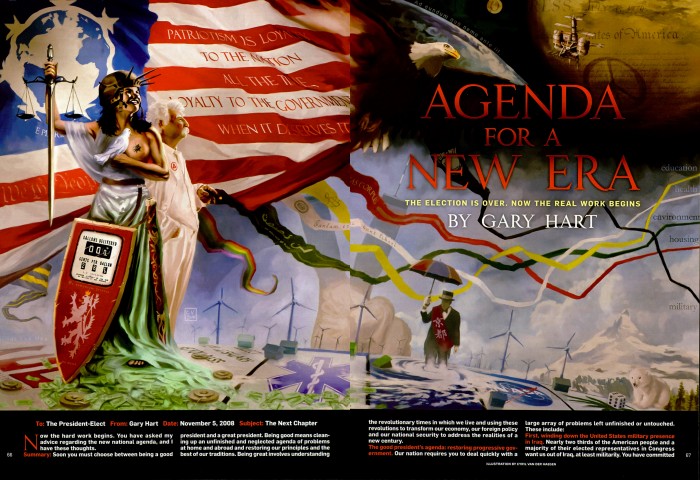
Agenda For A New Era
December, 2008
HE ELECTION IS OVER. NOW THE REAL WORK BEGINS
To: The President-Elect From: Gary Hart Date: November 5,2008 Subject: The Next Chapter
y ow the hard work begins. You have asked my | advice regarding the new national agenda, and I
have these thoughts. Summary: Soon you must choose between being a good
president and a great president. Being good means cleaning up an unfinished and neglected agenda of problems at home and abroad and restoring our principles and the best of our traditions. Being great involves understanding
the revolutionary times in which we live and using these revolutions to transform our economy, our foreign policy and our national security to address the realities of a new century.
The good president's agenda: restoring progressive government. Our nation requires you to deal quickly with a
large array of problems left unfinished or untouched. These include:
First, winding down the United States military presence in Iraq. Nearly two thirds of the American people and a majority of their elected representatives in Congress want us out of Iraq, at least militarily. You have committed
to do this as swiftly as possible within the bounds of current political realities, sound military advice and long-term U.S. interests in the region. We have reached a point at which U.S. forces have reduced the level of violence as much as they can, security is manageable by Iraqi forces and our continued military presence has become counterproductive. You must cease this operation as professionally and expeditiously as possible and restore a more constructive foreign policy based on serious diplomacy in the Middle East. Second, intensifying U.S. and NATO operations in Afghanistan against the Taliban and Al Qaeda. Given the huge strategic error in undercutting this effort in the fall of 2002, we must now pick up where we left off. This means substantially increasing Special Forces operations along the northeast Afghanistan-Pakistan border, convincing the Pakistani government to seal its border from Taliban incursions, with U.S. air support if necessary, and persuading our NATO allies to provide more combat and combat-support units to track down Taliban and Al Qaeda insurgents. Success in Afghanistan will depend less on massive forces and more on the intelligent use of available allied forces. Third, stepping up homeland-security preparations. Appoint a secretary of homeland security whose hair is on fire. Intensify measures to tighten our borders, prevent terrorist incursions and beef up damage-limitation responses if prevention fails. Call unexpected national, state and local drills to measure and improve reaction times. Dramatically strengthen preparations for biological attack and increase port security, particularly the inspection of the huge number of shipping containers that pass through our ports. Recall the National Guard from Iraq and assign its units to their constitutional duty of homeland protection. We will be attacked again, and we are not prepared to prevent it or respond to it. Fourth, reducing energy waste immediately. Challenge Congress to increase the energy-efficiency standards of cars, buildings and appliances in the next 90 days. Order hybrids for the White House fleet. Call on all major cities to enforce no-drive zones in their centers. Reward government employees who carpool, bicycle or use mass transit. Call on corporate America and the media to promote and undertake their own efficiency programs. Even while implementing a long-term plan to move the nation to the postcarbon age, we must take immediate steps to reduce the wasteful use of carbon fuels. Fifth, taking the lead on climate change. Announce to the UN that the U.S. is prepared to lead in controlling and reversing climate change. Propose a Kyoto II treaty that takes into account the needs of developing nations. Also propose a new international environmental protection agency to administer the treaty. Create an international competition for the best new energy-efficient technologies in transportation and construction. Propose a graduated tax on carbon to be implemented by all nations. Use the UN forum to announce
a new American foreign-policy era of international goodwill and enlightened cooperation with dedication to protect the global climate as its centerpiece. Sixth, introducing a universal healthcare plan. Submit a proposal for universal coverage for all children, preventive care for all citizens and catastrophic protection for all adults that gradually expands over time. Make this the first step toward genuine universal coverage. Bring political pressure to bear on the health-insurance industry and on health providers to improve on your proposal instead of opposing it. Education and health are social goods in and of themselves, but they are now the keys required for our nation to be fully competitive in the international marketplace.
We cannot have a productive economy if our workforce is not in good physical and mental condition.
Seventh, financing all military operations on budget. Your predecessor kept much of the cost of the wars in Iraq and Afghanistan off budget and funded them with supplemental appropriations. That is a magician's trick to divert attention and accountability, the fiscal equivalent of censoring pictures of returning war dead. The already excessive budget deficit will soar when you do this, but taxpayers will finally know what these wars are costing financially. Likewise, insist that the Department of Defense report all casualties—killed and wounded, including post-traumatic stress syndrome. The American people must know the total cost of the wars they authorize, both in human lives and in the depletion of our national treasury.
These are just the first moves; much additionally needs to be addressed among our domestic priorities and our role in the world. You have inherited an aggressive legacy abroad and a neglected legacy at home. Your administration must not try to do everything at once, but a number of high-value policy initiatives dispatched quickly from the station will clear the tracks for others that must follow. The national train will not get back on track overnight; additional initiatives can be added as we go along.
Clearing up abandoned tracks and inherited train wrecks will be a huge job, but I urge you to keep your eyes on the times in which we live. To do so is the first step in becoming a great president, a very large step above being a good one.
The great president's agenda: transforming America. You have attained national leadership at a time when our nation is required to transform itself. Transformation means the adoption of dramatic new directions at home and abroad. We are in the midst of multiple revolutions: globalization, information technology, eroding nation-state sovereignty and the transformation of war. We have yet to respond fully and intelligently to these enormous changes.
Should you pursue the transformative role adopted by great presidents of the past, bold action will be needed over and above the agenda already (continued on page 178)
NEW EMA
(continued from page 68) outlined. To govern boldly requires a mandate, and a mandate can be achieved in one of two ways: either out of necessity because of dire circumstances, of which the Great Depression-World War II years are the most recent example, or by a campaign premised upon a substantial change of direction. John Kennedy and Ronald Reagan adopted this approach.
Your transformative opportunity is here because the Nixon-Reagan-Bush era, a conservative cycle in our history, is drawing to a close. The nation is ready for, and indeed requires, new directions. Broadly speaking, those new directions are necessary in three categories: the economy, energy and
defense. As you take the oath of office and address the nation, you should call for a transition from a consuming to a producing nation, a dramatic national departure toward a postcarbon economy and major reformation of our military structures and forces.
Under our Constitution you have three major responsibilities: establishing domestic priorities, acting as head of state for America's role in a new world and serving as commander in chief to reform our military forces. Each of these responsibilities now demands a caliber of leadership demonstrated by the Jeffersons, Lincolns and Roosevelts of our history. Consider these in order:
I. Setting domestic priorities. We must start transforming the American economy from one of con-
sumption to one ot production.
We are the largest consuming nation in the history of the world. That means most Americans enjoy a better overall lifestyle than even those in other developed economies. Were we paying as we go, this would be all to the good. Unfortunately, we live on credit to sustain this lifestyle. Our creditors are foreign lenders, particularly China and Japan, and future generations. We spend more than we earn, borrow more than we save and consume more than we produce. This 30-year trend is not sustainable.
To make the transition to a producing economy, we must reward saving instead of spending, encourage thrift, invest in math and science education and in invention and new technologies and increase our public and private laboratory systems. You should
send a package of measures to Congress featuring these investments and a savings-based tax system and challenge its members to join in this crusade.
By the end of your second term the United States can make huge progress in reducing its trade deficits, dramatically improve the value of the dollar and substantially reduce the deficits in its foreign accounts. Once again this transformation will continue beyond your presidency because of the redirection your initiatives represent. Future generations will honor your memory as a visionary who rescued his nation from a destructive path.
The companion part of the domestic transformation is to set a course toward a postcar-bon economy. The overwhelming scientific consensus is that global warmine must not
continue unless we are willing to accept a drastically altered planet. Carbon, released by fossil fuels, is die villain. By fundamentally changing our transportation and construction practices, in two and no more than three decades the United States can vasdy reduce if not eliminate carbon-producing fuels from our national energy budget.
The required policy steps include escalating fuel-efficiency standards for all vehicles; converting vehicle fleets to plug-in hybrids made of composite materials; enforcing building codes for sustainable homes and office buildings; replacing coal-fired power plants with renewable energy sources; adopting efficiency standards and practices in all energy sectors and researching new energy technologies such as hybrid engines and those in mass transit and building materials; and constructing stan-
dardized, modestly sized nuclear plants with proven waste-storage technologies.
Climate change is only one imperative for this historic transformation. Independence from dangerously unreliable sources in the Persian Gulf is another. The liberation of our foreign policy from oil dependence, especially in the Middle East, is yet another. Drastic reduction in trade imbalances and rescue of the dollar's value are additional reasons we need to make this change. Our current energy policy of trading the lives of young Americans for foreign oil is immoral, and you must state that this policy—and it is our policy—is no longer acceptable for a great nation.
This transition to a productive economy and the postcarbon age will take longer than vour two terms. But starting the coun-
try down these [win paths toward transformation will be one of your most enduring legacies and will rank you with the great presidents.
II. America's role in a new world. At the same time we transform our economy, we must also restore America's credibility and moral authority in the world. As head of state, you should adopt the mantle of Harry Truman as a creative internationalist. The United States must lead, as it did in the mid-20th century, in creating a new round of internationalism based on the central premise that we all inhabit a global commons and all nations of goodwill must share in its administration.
The new realities of the 21st century include proliferation of weapons of mass destruction, failed and failing states, cli-
mate change, viral pandemics, mass migrations, fading national boundaries, trade friction and a host of challenges unfamiliar in the previous century. No single nation, nor all the military power in the world, can solve these challenges. The international institutions of the mid-20th century were not designed for these missions either.
This new chapter of history gives you an opportunity few U.S. presidents have had: to stimulate a new international dialogue. The international community must consider new institutions to address this century's new realities. For example, we should now begin to network the public-health services of allied nations to prevent pandemics. This network should establish a common database and communications system, stockpile vaccine and inoculation banks
and be prepared to quarantine outbreaks immediately. Another new international institution should be developed to enforce a post-Kyoto climate treaty. Treaties are meaningless unless ihey can be enforced. A third institution should guarantee the security of world oil supplies. The United States should not be, as it currently is, the de facto guarantor of world oil supplies. Consideration should also be given to an international nation-building entity to support unstable states. Further, the mandate of the International Atomic Energy Agency to restrict proliferation of weapons of mass destruction should be strengthened.
Times change and new realities arise. The international institutions of the mid-20th century helped prevent World War III. But the elobal commons of the 21st century requires
new instruments to deal with these new realities. Since the age of Franklin Roosevelt, the president of the United States is not only the leader of our nation but the leader of the free world. Your constitutional obligations are to this nation. Other nations will look to you for global leadership and new approaches to new challenges as well.
III. Reforming our military to meet new challenges. Seldom has a nation reformed its military absent a major military defeat. We do not have the luxury of accepting that formula. The history of the world is a history of the changing nature of conflict. Traditional wars between nation-states, to which we have become accustomed, are declining—the destructiveness of nuclear weapons and the rising eco-
nomic aspirations in the developing world are rendering them obsolete. However, unconventional wars and insurgencies involving subnational entities and nonstate actors are increasing.
Our withdrawal from Iraq and successful completion of Afghan operations should not become simply the occasion for "resetting" our returning military forces. This word was used to describe reequipping our forces along Cold War lines. The Cold War is over, and military confrontation with a peer competitor is becoming increasingly remote. Big divisions, giant carrier task groups and extravagandy expensive aircraft are becoming less useful. Special Forces and smaller, faster, more mobile units and equipment are becoming more important. In your role as commander in chief you should convene the nation's best
and most creative military and civilian experts to design the force structures and weapons systems for the low-intensity conflicts of the future and increase the size and capabilities of our Special Forces for counterinsurgency and counterterrorism operations.
All this suggests nothing less than a grand new strategy for the United States in the early 21st century. Strategy is the application of a nation's power to the achievement of its large purposes. Our powers are economic, political and military. At this point we are unrivaled in all three. Our economic power must be transformed for a new competitive age. Our political power, our diplomacy, must be based on constructive goodwill and moral authority derived from
principled action. Our military power must seek permanent alliance partners to share common security interests.
The central issue is, What are our large purposes? I believe they are to expand economic opportunity globally, to promote liberal democracy peacefully and to organize the security of the global commons. A 21st century grand strategy will require us to apply our traditional economic, diplomatic and military powers to the achievement of these large purposes.
But we have a fourth power: our constitutional principles, the ideals we claim to believe in. These have been unnecessarily sacrificed for the short-term expediency of combating terrorism. Your highest duty is to restore America's highest principles.
Above and beyond your challenge to
become a good president who restores our principles or, I hope, a great president who leads us through major transformations, you have the burden of restoring our national purpose and our respect and honor in the global community. The confidence of our people in their government and the confidence of the world in us have diminished. That confidence can and must be restored. That will require candor, openness and integrity. By demonstrating a Jeffersonian respect for the common sense and good judgment of the people, you will restore their respect for their leadership.
Sunlight is still the best guarantor of integrity in government. Trust the people and they will trust you. Most important, respect our Constitution. Virtually every
abuse of power in our history, particularly in our recent history, has originated in a decision to ignore constitutional principles. You are entitled to no power that is not granted to you by the Constitution, and you should seek none. The Mad-isonian concepts of checks and balances, of equal branches of government, of accountability in an open political marketplace have been central to our survival and our flourishing. Follow the Constitution's bright light throughout your presidency and you will earn your place in history.
Virtually all these recommendations are premised upon visionary leadership. Leadership is a word often used but almost never defined. Leadership has three qualities: the ability to see over the horizon,
the talent to devise new solutions and the skill to convince fellow citizens of the need to adopt these solutions to address new realities in a new age.
Very few politicians can perceive the future ("the vision thing"). Your successful campaign has demonstrated you have this ability. The transformative ideas suggested here, and even better ones that others may provide, can lay the base for new governing policies at home and abroad. Your greatest challenge is to educate the American people, as did the great presidents of the past, to embrace a new future that requires the restoration of our pioneering spirit.
Now the hard, yet most exciting and rewarding, part begins. Godspeed.

