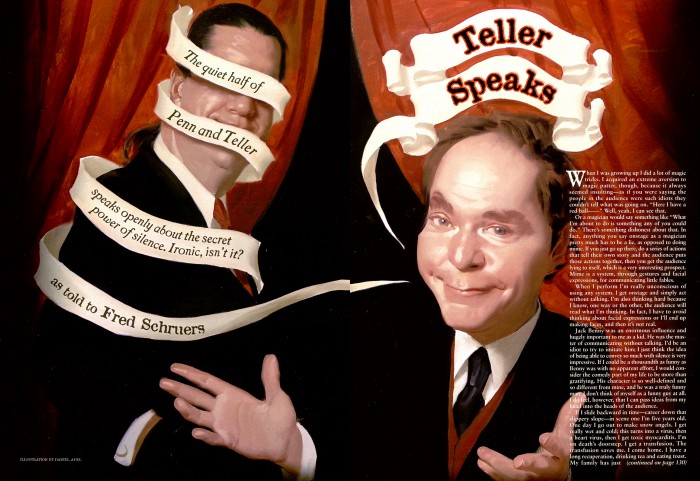
Teller Speaks
September, 2007
'hen I was growing up I did a lot of magic r tricks. I acquired an extreme aversion to 'magic patter, though, because it always seenfed insulting—as if you were saying the people in the audience were such idiots they couldn't tell what was going on. "Here I have a
red b/A\------" Well, yeah, I can sec that.
Or a magician would say something like "What **~" """out to do is something any of you could "here's something dishonest about that. In jnything you say onstage as a magician much has to be a lie, as opposed to doing If you just go up there, do a series of actions ill their own story and the audience puts ise actions together, then you get the audience lying to itself, which is a very interesting prospect. Mime is a system, through gestures and facial expressions, for communicating little fables.
When I perform I'm really unconscious of using any system. 1 get onstage and simply act without talking. I'm also thinking hard because ¦enow, one way or the other, the audience wilt Ead what I'm thinking. In fact, I have to avoid thinking about facial expressions or I'll end up making faces, and then it's not real.
Jack Benny was an enormous influence and hugely impoitanfj^Mie as a kid. He was the master of comiiiumenn^ without talking. I'd be an idiot to try to imitate him; 1 just think the idea of being able to convey so much with silence is very impressive. If I could be a thousandth as funny as Benny was with no apparent effort, I would consider the comedy part of my life to be more than gratifying. His character is so well-defined and so different from mine, and he was a truly funny ~' don't think of myself as a funny guy at all. ;1, however, that I can pass ideas from my into the heads of the audience. ' I slide backward in time—career down that ipcry slope—in scene one I'm five years old. he day I go out to make snow angels. I get ally wet and cold; this turns into a virus, then heart virus, then I get toxic myocarditis. I'm n death's doorstep. I get a transfusion. The 'ansfusion saves me. I come home. I have a ong recuperation, drinking tea and eating toast. Yly family has just (continued on page 130)
Teller
(continued from page 93)
gotten its first TV. It's a black-and-white, and Howdy Doody is on. I see an advertisement for a magic set. I have my parents send in the 10 cents and a box top, or whatever it is, and lo and behold, there in the mail comes a nine-bv-12-inch envelope, flat: the Howdy Doody magic-set. I remember opening that envelope.
Inside is a cardboard coin tray. Sou put two or three pennies inside the coin tray and three or four pennies on top. V'ou say to your friend, "I can make money multiply. Hold out your hand." You tip the coins into his hand. Secretly the coins inside the tray slide out. Thai was my first trick.
Since then, during no period of my life has magic not been some form of obsession for me. I'm 59, so that means I've had 54 years of a disturbing obsession with honest lying.
Magicians have this sick—well, it's both sick and sweet—brotherhood of people who think they have a little secret to themselves. If you ever go to a magicians' convention, they speak of magicians and laymen, as if magicians are the high priests and the rest of the world are the laypeople, as if to say, "They've never experienced the mysteries of magic." Penn and I have thrown that out the window. We say, "Sure, you know the magic of sleight of hand and trickery. We're going to take you behind the scenes of that a little."
Scene two would be my trying to do magic shows for other kids. I'm 11 years old. It's the day of the big show I've booked for the Cub Scouts. I have in my head that magic should be very picturesque, so I dress up as an old Chinese man with a beard, a mustache, a Chinese hat, an orange robe and a pigtail. I have a black-and-gold trunk full of tricks I have not rehearsed sufficiently. I'm not prepared at all. At the last minute I'm desperately throwing the props together. This audience of Cub Scouts sees me for what I am: an 1 1-year-old dressed up as a Chinese man, the perfect object of mockery. I am hooted off the stage while being pelted with hard candy.
Scene three is a better moment. I get to high school and become interested in acting, drama and theater as a continuation of magic, but I'm also just an exhibitionist. I'm a performer. I want to be onstage. I walk into my ninth-grade Knglish class, which is run by a gentleman who looks like Satan. He's your classic picture of Mephistopheles: a guy, perhaps 38, with a goatee, a mustache and a widow's peak, who wears tailored suits and a red vest with a watch chain. He has a deep voice and a passion for Shakespeare. On top of it all, 1 find out he has been a magician since he was a kid. I join his drama club and listen at his feet as he talks about how Shakespeare works. I'm fascinated
by this. He's an excellent English teacher, so he really teaches me to write.
His name is David G. Rosenbaum. though he does magic shows under one pseudonym and writes articles about magic under another. Occasionally he wears a rose in his lapel and is known to the kids as Rosey. Rosey and I become good friends and indeed remain friends until his death. We start to talk about magic as a theater form and where magic fits in the live-performance picture. Magic occupies an interesting place. In normal theater there's what Coleridge terms the "willing suspension of disbelief" to describe the moment when you sit and think. There's an actor onstage; he's holding a stick, but I'll pretend it's a sword. Rosey and I agree that magic-is the unwilling suspension of disbelief. You're sitting there, you know it's fake, but it seems to be real.
At this point 1 begin to realize magic is a tremendously rich form. Merely by doing a trick successfully, somebody can actually earn a living. As a result, magic is packed with the worst types of hacks. All they have to do is show an empty silk handkerchief and pull out a dove, and some people think they've done something artistic. But these hacks haven't written anything worth doing; they haven't created plots or characters. I decide 1 am going to be the guy who changes that. Mind you, that's very pretentious and self-important, but that's what you do when you're 16. You think. Okay, I'm going to change this entire art form.
Then I get this burning desire to do just that. I go to Amherst College, where I still sneak in magic courses somehow. I get hooked up with the theater department and persuade a rebellious professor to help me work on my magic performance and call it an academic reading course, the Figure of the Magician in Dramatic Literature. But it really just involves working on my magic act.
This scene—scene four, if you will— parallels the Cub Scout party. It is my final exam, which is to be a live show. I still haven't learned to rehearse. I have these grandiose ideas that I'm going to take the mythic element of magic and expand magic to the lyrical, the poetic. I decide I'm going to do a little stunt called the Creation of Life. It consists of taking a bunch of rags, putting them together, setting them on (ire. stamping out the fire and having it turn into a multicolor live animal—in this case a rabbit, since rabbits are convenient.
I buy a multicolor rabbit, but it's a pretty wild species, not the nice, tame white type. It's the kind that kicks the hell out of you when you try to pick it up. I have a friend who's a medical student, so I say to him, "We have to calm this rabbit down or it's not going to stay in its hiding place." He says, "Okay, I'll get a syringe and a sedative." It's the night of the performance, and 1 haven't rehearsed
this thing straight through from beginning to end. I've rehearsed it only with stand-in objects for the rabbit, but I'm still confident that if we just sedate it, all the problems will be solved. My friend comes over and gives the rabbit an injection. The rabbit calms down; it doesn't die, just calms down. I go through this whole procedure. I'm silent, of course. I push the rags together. I'm dressed in black against a black background—every pretentious cliche you can conceive of. I set the rags on fire, tap the fire out and reveal the rabbit. Then, to show it's truly alive, I set the rabbit down on the floor, whereupon it completes its entrance by dragging one leg, which has been completely numbed, behind it. It's a gimpy rabbit. It is limping miserably across the floor with this dead leg hanging behind it. It is the most pitiful spectacle I've ever seen.
Simultaneously I develop a taste for noir. I fall in love with TV shows like The Twilight Zone and Alfred Hitchcock Presents. By this time my favorite movie is Psycho, no question about it. I love things that have a sting in the tail and a dark turn to them, so the kinds of tricks I do move more into the area of the dark and dangerous. I return to what I said to myself much earlier: I'm sick of magic patter— it's always insulting. Let's try to do it without speech. Let's try to do it without even the crutch of music. Let's see if you can just, very nakedly, put the story out there. Act the story and let the audience fool itself; let the audience make sense out of that. I start to pick plots such as
eating a dozen sharp razor blades. I move on to eating some string and then dragging the razor blades out by the string, a variation on Houdini's famous needle trick.
During this time at Amherst I get an occasional gig at a frat party, and I find that if I shut up and do disturbing, dark, unpleasant stuff without talking, they pay attention. I feel comfortable without the crutch of speech, just walking out there and saying, "You're going to pay attention, and this is going to be worth your while because I know where my story is going." For some reason the audience goes along with me. It's a very lucky discovery.
I finish college and am number four in the draft lottery, so I get a teacher's deferment. I find a little high school in Trenton, New Jersey that needs a Latin teacher and is willing to take somebody totally inexperienced. Like me, they're desperate. Around this time, I design some magic for a rock musical called Moon Shoes being done at Princeton University. They want me to promote the show by doing some magic at the Princeton University pub, a cylindrical building with balconies all around on which people sit and drink beer. I walk into the middle of the floor, with my follow spot identifying me as a target. They begin dropping their cups of beer like water balloons on all sides of me. I do the needle trick, in which I swallow a hundred needles and six feet of thread and bring the needles up threaded. It's a compelling trick. By the end the students are actually paying attention to what I'm
doing. 1 get a little round of applause, more than I ever hoped for, and leave. This is, I guess, what's called paying your dues: You get enough projectiles thrown at you and you start to do things like rehearse. You start to learn.
I was invited to a performance by my best friend in college. VVier Chrisemer. He put together a vast orchestra and performed classical music in psychoti-cally beautiful ways. Wier had a couple of guests at one of his shows: One was a crazy, tall juggler kid—Penn Jillette. of course, whom Wier had met when Penn was selling him a stereo. Penn had just come back from Ringling Brothers and Barnum & Bailey Clown College, where he'd learned to ride a unicycle. U'ier had Penn juggling plungers and riding a unicycle and then throwing the plungers around Wier and onto a slick board—a parody of a carnival knife-throwing act— to the accompaniment of Khachaturian's "Saber Dance." The three of us seemed to hit it off.
I thought Penn was interesting, and periodically I would go to New York on weekends to debauch and hang out with him. Since he was starving and I had an income, I would take him out for a good dinner. I believe he began to associate me with eating.
One time he visited Trenton, where I was doing a stupid little show in a library, featuring the needle-swallowing trick. I think he was struck by what he always calls the nakedness of it. That touched a nerve for him.
Within a year I got a phone call from Penn: "I have a job for you this summer, doing magic at a Renaissance festival in Minnesota." I said, "Great. I'd love to do that during the summer break.' He said, "Yeah, well, it goes through October." I protested, "Hmm, that's when school starts." But I was seduced by this. I took a year's leave of absence from school, which turned out to be permanent.
What has worked between Penn and me? When people get metaphorical, they say. "Oh, it's just the chemistry." I think maybe they're right. Maybe that's the place to stop. I worked silent before I ever knew Penn, and I stayed that way. He worked talking and aggressive before he ever knew me. and he stayed that way. It happened to fit.
I'm proud of one thing not talking does: It says that when we're together, we're willing to behave like a team; I'm willing not to talk, and Penn is willing to cede all the exciting physical action to me. We become like one person with two heads, or he becomes the head and I become the body—some strange combination, like a pair of Siamese twins who can't function without each other. To me, that is one of the most important statements we make to the world—that it's okay to depend on somebody else.
When Penn's father was a jail guard, he noticed that when prisoners were put
in a cell by themselves they immediately started to work out, doing push-ups and weight lifting. They wanted to make themselves strong because they knew they were now alone.
In the past 50 years comedy has gotten away from everybody being part of a team. When I was a kid watching TV, I could see George Burns and Grade Allen, Rowan and Martin, Lucy and Ricky, Jackie Gleason and Art Carney. Sometime between the 1970s and the 1990s, that eroded, and comedy became all about one person standing at a microphone complaining about his or her failed relationships. One of the things I feel Perm and 1 stand for is the possibility that you can indeed have somebody you're joined at the hip to, somebody you agree to be dependent on and committed to in a serious long-term sense. But we're not exactly friends. If our act had depended on our friendship, it would have ended in 1975.
Outside the Penn and Teller context I actually do plenty of talking—numerous National Public Radio pieces, for example—and 1 think as a talker I'm at my best when ruminating on something odd that has happened to me. But in the Penn and Teller context, not speaking just feels right. We both have numerous projects that allow us other forms of expression. If all we did was Penn and Teller, we'd go nuts, but because we have all these other things,
we can just enjoy the classic symmetry of Penn and Teller.
You'd be surprised how much I talk to people who are onstage with us during our act. I do it quietly, and often they'll do a sort of double take. It's amazing how, once the members of the audience have decided I don't talk, they persist in believing that, no matter how much information comes through to the contrary. For example, after every show people come into the lobby, and we sign autographs and pose for pictures. I think it would be precious to stay in character for that. The fans want to feel as if they're with you offstage, and frankly that's the way I want to feel about them. I'll chat with them there several times a night. Someone will make a big fuss; they'll say, "Oh, I didn't know you could talk." But of course they did. It's this wonderful game they play, and they're playing it right along with me.
A fan once told Penn that one afternoon he was visiting New York City and his heart was broken twice: He saw Steven Wright laughing and Teller talking.
My favorite moment was when I was walking through Times Square once and a cop stuck out his nightstick and stopped me. It hit me right in the chest. He said, "Name? ' I said, "Teller." He turned to his buddy, nudged him and said, "See? I knew I could make him talk."

