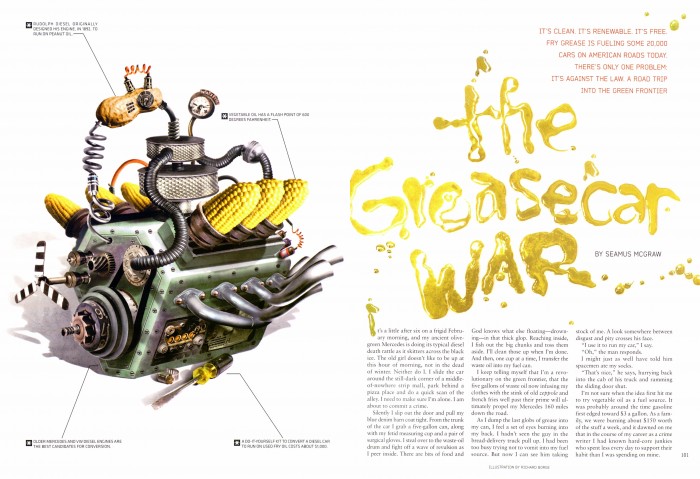
The Greasecar War
August, 2007
t's a little after six on a frigid February morning, and my ancient olive-green Mercedes is doing its typical diesel death rattle as it skitters across the black ice. The old girl doesn't like to be up at this hour of morning, not in the dead ot winter. Neither do I. I slide the car around the still-dark corner of a middle-of-nowhere strip mall, park behind a pizza place and do a quick scan of the alley. I need to make sure I'm alone. I am about to commit a crime.
Silently I slip out the door and pull my blue denim barn coat tight. From the trunk of the car 1 grab a five-gallon can, along with my fetid measuring cup and a pair of surgical gloves. I steal over to the waste-oil drum and fight off a wave of revulsion as 1 peer inside. There are hits of food and
God knows what else floating—drowning—in that thick glop. Reaching inside, I fish out the big chunks and toss them aside. I'll clean those up when I'm done. And then, one cup at a time, I transfer the waste oil into my fuel can.
I keep telling myself that I'm a revolutionary on the green frontier, that the five gallons of waste oil now infusing my clothes with the stink of old zcppitlc and trench fries well past their prime will ultimately propel my Mercedes 160 miles down the road.
As I dump the last globs of grease into my can, I feel a set of eyes burning into my back. I hadn't seen the guy in the bread-delivery truck pull up. I had been too busy trying not to vomit into my fuel source. But now I can see him taking
stock of me. A look somewhere between disgust and pity crosses his face.
"I use it to run my car," I say.
"Oh." the man responds.
I might just as well have told him spacemen ate my socks.
"That's nice," he says, hurrying back into the cab of his truck and ramming the sliding door shut.
I'm not sure when the idea first hit me to try vegetable oil as a fuel source. It was probably around the time gasoline first edged toward $3 a gallon. As a family, we were burning about $150 worth of the stuff a week, and it dawned on me that in the course of my career as a crime writer I had known hard-core junkies who spent less every day to support their habit than I was spending on mine.
I had read about conversion systems that allow cars to run on used trench-fry oil, mostly gee-whiz newspaper features that depicted the fry boys as colorful eccentrics. But those fry boys had some compelling engineering on their side. In fact, in 1892, when Rudolf Diesel, a debt-ridden paranoiac, designed the engine that now bears his name, he planned for it to run on peanut oil and even predicted in 1912 that while "the use of vegetable oils for engine fuels may seem insignificant today...such oils may become in the course of time as important as the petroleum and coal-tar products of the present."
By all accounts, his first foray into the field was less than successful. The peanut-oil diesel engine that the Otto Company unveiled at the Paris International Exposition in 1900 smoked and hissed and was generally considered unreliable. Diesel died 13 years later—an apparent suicide—and so too did his vision of an engine powerful nough to plow the fields, harvest its own fuel and cart the rest to market.
In recent years Diesel's idea has been re-
vived, driven partly by a desire for a cleaner fuel and more so by a desire, as those who study such things put it, "to stick it to the man." In some cases vegetable oil can propel a car for 70 miles a gal-
Ion while producing fewer paniculate pollutants than either conventional diesel or gasoline. It also has the advantage of being renewable and domestically produced, offering drivers the ability to opt out of the petroleum-based economy.
Then, of course, there is the cost. The roughly 3 billion gallons of waste vege-
table oil generated every year by American bistros and hotels is considered almost a toxic substance, and those restaurateurs too ethical to flush it down the toilet are often forced to pay a waste hauler to cart it away. In yet another of the peculiar ironies of American commerce, the fry grease your mother always warned would ruin your complexion is sometimes rendered and used in makeup. In other cases it's converted into animal feed and pet food.
Given a chance, however, many of those restaurateurs will gladly give away their waste vegetable oil to, say, a guy like me.
The instant I understood the facts, I was committed to the cause. I was determined to find an old car and convert it to run on fry grease. I am not alone. There are some 20,000 drivers on the green front, among them Hollywood beauty queens and a certain gov-ernator named Arnold.
Justin Carven sits behind his desk in his cluttered office on the second floor of a converted factory in the
village of East Hampton, Massachusetts. He is buried under a mountain of flowcharts and sales projections. The office mongrel, Olive Oil, snores beneath the desk, and as I peer over the wall ot documents, I can't help but imagine the number of trees it took to produce all that paper.
Carven is the founder and CEO of Greasecar, one of the nation's largest and fastest-growing companies specializing in waste-vegetable-oil conversions. Starting at $1,000, his company will sell you even-thing you need in one box to turn a diesel car into a grease burner. Lanky, bespectacled and nearly the same age as my wheezing old Mercedes, Carven was just a kid seven years ago when he scraped together $1,500 and set off across the country in an 18-year-old VW fitted with a conversion system he had developed. His goal: to prove veggie oil could be a viable fuel.
"I realized that the only way this was going to be taken seriously was if we could commercialize it and sort of prove it in the U.S. market," Carven says.
Fishing enough oil out of restaurant Dumpsters to keep himself on the road, he made it most of the way before an oil leak—which had everything to do with the infirmity of his car and nothing to do with the fuel—cut the trip short. The stunt generated some buzz. "There were a lot of people expressing interest that, if such a thing were available, they would want to buy it," he says. "Of course, turning that into a business that pays the bills is a longer story. But that's how it started."
(continued on page 128)
GREASECAR WAR
(continued from page 102)
Carven now employs 1 1 people. His company recorded sales of S- million last year, a number growing fast in 2007. In the past nine months alone, he has negotiated with public transportation companies and commercial trucking firms from the beaches of Brazil to the frost-scarred streets of Chicago. The way he sees it, the pioneer days of the greasecar movement are coming to a close. If Carven's industry is to succeed in the mainstream, it needs to develop an infrastructure that allows people to buy filtered waste oil as easily as they buy gas today.
It's already beginning to happen. A Pennsylvanian named Dave Dunham, for one, has launched a company called Smarter Fuel. Dunham processes three quarters of a million gallons of used vegetable oil a year and sells it at smarterfuel.com. He is working with Carven on getting his product onto shelves at service stations at SI.90 a gallon. Their eventual goal, Carven tells me, is worldwide distribution.
Carven rises from his desk and leads me through the labyrinthine corridors of the building, past rows of aluminum fuel tanks awaiting shipment to his warehouse and a storeroom holding an old drum set and a Coke machine converted to dispense Pabst and Miller. We end up in his garage. There, gleaming even in the dull February shadows, is a monument to his passion: Carven's personal car. It's a mint-green-and-cherry 1979 Austin Mini, painstakingly rebuilt from the ground up with a Peugeot diesel engine.
His stolid demeanor falls away when he talks about the car, built as a promotional vehicle and for use in alternative-fuel competitions. "It was a basket case when we got it. We did all the body work and repainted it, added an all-new interior. " Basking in the reflected glow of that Mini, Carven becomes more animated. Yes, buses, big rigs and mainstream cars are the future of necessity, but there's still life left in the notion that grease burners are simply cool.
"I've got sales figures I can show you," Carven says as he leads me briskly back to his office. "The pickup-truck market is huge and largely untapped. We need to go in a direction where we're marketing to that demographic." He sees jacked-up grease-burning pickups on the horizon, with Toby Keith blasting from a 10-CD changer. "We'll get involved with these tuning shops that are already selling performance addons," Carven adds, "and incorporate our products into monster trucks or truck pulls or whatever."
It all sounds ambitious and wonderful, but there's one problem: The whole veggie-oil movement — whether it's
using old restaurant grease or over-the-counter canola—is illegal.
During a phone conversation, Environmental Protection Agency spokesman John Millet says, in those cold and clinical terms favored by Washington bureaucrats, that "vegetable oil has not been registered as a motor-vehicle diesel fuel under 40 CFR 79. In addition, no motor vehicle manufacturer has obtained EPA emissions certification for a motor vehicle to operate on vegetable oil. Thus, introduction into commerce of vegetable oil for use as a motor-vehicle fuel would violate the Clean Air Act and EPA regulations."
What's more, he says, "no alternative-fuel conversion kits to modify motor vehicles to operate on vegetable oil have been certified by the EPA." It should be noted that, in the seven or so years since grease technology first started to turn up on the streets and highways of America, the EPA has prosecuted no one.
Still, for Carven's vision of veggie oil as a mainstream fuel source to be realized, laws will have to be rewritten. For the past two years, he has been working with engineers in the EPA's Troy, Michigan compliance office, trying to establish a set of protocols that can be used to test the technology and the fuel.
Cars are the second-largest carbon dioxide polluters in the States. (Coal-burning power plants are the first.) Scientists say this CO,, is causing global warming. It is raising the amount of carbon in our atmosphere; with deforestation, this carbon is not being reab-sorbed fast enough into the earth's natural biocycle. We're changing the chemical makeup of the air we breathe and not for the better, and cars are the major culprit. The EPA has conducted studies on a fuel called B100, a kind of processed, enhanced veggie oil called biodiesel, and found that, when burned in a car engine, it produced almost no sulfur (the stuff that causes acid rain) and about half the smog-forming hydrocarbons of conventional diesel. Among the items Carven has submitted to the EPA to bolster his case is a 2004 study conducted by independent researchers on roads in San Diego County. It found that vegetable oil released nearly 30 percent less carbon monoxide than diesel and generated between 37 percent and 41 percent less particle pollution (smoke). While the bureaucratic jury is still out at the EPA regarding used restaurant fry oil, with its General Tso's chicken chunks, almost no expert out there believes that, if properly filtered, it is not cleaner than what we burn on our roads today. Never mind that it's free, renewable and would allow America to collectively raise its middle finger to the Middle East.
Even some automakers, the same guys who will void your warranty in a heartbeat if you install one of these grease sys-
tems in your new car, are intrigued by the possibilities. As Keith Price, public-relations manager for product and technology at Volkswagen North America, put it, "We at VW are delighted that older and higher-mileage Volkswagen diesels are the official tuner car of the stick-it-to-the-man set. Sproutheads and tree huggers have always had an affinity for our brand. We're delighted and amazed at the ingenuity—but ultimately the fuel conservation and the reduced dependency on foreign oil—that some of our more fringe owners practice."
In fact, VW officials have gone so far as to give Carven and a few others a sneak peek at the new ultraclean diesel engine VW plans to begin importing to America next year, so the greasers can get a head start on designing systems to run the thing on veggie oil.
When I finally decided to do my conversion, I settled on Carven's Greasecar system and selected a car specifically with that kit in mind—a turbo-charged 1982 Mercedes 300SD that I picked up for $1,200. Most aficionados of grease believe older diesels, with their more expansive fuel injectors, are better candidates for conversion than newer, more fuel-efficient models. As an added bonus, there are no warranties to be voided when the factory-installed fuel lines are cut and grafted to run vegetable oil. But unlike most in my demographic, who tend to select more subdued vehicles, I picked a jet-black Mercedes with a leather interior and enough chrome bling on the wheels and fenders to make a Mafia don bite a knuckle with envy.
Still, I planned to do the conversion on the cheap, opting not to spend the $900 to have a company-approved mechanic install the system. Besides, Greasecar had promised it was a simple operation, well within the capabilities of any moderately talented backyard grease monkey.
While I'm not completely inept, mechanical skills have never been my strong suit. Most of what I know I learned from my father, a man who, as far as I know, never completed a single significant wrench job in his life. I had my doubts when I arranged with several friends, none of them mechanics, to spend a weekend on the process.
For two days we labored as a team, drilling holes here, feeding tubes there. So obsessed was 1 with the idea of using food-based products to power my car, I insisted we use only food products to complete the job, going so far as to slather the connections with bacon fat rather than conventional petroleum-based grease. My bemused co-workers indulged me. They were true believers, and I think I had convinced them, falsely, of course, that I was too.
Then Finally it was Sunday, and after some 20 man-hours of labor we stood
back and admired our handiwork. Every connection, every wire, every switch was placed right where it should be, just as it had appeared in the almost indecipherable schematics of the installation manual. It was a thing of beauty.
1 slid the key into the ignition and turned it halfway, wailing for the glow plugs, those mysterious devices that take the place of spark plugs in a diesel engine, to warm up enough to ignite the fuel. Then, trembling with anticipation, I turned the key the rest of the way. The car grunted like a rutting elk and then fell silent. I tried again. Nothing. And again. Nothing.
Over the next 10 days a steady stream of socket-wrench Samaritans and I tried everything we could to get the beast started. The following weekend 1 found myself shelling out the $900 to get the mechanic over to my driveway. By the time he left, we had at least identified the problem: A $ 15 primer pump—original equipment in the car—had given out during the conversion process, and as a result of all our attempts to kick over the engine, we had fried the fuses that feed power to the glow plugs. It was, I was told, an easy and inexpensive
fix, one that would cost about $135 if done by a mechanic. I pushed the car up the driveway, taking the extra precaution of chocking all four wheels with cinder blocks.
Of course, I forgot to put the car in park. I also forgot to put on the emergency brake. And that was why, on the following morning—after arranging with a towing company to carry the car off to a local Mercedes infirmary to have it fixed and after removing two of the cinder blocks—I stood on my driveway, watching with horror as my Mercedes 300SD, now valued at more than $4,000, began to roll back toward the edge of a small cliff behind my home.
A searing panic spewed through my gut. I threw every ounce of my 160-pound middle-aged frame against the rolling Mercedes before giving up. All I could do was watch as the 7,826-pound behemoth, one of the heaviest passenger cars of its generation, headed toward the cliff, gaining terminal velocity.
There was, I can now see in hindsight, a certain grace in the way it hurled itself over the precipice. But at that moment, the operatic beauty of the scene was lost on me. Perhaps I wasn't pure enough of
heart. After all, I was in this mess not trying to save the world but trying to save a buck. As 1 knelt beside the wreckage of the Mercedes, watching as its 100 percent soy lifeblood trickled out onto the cold stones, I wondered whether the Birkenstock-shod nymphs and dryads of the waste-vegetable-oil world had sensed I was not a true believer in their movement and were punishing me.
A few days later, after a brief period of mourning during which I went through the five stages of grief, I acquired a slightly older, considerably drabber 1980 300SD with modest fabric upholstery and a blown engine. I paid S500 for it. Then I paid a local mechanic another $1,200 to transplant the belatedly repaired engine from my crumpled Mercedes into it, plus another $600 to transfer the various components needed to make it run on veggie oil.
This time I turned the key and the engine burst into song. At last it was done. I was officially a fry boy.
There is a wrinkle to this story. It is called biodiesel. It is a completely different kind of fuel. Biodiesel: a fuel composed
of mono-alkyl esters of long-chain fatty acids derived from vegetable oils or animal fats. Essentially it is a processed veggie oil sold in grades from B2 (two percent biodiesel, 98 percent straight diesel) up to B 100 (100 percent biodiesel, zero straight diesel). It has its own lobbying and trade group, the National Biodiesel Board. The EPA has certified use of this stuff at grades of B20 and below, meaning the fuel has to be 80 percent straight diesel to be legal. Biodiesel is sold today at some 1,200 gas stations across the country. Willie Nelson brews his own brand. It can be used in a diesel car without any modifications.
The National Biodiesel Board claims biodiesel sales have increased from 25 mil-
lion gallons in 2003 to 250 million gallons last year. (That is but a fraction of the roughly 40 billion gallons of diesel burned on American roads each year.)
The National Bio-diesel Board is not fond of us fry boys. As Jenna Higgins, spokeswoman for the board, informed me with more than a hint of contempt in her voice, "Well, we sort of understand that there are people out there who want to take control of their own impact on the environment and their own use of petroleum. If hobbyists want to tinker around with this and experiment with raw vegetable oil, that's certainly their choice."
Higgins warned that those of us on the raw-veggie-oil fringe run the risk of gumming
up our engines with all manner of unstrained fats, not to mention running afoul of the law.
It is true that fry connoisseurs need to pay more attention to maintenance by keeping fuel lines and filters clean. But the raw-grease community is undeterred by the National Biodiesel Board. Grease enthusiasts say that even with federal subsidies biodiesel is still slightly more expensive lhan petroleum diesel. And though the biodiesel board says it fully expects to have five percent of the nation's on-road diesel market within the next eight years, at the moment, in most places, the stuff can be hard to come by. What if you don't live near one of the 1,200 stations that carry it? There are
that many grease-chucking restaurants in Brooklyn alone.
Nor does biodiesel seem to have any more friends among car manufacturers than grease does. Though most auto and truck manufacturers permit the use of some biodiesel in their vehicles, almost all of them cap the amount at five percent before they will void warranties, meaning 95 percent of what you're burning is straight, old-fashioned diesel.
With its government support and public-relations operation, biodiesel also has no stick-it-to-the-man appeal. Big Bio feels all too much like Big Oil.
No one knows that better than Tacee Webb, who worked in the fashion industry before she decided to take the
reins of Lovecraft, a boutique waste-oil-conversion-system company that, over the past year, has virtually cornered the market in Los Angeles. Its office, located on Sunset Boulevard in Silver Lake, has already done more than 1,300 conversions, mostly on old Mercedes and VW cars, and counts among its clientele more than a few young stars—among them Mandy Moore, who, Webb says, now tools around L.A. in a "very hot little dark-cherry-red 300CD turbodiesel."
"There's an underground, almost urban-myth quality to this product we've managed to capture and put into a box," Webb says. She's almost giddy with the excitement of it all. "It's illegal. We are operating a biofuel company that is
exactly the same as a head shop. We can put this conversion kit in your car and we can sell you a box of vegetable oil, but if we pump it, we get fined."
The truth is, Webb doesn't expect to get in any trouble. Lovecraft, which recently opened a branch in Portland, Oregon and is planning to expand its operation to San Francisco and Seattle, has an ace in the hole. One of its outlaw' clients is none other than Governor Arnold Schwarzenegger. Last fall he brought in a Hummer and had it converted in Lovecraft's garage, Webb says. We doubt Schwarzenegger is doing any Dumpster diving. But burning supermarket-purchased veggie oil is still against the law.
"Is the governor going to fine himself for pumping fuel into his car?" Webb asks. "No."
Schwarzenegger did not respond to requests to be interviewed for this story, but his press people in Sacramento did everything they could to downplay any notion that the governor, who recently ordered California to develop the toughest emissions standards in the country, is engaged in an act of civil disobedience. Spokesman Bill Maille insisted Schwarzenegger burns only EPA-approved biodiesel.
In other words, the governor may have bought the automotive equivalent of a bong, but he'd never dream of putting anything illicit in it.
Besides, Maille
says, Schwarzenegger is "mostly driven around by the California Highway Patrol. As governor, he is very active and travels extensively and is, you know, provided with a staff to drive him around, a protective detail, as
you would imagine, and__" Maille's
voice trails off before he finally gives up, reciting a litany of the governor's environmental accomplishments in the hope that the incantation will drive away any further uncomfortable questions.
Terry Tamminen is not nearly as reticent. As secretary of the California Environmental Protection Agency ]
during Schwarzenegger's first term and still one of the governor's most trusted advisors, Tamminen first turned the governor on to the forbidden world of grease-fueled cars. I caught up with him during a tour for his new book, Lives Per Gallon, an exploration of the hidden costs of the petroleum economy.
"I think this is one of those situations in which the people are out in front of their leaders," Tamminen says. And Schwarzenegger, he notes, is right out there with them.
"We're carrying on a great American tradition, but instead of throwing tea into Boston Harbor we're saying, 'Let's throw the oil barons out the window and put our transportation destiny into our own hands," " Tamminen says. "Isn't it great that all these years we've been lied to by these bastards, and now in fact we can power our cars with waste material from a restaurant or with 99-cent-a-gallon canola oil from Costco?"
Tamminen admits that, in the end, yes, the governor is breaking the law. "I think this is on a par with when a California football team competes against a New York football team, and the two governors bet a case of oranges against whatever the hell it is they have in New York." That's a small price to pay, he says, to have someone in political power show leadership on the issue.
But until the government finally catches up to the renegades and legalizes veggie-oil cars, those of us on the frontier are still officially outlaws— grease-soaked freedom fighters battling side by side with the Terminator
for the future of the planet. Or at least for a few gallons of free fuel.
Beneath all that outlaw panache, however, drowned out by the distant rumblings of Carven's longed-for pickups with 40 foot-pounds of turbo boost, another problem nags. For the fry-oil fringe, the issue is best articulated by Carl Bielenberg. Every movement has its mes-siah. Bielenberg founded the waste-veggie-oil movement—quite by accident.
Bielenberg lives in the north woods of New England. He is everything you would imagine a biofuel pioneer to be. A quiet, studious MIT-educated mechanical engineer who spends what little spare time he has studying the history of the long-abandoned American canal system, he began working three decades ago to find a way to feed malnourished villagers in sub-Saha-ran Africa. He had heard about Rudolf Diesel's early work and knew that various European agencies had been experimenting with vegetable oils, without much success, as a potential fuel for generators and other devices. The idea intrigued him, he says, and he began tinkering.
"1 experimented first with some Chinese air-cooled diesel engines—stationary engines, the kind that might run an electric generator or an irrigation pump," Bielenberg says. When those results showed promise, he started importing jatropha-plant oil from a project in Nicaragua. There were some drawbacks, but in the end, his ideas laid the groundwork for entrepreneurs and inventors like Carven, who worked with Bielenberg for a time overseas before starting Greasecar.
It never occurred to Bielenberg that his early efforts to help feed the \vorld"s hungry would spark the creation of a new industry. In fact, he never bothered to patent any of his inventions. Even now, as the movement he helped trigger spreads, Bielenberg says he is both amazed and repelled by what he set in motion. He tries not to be judgmental when 1 explain Carven's idea about cornering the veggie-fueled monster-truck market.
"Yeah, 1 can see why Justin would think that, and he may well be right that that's the way to increase his market share," Bielenberg says. All the same, he finds it troubling. "I've had people pull into my driveway with a four-wheel-drive Dodge pickup with a 300-horsepower Cummins engine and say, 'Can you convert mine to run on vegetable oil?' I tell them, 'I can do that, but it would break my heart. Vegetable oil is a food. Why would you feed so much of it to a machine that uses so much and for so little real purpose?"'
I have to confess, even after talking to Bielenberg, a big part of me still wanted to impress Tacee Webb. But I understood Bielenberg and felt for him. He is honest. He is ethical. He used air-cooled engines from China fueled by vegetable oil from Nicaragua to empower African villagers. The guy is a goddamn saint.
He is also right. As we've done with everything else in American society, we're in danger of taking this positive technology, this clean, renewable fuel source, and supersizing it. It is perhaps the nature of our culture, one that demands everything and demands it in excess.
It has been six months since I finished work on my car. As I write this, I now have some $6,500 tied up in a 1980 Mercedes, a car so old the Kelly Blue Book no longer publishes its estimated value but would probably fetch about $1,300 if hawked by a particularly aggressive used-car salesman.
So much for doing the conversion on the cheap.
But the thing is. I don't care. After some 20,000 largely trouble-free miles fueled by waste vegetable oil. I've started to take pride in the fact I hat little by little I'm opting out of the petroleum-based economy. I get about 32 miles to the gallon, and my car is no less powerful than it was before conversion.
Of course, the next time I am hit with a major expense, I'll no doubt want to chuck it all, maybe even buy a Hummer, secure in the knowledge that someday I'll be able to fill it with $15-a-gallon gas and take it on a joyride across the sunbaked deserts of Antarctica.
But at the moment. I've become a true believer. And the nymphs and dryads of the waste-veggie-oil world are smiling on me.
ITS CLEAN. ITS RENEWABLE. IT'S FREE.
FRY GREASE IS FUELING SOME 20.000
CARS ON AMERICAN ROADS TODAY.
THERE'S ONLY ONE PROBLEM:
IT'S AGAINST THE LAW. A ROAD TRIP
INTO THE GREEN FRONTIER

