Hemingway Style
August, 1999
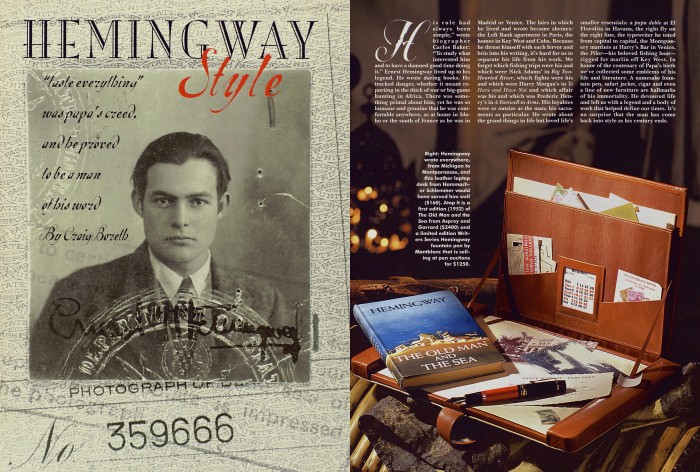
His rule had always been simple," wrote biographer Carlos Baker: "To study what interested him and to have a damned good time doing it." Ernest Hemingway lived up to his legend. He wrote daring books. He tracked danger, whether it meant reporting in the thick of war or big-game hunting in Africa. There was something primal about him, yet he was so humane and genuine that he was comfortable anywhere, as at home in Idaho or the south of France as he was in Madrid or Venice. The lairs in which he lived and wrote became shrines: the Left Bank apartment in Paris, the homes in Key West and Cuba. Because he thrust himself with such fervor and brio into his writing, it's hard for us to separate his life from his work. We forget which fishing trips were his and which were Nick Adams' in Big Two-Hearted River, which fights were his and which were Harry Morgan's in To Have and Have Not and which affair was his and which was Frederic Henry's in A Farewell to Arms. His loyalties were as outsize as the man; his sacraments as particular. He wrote about the grand things in life but loved life's smaller essentials: a papa doble at El Floridita in Havana, the right fly on the right line, the typewriter he toted from capital to capital, the Montgomery martinis at Harry's Bar in Venice, the Pilar--his beloved fishing boat--rigged for marlin off Key West. In honor of the centenary of Papa's birth we've collected some emblems of his life and literature. A namesake fountain pen, safari jacket, cigar and even a line of new furniture are hallmarks of his immortality. He devoured life and left us with a legend and a body of work that helped define our times. It's no surprise that the man has come back into style as his century ends.

