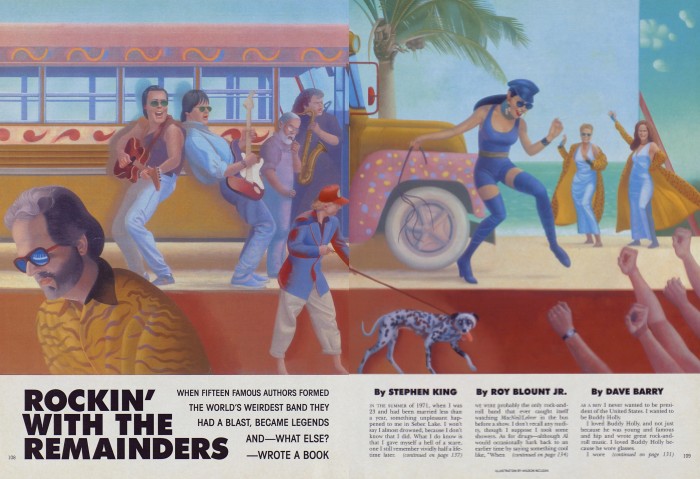
Rockin' With The Remainders
September, 1994
As a boy I never wanted to be president of the United States. I wanted to be Buddy Holly.
I loved Buddy Holly. and not just because he was young and famous and hip and wrote great rock-and-roll music. I loved Buddy Holly because he wore glasses.
I wore (continued on page 131)Remainders/Barry(continued from page 109) glasses, too. I got them when I was young, way before any of the other kids in my class. Sometimes I felt as though I'd had them at birth, as though I came into the world wearing thick little lenses framed in plastic fake-tortoiseshell rims, which had been damaged somewhere in the birth canal and consequently were being held together by a little strip of white adhesive tape. And Dr. Mortimer "Monty" Cohn, who attended all the Barry births, had looked down at me, then looked up at my mother, shook his head and said, "I'm sorry, Marion. It's a dweeb."
Not that I am bitter.
My point is that in those days I was not overly fond of myself. Low self-esteem is what I had, way before it was popular. And the focal point of my unhappiness was my glasses. So you can imagine how excited I was when I found Buddy Holly. Here was a guy who had glasses at least as flagrant as mine, a guy who did not look like a teen heartthrob but more like the president of the Audiovisual Club, the kid who always ran the projector for educational films with titles like The Story of Meat. In a word, Buddy Holly, let's be honest, looked like a geek. And yet he was unbelievably cool.
The first song of his that I ever heard was That'll Be the Day. I heard it on the radio, and it was the first record I bought, a 45 rpm costing 49 cents at the Armonk Pharmacy. I cannot tell you how much I loved that song. We had a primitive Fifties-style extreme-low-fidelity record player that seemed to be actually designed to scratch records, with a tone arm that had about the same weight and acoustic characteristics as a ball peen hammer, and a spindle that slapped the records violently on top of each other, as though it had a personal grudge against them. If you didn't put a new record on, it would play the same one over and over, and that's how I listened to That'll Be the Day. I'd set up the record player in my room and get out my pretend guitar. I'd face a large imaginary worshipful audience of cute girls and I'd sing: "When Cupid shot his dart, he shot it at your heart...."
Words cannot describe how irresistible I imagined I was.
I was really blue when Buddy's plane went down. Not blue enough to write a 374-verse, 14-hour song about it the way Don McLean did, but blue.
Nevertheless, Buddy Holly, in his short time on earth, had taught me an important lesson: namely, that you didn't have to look like Elvis to be popular and attractive and cool. All you had to do was work hard and use your Godgiven talent. There was nothing standing between me and international fame and adulation except the fact that, compared with Buddy Holly, I had no Godgiven talent. God had chosen to deposit the majority of this particular brand of talent in Buddy, and then he had chosen to put Buddy on a small plane in a bad storm in Clear Lake, Iowa. (And yet Fabian is still performing. Go figure God.)
•
I had to wait until I got to college to find some musical guys to be in a band with. I went to Haverford, a small all male college near Philadelphia that had a very good academic reputation, by which I mean it had--this could be proved mathematicall--the worst football team in the U.S. We lost games to Swarthmore.
I got to Haverford in 1965, when what we now call the Sixties were really starting to explode, and everybody (except Bill Clinton) was starting bands with names like the Catatonic Sturgeon. The first band I was in was called the Guides, because we had read in some hip underground newspaper that "guide" was a hip underground slang term for a person who took people on an acid trip. Unfortunately, it turned out that nobody except the person who wrote the article had ever heard this particular term, so people had a lot of trouble grasping what our name was.
"The Guys?" they'd say. "You're called the Guys?"
In succeeding years the Guides acquired new personnel and more instruments that enabled us to play at a new level, by which I mean louder. We also changed our name to the Federal Duck. We selected this name one night when our new bass player, Bob Stern, became briefly, but very seriously, concerned that some ducks in the Haverford College duck pond were in fact government narcotics agents. Bob Stern is now a respected dentist in New Jersey, so I am not about to suggest that the use of illegal hallucinogenic substances had anything to do with this incident.
The Federal Duck was the best thing that happened to me in the Sixties (and a lot of things happened to me in the Sixties). And although Haverford is a fine educational institution that taught me many important life lessons (such as, Never take any course that meets before noon), I remember playing in that band far more vividly, and more fondly, than I remember anything that happened in any classroom.
•
So anyway, after I graduated, a number of years passed, in chronological order, and I became an older person with a wife and a son and a writing career and a mortgage and (finally) contact lenses and certain gum problems and two dogs so stupid that they are routinely outwitted by inanimate objects. I play the guitar a lot in my office (just ask the dogs). It reassures me to play old rock songs, because I know how they're supposed to end, which is something I cannot say about anything I am trying to write.
But diddling around with a guitar in an office is not the same as being in a band. So when Kathi Goldmark called to ask if I wanted to be in a rock band consisting of writers who met the tough musical criterion of saying yes when Kathi called, I said yes.
And when she called again to say that Al Kooper had agreed to be the musical director of this band, I wet my figurative pants. I mean, Al Kooper. The man is a rock icon. A giant. A defining musical force. A really weird guy, it turns out. But that is not surprising. Al has been a professional rock musician since his early teens; this is an experience that, in terms of social development, is comparable to being raised by wolves, except that people raised by wolves are more comfortable in a social setting.
Don't get me wrong: I have come to love Al like the older brother I never had (thank God). But he made me nervous the first day the band got together in Anaheim to start practicing for our performance at the 1992 American Booksellers Association convention. I walked into the rehearsal room, and there, behind the organ, was this big, brooding, bearded guy, dressed in black, staring balefully out from the world's deepest set of eye sockets, looking like the leader of a group called Billy Goat and the Gruffs.
I later realized that even when he's in a good mood, Al looks like a man whose toes are being gnawed by rats, but at the time I was intimidated. I thought, Whoa, what am I doing here, presuming to play guitar next to this guy, a guy who has jammed with Mike Bloomfield, a guy who was in the Blues Project, a guy who co-founded Blood, Sweat and Tears, a guy who has backed up Bob Dylan, a guy who has worked with the Rolling Stones, a guy who--and very few living musicians can make this claim--performed on the original Royal Teens recording of Short, Shorts?
I think all of us writers were intimidated the first day. But Al was surprisingly gentle with us, listening nonjudgmentally as we'd fumble through a song, then offering insightful suggestions for making it sound better, such as:
"Don't play so loud."
"Don't play at all."
"I don't think we should do this song."
Using this technique we were quickly able to develop a fairly large repertoire of songs that we were definitely not going to do. We also got to know one another better and got to share our ideas about the craft of writing. For example, on our first lunch break, Stephen King, whom I had never met, walked up to me, leaned down to put his face about an inch from mine and said, in a booming, maniacal voice, "So, Dave Barry, where do you get your ideas?"
Stephen was making a little writer's joke. He hates this question. Like most writers, he has been asked this question 900 squintillion times.
The truth is, the Remainders hardly ever talked about writing, and that was one thing I liked about being in the band. We spent a lot more time talking about issues such as the chord changes in Leader of the Pack, whether Elvis was bald and where was the most interesting place that anybody in the band had ever had oral sex. (Roy Blount Jr. definitely had the most interesting place, but out of respect for his privacy I will not discuss it here except to say that it involved a trampoline.)
After we got on the bus and started traveling, we hardly talked about anything except band-related stuff, such as where we were playing, what songs we were going to do, what the audience was going to be like, and--about all--what bus travel was doing to everybody's hair. Al Kooper had warned us about bus hair, which is a disgusting medical condition that strikes you after you have spent a night attempting to sleep in a bus with your head smooshed up against a seat coated with a mixture of old hairspray, spilled beer and potato-chip grease--and your hair is relentlessly exposed to a bus atmosphere consisting of two percent oxygen, 17 percent nitrogen, 39 percent diesel fumes and 42 percent bodily vapors. You'd be rolling down 1-95 in some place like South Carolina (such as North Carolina), and you'd wake up at dawn, having slept for maybe two hours. You'd look around, and there, in the other seats, instead of your fellow band members, were these horribly deformed creatures with bloated faces and red eyes and green moss visibly growing on their teeth and big sectors of hair sticking straight out sideways, looking like Bozo the Clown but with pastier skin. They'd be laughing at you, and you'd realize that you looked even worse than they did.
A major insight that I had on the Remainders bus tour, after maybe the ninth straight day of getting almost no sleep and not eating any green vegetables except for the ones that come in a bloody mary, is that traveling rock bands do not have a healthy lifestyle. I believe the reason so many rock stars elect to die young is that, basically, it is better for their health.
•
After we'd been on the road for a while, the Remainders drifted into a collective, surreal state of mind that I think of as Bandland. Bandland was our little separate cocoon-bus world, whose residents had little direct contact with the normal human race. We developed our own verbal communications system, which was based on saying only the punch lines to inside jokes. For-example: Early in the tour, we were riding through New England on our way to play in Northampton, Massachusetts. We had been riding through the New England countryside for maybe two hours, with traditional scenic New England vistas on both sides of us as far as the eye could see, and suddenly our saxophone player, Jerry Peterson, an incredible musician with an enormous hairstyle that, I believe, enables him to receive signals from another planet, looked out the window and said, quote:
"New England. Check it out."
Apparently Jerry had just then noticed New England and wanted to make sure the rest of us didn't miss it. We all thought this was wonderfully funny, and for the rest of the trip, many dozens of times per day, we urged one another to check things out, as in: "Popcorn. Check it out." And "Marcel Proust. Check him out." It became virtually impossible for any object, person or abstract concept to come to our attention without somebody urging everybody to check it out. I am not saying this was good; I'm just saying this was the way it was, in Bandland.
And the thing is, the Remainders were together for only a couple of weeks. Some bands have been together for years. No wonder so many rock musicians are weird. Not that I am specifically referring to Kooper.
Speaking of Kooper, one of the best things about the tour was playing with him, Jerry Peterson and drummer Josh Kelly, the professional musicians who had been everywhere and played with everybody and who kept the Remainders from being really horrible. It made me feel as though I had been allowed, just briefly, inside a secret and exclusive club. There would be times when we'd be onstage, playing, and I'd look over at Al, and he'd give me some musical handsignal reminder, like quickly touching his hand to the top of his head to indicate that we were supposed to go to the "top," or beginning, of the song, and I'd think: Here I am, onstage, getting cool secret hipster-musician hand signals from Al Kooper! I'd be so excited thinking this that I would not necessarily remember to go to the top of the song.
•
We were not, it goes without saying, a very good band. Fortunately the audiences didn't expect us to be. They seemed to be satisfied with the novelty of it, with knowing that very few bands have novelists of the stature of Amy Tan singing Leader of the Pack, or have Stephen King singing his special version of the immortal teen-tragedy song Last Kiss, featuring such sentimental, improvised lyrics as: "I saw my baby lying there./I brushed her liver from my hair."
And no normal band has a weapon anything like the Critics Chorus. This is a group of men who make their living criticizing professional musicians in print, so it goes without saying that they were, in terms of raw musical skills, Probably the least talented group of individuals ever assembled.
Naturally, audiences loved the Critics Chorus. They loved it when respected critic Joel Selvin took his now-legendary scream solo in Louie Louie, they loved it when respected critic Dave Marsh came out during Teen Angel wearing a ketchup-stained wedding dress, they loved it during These Boots Are Made for Walkin' when Roy Blount Jr.--three-time winner of the coveted World's Whitest Man title--attempted to dance and light Amy Tan's cigarette at the same time. There was not a dry pair of underwear in the house.
After we played our last gig, I had a hard time coming back to earth--having to trudge back into my office and spend my days staring at the computer screen again, having to communicate with people in complete sentences, having nobody to play music with and no audience to play in front of except the dogs. I realize that, for my career and my health (especially my hair), I had to get back to reality. But I miss Bandland. When you get to be in your 40s, heading directly toward (can this be?) your 50s, you tend not to do stuff like this--make new friends, go out and have wild adventures, risk making a fool of yourself.
Actually, we did more than just risk this, but you get my point: It was worth doing. My advice is, if you are, like so many people these days, getting older, and you get a chance to do anything like this, you should. I'm not talking necessarily about being in a band; I'm just talking about doing something that you have no rational business doing, except that you always wanted to. That's a good enough reason. That's the best reason. Because life is pretty much finite. I bet Buddy would tell you the same thing.
"The focal point of my unhappiness was my glasses. Imagine how excited I was when I found Buddy Holly."

