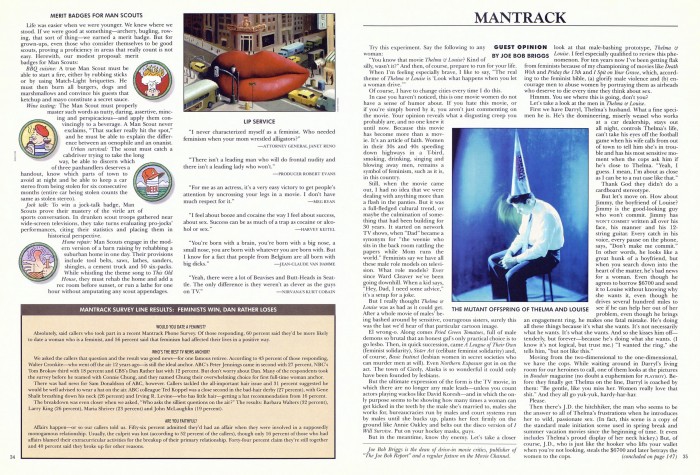
Mantrack
February, 1994
Try this experiment. Say the following to any woman:
''You know that movie Thelma & Louise? Kind of silly, wasn't it?'' And then, of course, prepare to run for your life.
When I'm feeling especially brave, I like to say, ''The real theme of Thelma & Louise is 'Look what happens when you let a woman drive.'''
Of course, I have to change cities every time I do this.
In case you haven't noticed, this is one movie women do not have a sense of humor about. If you hate this movie, or if you're simply bored by it, you aren't just commenting on the movie. Your opinion reveals what a disgusting creep you probably are, and no one knew it until now. Because this movie has become more than a movie. It's an article of faith. Women in their 30s and 40s speeding down highways in a T-bird, smoking, drinking, singing and blowing away men, remains a symbol of feminism, such as it is, in this country.
Still, when the movie came out, I had no idea that we were dealing with anything more than a flash in the panties. But it was a full-fledged cultural trend, or maybe the culmination of something that had been building for 30 years. It started on network TV shows, when ''Dad'' became a synonym for ''the weenie who sits in the back room rattling the papers while Mom runs the world.'' Feminists say we have all these male role models on television. What role models? Ever since Ward Cleaver we've been going downhill. When a kid says, ''Hey, Dad, I need some advice,'' it's a setup for a joke.
But I really thought Thelma & Louise was as bad as it could get. After a whole movie of males' being bashed around by sensitive, courageous sisters, surely this was the last we'd hear of that particular cartoon image.
El wrong-o. Along comes Fried Green Tomatoes, full of male demons so brutal that an honest gal's only practical choice is to go lesbo. Then, in quick succession, came A League of Their Own (feminist solidarity). Sister Act (celibate feminist solidarity) and, of course, Basic Instinct (lesbian women in secret societies who can murder men at will). Even Northern Exposure got in on the act. The town of Cicely, Alaska is so wonderful it could only have been founded by lesbians.
But the ultimate expression of the form is the TV movie, in which there are no longer any male leads--unless you count actors playing wackos like David Koresh--and in which the only purpose seems to be showing how many times a woman can get kicked in the teeth by the male she's married to, males she works for, bureaucracies run by males and court systems run by males until she bucks up, plants her feet firmly on the ground like Annie Oakley and belts out the disco version of I Will Survive. Put on your hockey masks, guys.
Joe Bob Briggs is the dean of drive-in movie critics, publisher of ''The Joe Bob Report'' and a regular fixture on the Movie Channel.
But in the meantime, know thy enemy. Let's take a closer look at that male-bashing prototype, Thelma & Louise. I feel especially qualified to review this phenomenon. For ten years now I've been getting flak from feminists because of my championing of movies like Death Wish and Friday the 13th and I Spit on Your Grave, which, according to the feminist bible, (a) glorify male violence and (b) encourage men to abuse women by portraying them as airheads who deserve to die every time they think about sex.
Hmmm. You see where this is going, don't you?
Let's take a look at the men in Thelma & Louise.
First we have Darryl, Thelma's husband. What a fine specimen he is. He's the domineering, miserly weasel who works at a car dealership, stays out all night, controls Thelma's life, can't take his eyes off the football game when his wife calls from out of town to tell him she's in trouble and has his most sensitive moment when the cops, ask him if he's close to Thelma. ''Yeah, I guess. I mean, I'm about as close as I can be to a nut case like that.''
Thank God they didn't do a cardboard stereotype.
But let's move on. How about Jimmy, the boyfriend of Louise? Jimmy is the good-looking guy who won't commit. Jimmy has Wont Commit written all over his face, his manner and his 12-string guitar. Every catch in his voice, every pause on the phone, says, ''Don't make me commit.'' In other words, he looks like a great hunk of a boyfriend, but when you search down into the heart of the matter, he's bad news for a woman. Even though he agrees to borrow $6700 and send it to Louise without knowing why she wants it, even though he drives several hundred miles to see if he can help her out of her problem, even though he brings an engagement ring, he makes one fatal mistake. He's doing all these things because it's what she wants. It's not necessarily what he wants. It's what she wants. And so she kisses him off-- tenderly, but forever--because he's doing what she wants. (I know it's not logical, but trust me.) ''I wanted the ring,'' she tells him, ''but not like this.''
Moving from the two-dimensional to the one-dimensional, we have the cops. While waiting around in Darryl's living room for our heroines to call, one of them looks at the pictures in Boudoir magazine (no doubt a euphemism for Playboy). Before they finally get Thelma on the line, Darryl is coached by them: ''Be gentle, like you miss her. Women really love that shit.'' And they all go yuk-yuk, hardy-har-har.
Please.
Then there's J.D. the hitchhiker, the man who seems to be the answer to all of Thelma's frustrations when he introduces her to wild, passionate sex. (In fact, this scene is a copy of the standard male initiation scene used in spring break and summer vacation movies since the beginning of time. It even includes Thelma's proud display of her neck hickey.) But, of course, J.D., who is just like the hooker who lifts your wallet when you're not looking, steals the $6700 and later betrays the women to the cops.
'''Do you realize how many people would die every Friday night if you shot people for saying suck my cock?'''
Even Hal, the one good cop, the one with an ounce of humanity, the one who's trying to save these women's lives--even he is finally disposed of as just another man. He gives Louise her last chance to give up and turn herself in. ''I feel like I know you,'' he tells her.
This makes her extremely angry, angry out of all proportion to what he said. Because this is near the end of the movie, and by the end of the movie all men are the enemy. No man has a right to say, ''I feel like I know you.'' It must be a manipulation. And so she answers with a sigh: ''You don't.''
I've saved Harlan for last. You remember Harlan. Harlan is the guy they meet in the dark, dingy bowels of that overwhelmingly male institution, the road-house. In fact, it's the Silver Bullet Bar. (Symbolism! Symbolism!) One of Harlan's opening lines is something about ''such purty ladies as yourself,'' after which he dances with Thelma while holding a Miller longneck over her shoulder. Thelma gets sick, and so this sleaze sees his chance to take advantage of her. He takes her to the parking lot, grabs her, feels her, slaps her, makes her cry, becomes viciously violent when he gets slapped back, and then attempts to rape her. All this stops when Louise puts a gun to Harlan's neck, says ''Let her go'' and calls him an asshole.
But here's the difference between Thelma & Louise and a Charles Bronson movie. Charles Bronson kills criminals for what they do. Louise kills Harlan largely for what he says. He says three things, and each one of them makes Louise just a little angrier.
First Harlan says, ''Calm down. We was just having a little fun, that's all.''
And Louise seems to be willing to let this guy off with a lesson. She says, ''In the future, when a woman is crying like that, she isn't having any fun.''
But, as soon as the women start walking away, the redneck from hell decides to taunt them: ''Bitch! I should have gone ahead and fucked her.''
Louise can't stand it. So she turns around, ready to teach him a stronger lesson: ''What did you say?''
''I said, 'Suck my cock.'''
And immediately the guy is dead. Bang. Dead. She looks at his corpse and says, ''You watch your mouth, buddy.''
The next question is, why doesn't Louise go to the police, like Thelma asks her to? And the answer is, all the police are Boudoir-reding males, and they wouldn't believe the jerk was attempting rape. And, even if they did, the attempted rape was over when the killing occurred. (A better reason would be that the police would believe her story, but, being good policemen, would say, ''Let me get this straight. You killed him for saying 'suck my cock'? Do you realize how many people would die every Friday night in Arkansas if you could shoot people for saying suck my cock?'')
I don't even think Harlan's crime was that he tried to rape Thelma. Because Callie Khouri, the screenwriter, could have easily allowed him to be successful at raping her, and then the homicide would be more justifiable. And it wasn't that he said ''suck my cock.'' It was that he paid no respect to a woman. It's like a Mafia code thing. He made jokes and smartass remarks when he should have been saying, ''I apologize.''
Lack of respect is the theme. It's not really a pro-female movie. It's antimale. Louise and Thelma might bicker about everything else in the world, but on one thing they agree: Men are the cause of everyone's problems. And the reason is that they have no respect.
Even though Louise shoots Harlan, Thelma makes it clear that she supports the killing and thinks it was the morally correct thing to do. In fact, it enhanced her life: ''At least now I'm having some fun. And I'm not sorry that sumbitch is dead. I'm just sorry it was you that did it and not me.''
In fact, this movie is not much about Louise at all. The whole story is the education of Thelma, converting her from a lover of men to a hater of men. (Remember how frisky toward men she is in the early scenes, planning Darryl's dinner, jumping up to dance at the Silver Bullet, whimpering like a puppy so that Louise will let her pick up the hitchhiker? And remember how hard and brutal she is at the end? That's when we're supposed to say, ''Well, thank God, Thelma has finally got her head screwed on straight. Of course, she's about to die, and take her friend with her, but at least she has her political opinions in order.'')
You can't blame Callie Khouri or director Ridley Scott for what the women of America thought this movie was. They're not responsible if somebody takes a cartoon and acts like it's a Picasso. In fact, Thelma & Louise is nothing more nor less than a great exploitation movie. The Great Texas Dynamite Chase, which came out in 1977, is basically the same story, and Assault of the Killer Bimbos, which came out in 1988, has many resemblances as well. The only difference among the three movies is that Thelma & Louise claims to be serious in intent.
But after hearing for the past ten years about the way women are treated in male movies, I have to say this:
Charles Bronson never killed anybody for saying ''suck my cock.''
Jason never killed anybody because they were the wrong sex.
Even Leatherface, the original chain-saw killer, had his limits. And he had the moral advantage of being crazy.
I've seen 40,000 exploitation movies in my lifetime, and I'd just like to say, This one is scary.
I have seen the.future, and it has a lot of lesbians in it.

