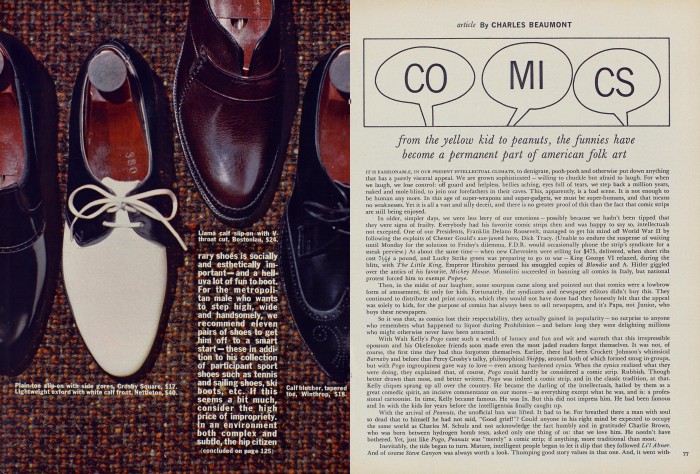
Comics
March, 1961
It is Fashionable, in Our Present Intellectual Climate, to denigrate, pooh-pooh and otherwise put down anything that has a purely visceral appeal. We are grown sophisticated – willing to chuckle but afraid to laugh. For when we laugh, we lose control: off guard and helpless, bellies aching, eyes full of tears, we step back a million years, naked and mole-blind, to join our forefathers in their caves. This, apparently, is a bad scene. It is not enough to be human any more. In this age of super-weapons and super-gadgets, we must be super-humans, and that means no weaknesses. Yet it is all a vast and silly deceit, and there is no greater proof of this than the fact that comic strips are still being enjoyed.
In older, simpler days, we were less leery of our emotions – possibly because we hadn't been tipped that they were signs of frailty. Everybody had his favorite comic strips then and was happy to say so, intellectuals not excepted. One of our Presidents, Franklin Delano Roosevelt, managed to get his mind off World War II by following the exploits of Chester Gould's axe-jawed hero, Dick Tracy. (Unable to endure the suspense of waiting until Monday for the solution to Friday's dilemma, F.D.R. would occasionally phone the strip's syndicate for a sneak preview.) At about the same time – when new Chevrolets were selling for $475, delivered, when short ribs cost 71/2¢ a pound, and Lucky Strike green was preparing to go to war – King George VI relaxed, during the blitz, with The Little King, Emperor Hirohito perused his smuggled copies of Blondie and A. Hitler giggled over the antics of his favorite,Mickey Mouse. Mussolini succeeded in banning all comics in Italy, but national protest forced him to exempt Popeye.
Then, in the midst of our laughter, some sourpuss came along and pointed out that comics were a lowbrow from of amusement, fit only for kids. Fortunately, the syndicates and newspapers editors didn't buy this. They continued to distribute and print comics, which they would not have done had they honestly felt that the appeal was solely to kids, for the purpose of comics has always been to sell newspapers, and it's Papa, not Junior, who buys these newspapers.
So it was that, as comics lost their respectability, they actually gained in popularity – no surprise to anyone who remembers what happened to liquor during Prohibition – and before long they were delighting millions who might otherwise never have been attracted.
With Walt Kelly's Pogo came such a wealth of lunacy and fun and wit and warmth that this irrespressible opossum and his Okefenokee friends soon made even the most jaded readers forget themselves. It was not, of course, the first time they had thus forgotten themselves. Earlier, there had been Crockett Johnson's whimsical Barnaby and before that Percy Crosby's talky, philosophical Skippy, around both of which formed smug in-groups, but with Pogo ingroupiness gave way to love – even among hardened cynics. When the cynics realized what they were doing, they explained that, of course,Pogo could hardly be considered a comic strip. Rubbish. Though better drawn than most, and better written,Pogo was indeed a comic strip, and in the classic tradition, at that. Kelly cliques sprang up all over the country. He became the darling of the intellectuals, hailed by them as a great comedic spirit, an incisive commentator on our mores – as everything except what he was, and is: a professional cartoonist. In time, Kelly became famous. He was In. But this did not impress him. He had been famous and In with the kids for years before the intelligentsia finally caught up.
With the arrival of Peanuts, the unofficial ban was lifted. It had to be. For breathed there a man with soul so dead that to himself he had not said, "Good grief!"? Could anyone in his right mind be expected to occupy the same world as Charles M. Schulz and not acknowledge the fact humbly and in gratitude? Charlie Brown, who was born between hydrogen bomb tests, asked only one thing of us: that we love him. He needn't have bothered. Yet, just like Pogo, Peanuts was "merely" a comic strip; if anything, more traditional than most.
Inevitably, the tide began to turn. Mature, intelligent people began to let it slip that they followed Li'l Abner. And of course Steve Canyon was always worth a look. Thumping good story values in that one. And, it went without saying,Beetle Bailey – well, after all, didn't President Eisenhower himself admit that this was a favorite of his? Didn't Grace Kelly's father express enthusiasm for The Phantom? And one couldn't really afford to ignore Dick Tracy, could one? And King Aroo, needless to say. And Tarzan. And...
At Boston University $37,000 will be spent in a study of the history and influence of comic strips. There are already several books on the subject. We are told it is all right for us to dig the funnies because they are of vast sociological and cultural significance. And already there are mutterings to the effect that they are art, of the highest order and deepest importance.
Maybe so. If, as the Encyclopaedia Britannica tells us, art is "anything which is not natural," then there is no reason to withhold the handle, particularly not if it will comfort us after we have split a gut over the funnies. But even if there's more to art than that, even than the comics might qualify; a few of them, anyway; the best of them. In terms of beauty, imagination, communication, emotional response, and general good to the world, whose creation is more deserving of the laurel – Salvador Dali's The Invention of the Monsters of Peanuts?
Before 1895, there was no such thing as a comic strip. The newspapers of the period were gray with tight, tiny rows of type, unrelieved except by an occasional realistic sketch or a laboriously detailed cartoon of the Hogarth School. A funny animal feature,The Little Bears and Tigers, began to appear regularly in the San Francisco Examiner in 1892 but it had no real continuity and is mentioned only because its creator, James Swinnerton, was later to become a major influence on comic artists. The first bona fide ancestor of our present family of comic strip characters was a bizarre little elf called The Yellow Kid. He came into existence July 7, 1895, born of a happy union between Richard Felton Outcault and Joseph Pulitzer. In keeping with tradition, neither of these gentlemen had any inkling of what he was starting. Pulitzer, whose New York World was locked in mortal combat with William Randolph Hearst's Journal, simply wanted a gimmick to sell more newspapers. The gimmick, however, was not a trail-blazing excursion into comic art but, instead, the newly-discovered color printing process. Pulitzer had it working fine, except for yellow. For some reason, no one could make this color dry properly. So Pulitzer decided to experiment – publicly. For the purpose, he called in staff-artist Outcault and laid the problem before him. Outcault responded with a variation on his popular Hogan's Alley drawings. Into the New York slum settings, replete with mobster brats, broken bums and scrofulous dogs, he inserted a wildley improbable creature belonging neither to Hogan's Alley nor to the natural world. It's – one could guess the gender – was about half the size of the smallest child, yet with its mandarin features, its bald head and conch-shell ears, it was clearly no child. (Years later Milton Caniff revived The Yellow Kid in Terry and the Pirates, changing his name to Connie, adding a few feet to his stature, but otherwise sticking to the original. Few but insiders ever got the joke.) Outcault himself never stated the reason for the outré features, but for the flowing nightgown there was full justification: it was a perfect proving ground for the color tests.
The Yellow Kid (from whose name the phrase "yellow journalism" is said to have been derived) became popular at the outset. So popular, in fact, that even after Pulitzer gave up wondering where the yellow went, the panel was continued. Soon thereafter, Hearst lured Outcault to the Journal, but Pulitzer retained legal rights to his feature and shortly there were two Yellow Kids – each a tremendous hit.
It is difficult to understand why. Despite his sagacious countenance, the Kid was a vicious little hoodlum, taking keen delight in such boyhood pranks as torturing Negroes, hectoring dog-catchers and breaking windows. The captions, talcumed throughout each drawing, were as phony as an operatic laugh, depending for their effect almost entirely upon dialect and freakish word combinations ("Gee Dis Beats De Carpet Which Is Hard To Beat"). Certain representatives of the "genteel readership" posted sharp protests, but to no avail. The Kid was a winner.
He stayed a winner for two years; then, when people began to tire of the back-alley humor, Outcault came up with Buster Brown, who differed from the Kid in that he was rich and of a somewhat less homicidal nature.
Still we have no comic strip as such, but we are getting close. In 1897 an elegantly mustachioed young artist moved East. His name was Rudolph Dirks. He possessed an uncertain line, an average imagination and a lucky star. The latter manifested itself when the Journal's comic editor, Rudoph Block, suggested that Dirks put together a feature based upon German humorist Wilhelm Busch's famous rapscallions, Max and Moritz. Dirks experimented with his adaptation, renamed the mischievous heroes The Katzenjammer Kids, and made the speech "balloon" an integral part of graphic humor in America.
"Mit dose kids society iss nix," commented one of dose kids' victims, and he was right. Hans and Fritz were rowdies, but unlike Outcault's grotesques, they perpetrated their maddening japes in a spirit of fun. By 1900 they had become a permanent landmark on the American cultural scene, beloved by millions.
As in the case of Outcault, Dirks was seduced away from his home paper, and out of this came a now famous legal dispute. The Journal claimed ownership of the Kids. So did Dirks. The courts decided in favor of both. Dirks could continue with his characters, but he could not retain the title. Result: the Journal hired H. H. Knerr to carry on The Katzenjammer Kids, while Dirks chose the title The Captain and the Kids and went on drawing and writing as before. There was never much to choose between the two. Dirks was zanier and had a better grip on the Ach! Himmel! dialog, Knerr drew with a surer line. Both creations were splendid.
Legend has it that Bud Fisher created the first honest-to-gosh comic strip (as we understand the term: four or five panels running across the page, either developing an episode or telling a complete story). The truth is that Clare Briggs beat everyone to the punch with his A. Piker Clerk, in 1904. The strip was not very good, however. But neither was Fisher's strip much to shout about until, on March 29, 1908, a magical accident occured. Mr. Augustus Mutt, a flashily dressed racing tout, had been planned as a lone hero. Although no one could claim that he was a sensation, he had a certain appeal, and for the most part, people liked him. Then, one day, Fisher decided to give Mutt a friend. He would call the friend Jeff, after the fighter Jim Jeffries. Appropriately, the two met for the first time in an insane asylum, and the rest, as they say, is history.Mutt and Jeff became the most popular comic creation in the world, and Harry Conway Fisher became the first cartoonist to earn $1000 a week. Now Fisher is dead, but, after fifty years, his characters are still going strong, carried on in the old tradition by Fisher's one-time assistant, Al Smith.
After Mutt and Jeff, the comics stopped being a novelty and became a respectable occupation. Of course there were no training schools then, and most of the artists came either from the sports departments (as Fisher did) or from magazines. For some reason, the magazine illustrators didn't cut the condiments, perhaps because they were too good. More often than not, their pictures were so well drawn that people forgot the stories. An exception, however, was Winsor McCay. Having established an (continued on page 110)
Comics(continued from page 78) enviable reputation in the book and magazine field, he moved into the comics, bringing with him an ability with pen and ink that has seldom been excelled to this day. He had the good sense not to try for funny animals or humorous grotesques. Instead, he created the first of the "realistic strips,"Little Nemo. The draftsmanship, with its unprecedented use of perspective, and its Max-field Parrish–like settings, was a miracle of skill combined with imagination. The story itself was fantastic, following a typical seven- or eight-year-old boy through the land of his dreams. No one with eyes in his head could resist the strip. And it is a mark of the ageless beauty of Little Nemo that when it was reprinted, forty years after its first appearance, most people thought it was a new feature.
According to Arthur Brisbane, Harry Hershfield's Abie the Agent was "the first of the adult comics in America." Hershfield produced a gentle strip about a mild, sweet-tempered Jew and charmed the world, for a while. Abie spoke in an odd dialect, when he spoke at all, which was seldom, and probably accomplished much in the fight against prejudice.
August 3, 1913, saw the first appearance of Bringing Up Father and its protagonist, the mighty Jiggs. To George McManus, who had already achieved fame with such pioneering efforts as Alma and Oliver, Snoozer, Let George Do It and Panhandle Pete, it was only another comic strip. But Jiggs caught on fast. People fell in love with the little Irishman and sympathized with him in his problem, which was that of a simple, honest man who likes the simple, honest things of life (viz., corned beef and cabbage, billiards, poker) but is forbidden to enjoy them. Jiggs and his termagant wife Maggie were nouveaux riches. After many years of happy penury, suddenly they had become millionaires. Jiggs did not see why this should make any great difference in his life, but Maggie had other ideas. Now that we're rich, she said, brandishing her rolling pin, we're going to act the part. Whereupon Jiggs found himself a prisoner of his own ambition, forced to brave the wrath of wife, daughter, servants and business associates, in order to partake of pleasures he'd previously taken for granted. The message was comforting, particularly during the Depression: don't hanker after material wealth – you might end up like Jiggs.
Of course, you might also end up like that other son of Eire, George McManus, who lived a rich, full life, apparently undisturbed by the fat bank account he acquired thanks to Jiggs – whom he strikingly resembled, by the way.
Not so well remembered as Jiggs, but equally famous in his day, was Barney Google. Barney began life, in 1919, as a bug-eyed shrimp devoted, like Augustus Mutt, to the Sport of Kings. He made bets, lost them, and cringed at the invective of a shrewish and domineering wife, and it appeared that he would go the way of a hundred similar clichés. Then, on July 17, 1922, Barney met Spark Plug. No sadder horse existed, no heart was so easily broken nor so full of love for Google. The little fellow's character changed almost overnight. Now that someone really cared for him, he dropped his wiseacre mannerisms and became, in time, the sweet soul Spark Plug had known him to be all along.
Barney rode high for almost two decades; then his creator, Billy DeBeck, introduced him to the various members of an Ozark family named Smith, and that was the beginning of Barney's decline. No saint has ever been able to match a rascal in popularity. And no more rascally figure than Snuffy Smith could be found on the comic scene. Snuffy, his long-suffering wife Lowizie, and his wild offspring Jughaid, thrust Barney from the center of the stage and, with an angry "Balls o' fire!" took over the strip. Together, these children of DeBeck's imagination contributed more valuable words and phrases to the public vocabulary than any group of real-life people had done for twenty years. From them we inherited "google-eyed," "heebie-jeebies," "tetched in the haid," the aforementioned "Balls o' fire!" and many more. DeBeck died in 1943, but there was no change in Barney or Snuffy. Fred Lasswell wisely refused to "bring them up to date."
Another example of a minor character's taking over from the ostensibly more important characters may be found in Raeburn Van Buren's strip, which for some reason is still called Abbie 'n' Slats, although an unsanitary old curmudgeon known as Bathless Groggins long ago took the stage away from the title two-some. Van Buren, an able draftsman, usually finds some excuse to involve Bath-less in adventures with dusky harem beauties. They are decorously brassiered, as a rule, but once Van Buren managed to slip past editors a harem episode in which one or two of the houris were drawn bare-bosomed, complete with nipples. Sad to relate, the bras were back on in the very next episode.
Now the question of art must raise its Janus head again, for it is time to speak of Krazy Kat. George Herriman was an artist in the sense that he drew pictures; he was a great artist in the sense that the pictures he drew were examples of great comic art; whether or not he was an artist in the sense of our current interpretation of that ill-used word is a matter of personal opinion. Learned students of the field have ranked him with Chaplin, and his creation, Krazy, with Don Quixote. Others think he was simply a good cartoonist who happened to have a screw or two loose in his head. Out of the debate one fact emerges healthy and unbruised: Herriman and Krazy were the most original fun-makers of their time. They were natural phenomena, without ancestors and without heirs, absolutely unique in a world where nothing new is supposed to happen under the sun. There was nothing like them before. There has been nothing like them since. And that cannot be said of any other comic strip. Who can forget those mysterious, ever-changing landscapes (located somewhere in mythical Coconico County); that trinity of fools – Offissa Pup. Ignatz Mouse and Krazy – who existed for and by themselves; the inevitable brick (POW!) hurled with love; and the jail that appeared like magic out of the Coconico dust? From the chaos came order, and no one questioned the order, for like the genius he was – if only at so humble a profession as cartooning – Herriman managed to create a microcosm and make it work.
A lesser talent was that of Sidney Smith. Nevertheless, because of a shrewd bargaining sense and the popularity of The Gumps, Smith became the first millionaire in the business. Unfortunately, he never got to enjoy his wealth, for on the day he signed his now-famous million-dollar contract he was involved in an automobile accident, suffering fatal injuries. The Gumps weren't particularly funny, nor were they well drawn. Andy, the protagonist, managed to look like a circus freak – huge nose, cigar-shaped mustache, no chin, a grotesque hole in his neck for a mouth – and, at the same time, like everybody's dad: a peculiar triumph. Min, his wife, was simply a witch. Yet they were accepted by America, and soon the Family Situation dominated the comics. Most of these strips were poor but they prepared the way for such genuinely worth-while efforts as Out Our Way, The Timid Soul and Blondie.
Neither Toonerville Trolley nor Harold Teen were Family Situation strips, though both were about families. Fontaine Fox gave us a stylized, economical, frequently sophisticated and always zany feature: the trolley began as his memory of an actual conveyance, but it is difficult to believe that Fox ever knew anyone remotely like The Terrible Tempered Mister Bang or Powerful Katrinka or Mickey (Himself) McGuire. Carl Ed's Harold Teen started at the top and stayed there for generations. Harold and his friend Shadow always managed to keep a jump ahead of the real-life teenagers, and so the characters never became dated.
In an odd way,Smokey Stover was born dated. Yet Bill Holman's wacky fireman never has conformed to an actual period, perhaps because he has never lived in an actual world. Understand Notary Sojac and Foo and you understand the strip.
By the time of World War I, the technique of the comic strip had reached its present form. There have been refinements since then, but no significant changes. The across-the-page panels, the "speech balloons," the heavy outlines, the sound effects, even the punctuation (sentences are never said in comicland; since the days when periods, being tiny, got lost in the crude printing processes, characters have always exclaimed!!!!) – all were standard operating procedure forty-five years ago. For some reason, people picked up instantly on the cartoonists' various codes and symbols, even while they were vociferously rejecting the less arcane experiments of modern artists, poets and composers. If a cartoonist wished to get across the idea that his character was in the grip of anxiety or fear, he drew little droplets of perspiration about the character's head. Embarrassment was shown by a number of lines across the face, surprise by a general paralysis of the body, a bugging of the eyes and a straight-up flight of hat and hair. No emotion, however subtle, escaped the swift invention of those early comic artists. They were able, through a thousand and one stylized devices, to depict the whole complex structure of man's nature. Stream of consciousness, for example, was a commonplace in comics before most of us had heard of James Joyce. Surrealism and Dadaism outraged a world which had long before accepted the fanciful flights of George Herriman. Even before the turn of the century, comic artists were making use of sound effects, too. At first they all relied upon the stock Bang! Pow! and Sock!, then Dirks began to think up new words and the others followed suit. Soon each cartoonist had his own store of effects, some ideal, some outlandish. In fifty years, for example, guns have gone: Bang! Blam! Crash! Crack! Chow! and even Burp! (At Dell, publishers of the world's largest line of comic magazines, there is a rule which forbids the depiction or mention of alcohol, or any establishment brewing, selling or dispensing it. A puckish cartoonist finally satisfied a lifetime ambition by making his gun go: Bar-Room!)
For a long time, the comics were meant to be comical. Frank King started Gasoline Alley (in 1919) as a humorous comment on America's love affair with automobiles, for example, but the strip soon changed into a Family Situation and humor was traded for warmth. Walt Wallet and his foundling son Skeezix exuded appeal, behaving in a manner which most people took to be normal. Nothing startling here, nothing wild – except the wildest and most startling innovation of all, begun by King. These comic characters, and these alone, obeyed the laws of time. While Mutt and Jeff and Skippy and Harold Teen remained the same age always, existing in one suspended moment of forever, the Wallet family grew older every day, just like people; we watched Skeezix turn into an adult, before our eyes.
Harold Gray's Little Orphan Annie was also realistic, but Gray's methods were different. Annie is thirty-six years old now, but, apart from a slightly more attractive hair-do, she is still the same spavined, piteous, blank-eyed little waif the world first took to its heart in 1924. (Those famed blank eyes sprouted pupils, suddenly, for a short period in the Forties, but the heresy was soon squelched.) The strip has always been straight soap opera. Annie and her overage dog, Sandy, have blundered in and out of situations that would tax the resources of Superman, but invariably Annie has emerged daisy-fresh and undismayed. The truth is, she is far from piteous. Thanks to her creator, she is perhaps the most willful and stubborn female since Carrie Nation, and probably more dangerous. In a strip that reaches millions of young readers, Annie has advocated capital punishment, abolition of unions, impeachment of a President (F.D.R.) and the establishment of an aristocratic government – preferably headed by a munitions magnate along the lines of the story's beneficent hero, Daddy Warbucks.
Science-fiction would seem a natural theme for comics, but only three such strips managed to take hold.Buck Rogers was the first. Created by John F. Dille in 1929, and drawn by Lieutenant Dick Calkins, this strip – set five hundred years in the future – became an immediate hit with the public. The ideas were far-out – space travel, paralysis ray pistols (remember zap?) and – in a 1939 panel – the devastation of an atomic war, after which we were urged to join the Buck Rogers Solar Scouts so that Earth might be defended against such attack. Buck's cohorts were a shapely blonde female soldier named Lieutenant Wilma Deering and a bulb-headed scientific genius, Doctor ("Heh!") Huer. Buck's antagonists were snarling, mustachioed Killer Kane, the sinuous Ardala, and assorted extra-terrestrials such as the Tiger Men of Mars.Flash Gordon, which came after Buck, took place not in the future but on the fictional planet Mongo, ruled by the strangely Asian emperor, Ming the Merciless. Flash was an athletic Apollo of an Earthman, and, like Buck Rogers, numbered among his cronies a beautiful chick (Dale Arden) and a Great Scientist (black-bearded Dr. Zarkov). Thanks to Alex Raymond's superb draftsman ship, the most outlandish other-worldly creatures (hawkmen, lionmen, two-headed dragons) were lifelike, hence frightening. Also lifelike, but far from frightening, were Alex Raymond's females – Princess Aura, the Witch Queen of Mongo, and Dale herself – most of whom in the strip's heyday went around in get-ups that were translucent, or low-cut, or slit-skirt, or belly-baring, or all four.Brick Bradford used a time-traveling machine (the Time Top) as his gimmick. It was effective and allowed Brick – a Flash-like hero with curly locks and a way with curvilinear, under-dressed females – to engage in many wild adventures in time and space; but the strip was not distinctive enough to command a great following, and so, after a few years, Brick Bradford rode his Time Top into the past, where he remains.
Alley Oop began in the past, but this vaguely Popeye-shaped caveman soon established a record for restlessness unmatched by any other comic character. When his creator, V. T. Hamlin, tired of the distant Fictitious Era (zillions of years ago, when men rode pet dinosaurs), he catapulted Oop through time to the Twentieth Century. For fifteen years the gruff, no-nonsense prehistoric man has been shuttling in and out of most of the great periods of history.
Perhaps neither fantasy nor science-fiction – in light of today's discoveries in the field of hypnosis –Mandrake the Magician continues, after almost two decades, to enchant Americans. With his tiny mustache, patent-leather hair, top hat and opera cape, Mandrake looks either like an old-time movie heavy or the guy who never found out that not all hair dressings are greasy. He is neither. He is the world's greatest hypnotist, numbering among his accomplishments the power to create individual and mass hallucinations at a moment's notice and to turn his head into a kind of motion picture projector (he faces a blank wall, twin beams of light stab out from his eyes, and we are treated to a Technicolor movie of his inmost thoughts). Needless to say, Mandrake wages unending war with the underworld.
Prince Valiant must be included in this general category, for despite artist Hal Foster's meticulous attention to historical detail, he is essentially a fantasy man. The strip is alive with legends and myths, and always has been. It shows us what a Viking ship looks like but it also shows us a sword that sings and a dark sorcerer named Merlin who can pluck daemons out of the air and put them to work for him. Because of these threads of fantasy interwoven into the bright tapestry of fact, and because of Foster's magnificent art-work, the Duke of Windsor has stated, unequivocally, that Prince Valiant is "the greatest contribution to English literature in the past hundred years."
Chick Young's Blondie was perhaps the first strip to appeal equally to young and old. In the beginning she was an inane little flapper, and Dagwood was a John Held, Jr., type: rich, spoiled, stupid. All that changed when Dagwood's father disinherited him. He moved to the suburbs, went to work for Mr. Dithers, and settled in as an authentic piece of Americana. In him every housewife saw her bumbling but basically lovable husband; and in Blondie, every male saw the perfect wife.
A national favorite, after thirty years, is Popeye. He first appeared in a daily panel called Thimble Theatre, created by a fair-to-middling cartoonist named Elzie Segar. Segar had been drawing for several years, without any particular distinction. People sort of went for Olive Oyl and her addlepated brother Castor, but the feature could hardly have been termed a major success. Then came the one-eyed old spinach-eating sailor, and Segar soared to the heights of public acclaim. His drawing improved. It took on a weird, almost mystical quality. And so did his writing. In those days,Popeye was a fantasy, and the strip was filled with wild and wonderful creatures – Alice the Goon, with her body growth of fur; Eugene the Jeep, who could survive only if fed a daily ration of orchids; the infamous Sea Hag; and no less wild and no less wonderful, J. Wellington ("I'll gladly pay you tomorrow for a hamburger today") Wimpy – who single-handedly made the hamburger America's number one dish. Segar's contributions to the language were innumerable. In addition to jeep and goon, he gave us Blow me down! and I yam what I yam an' tha's all I yam! – surely one of the clearest statements of personal philosophy ever uttered.Popeye was continued after Segar's death, but not even the combined talent of Tom Sims and Bela Zaboly could duplicate the master's vision. Some fans still wish that the syndicate had decided to bury the creation with the creator, as was done in the case of Krazy Kat. (A memorial statue of the old sailor stands today in Crystal City, Texas.) For Popeye is exclusively a kid's strip now, cute as a bunny and dull as virtue.
No such description could ever apply to Li'l Abner. For twenty-five years this handsome, hulking hillbilly has been characterized as The Great American Boob, but Abner isn't a boob and neither is his author, Al Capp. Both are men of native, almost sinister intelligence, and though it is true that they make people laugh, it is also true that this laughter is more often bitter than joyful. Capp's subjects have always been serious. At one time or another he has dealt with almost every major issue of our era. But, like Swift, he is a profound pessimist, having faith only in man's sublime and transcendental stupidity. There is no stopping this stupidity, Capp seems to be saying, and there is no ignoring it. Therefore one must laugh.
In the strict sense, Capp is not a humorist at all, but a harlequin, singing funny songs in the court of a corrupt king. Charles Chaplin has said, "For me personally, Al Capp, with his delightful characters, opens new vistas of broad buffoonery with inspirational satire." John Steinbeck goes a step further: "I think Capp may very possibly be the best writer in the world today. I am sure that he is the best satirist since Laurence Sterne."
Despite his pessimism, his savage satire, and his coterie status, Al Capp has produced the most consistently amusing comic strip of them all. It may be that we enjoy laughing at ourselves, or it may simply be that we like the sugar coating so well that we don't mind the pill. It is certainly tasty sugar, compounded of great and distinctive drawing, succulent maidens, mad grotesques, unbridled imagination, and an argot so compelling that it has passed into the (ugh!) public vocabulary.
An additional secret to Li'l Abner's success is Capp's ability to keep in step with the times. His eyes and ears are open constantly, and they miss nothing. The same is true of Milton Caniff. He slipped into the comic world slightly ahead of Capp with a strip called Dickie Dare. It was not terribly inventive, but it was superbly rendered and carefully researched, and because of these qualities gained prestige. Caniff tired of Dickie after a while and thought up something new. It was roughly the same sort of thing, only with greater scope. He called it Terry and the Pirates.
For almost twenty years Caniff stuck with Terry, refining and improving the strip to perfection. Then he turned it over to George Wunder, who could copy his style but not duplicate it, and Caniff went on to even greater fame with his current creation,Steve Canyon. A cartoonist can work all his life and count himself fortunate if he manages one real success. Caniff has managed three. If he eventually tires of Canyon, the figure might very well become four.
We're in a slack period now. There haven't been many grand creations in the field, although we can point – with considerable pride – to Pogo and Peanuts. As such things are reckoned, those two are destined for immortality. And, who knows? Perhaps they indicate the end of a cycle and a return to the time when comics were all fun and warmth and love and mysteriousness, when we laughed without wondering why, and thrilled and shuddered, and were generally glad to be around.
O (sob) happy day!

